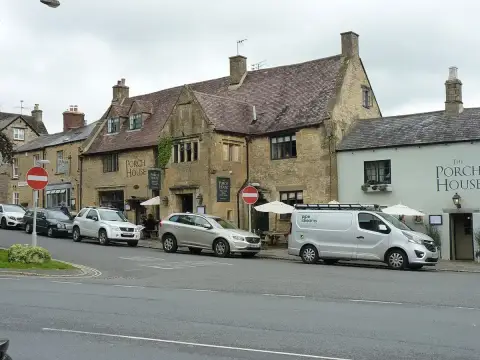
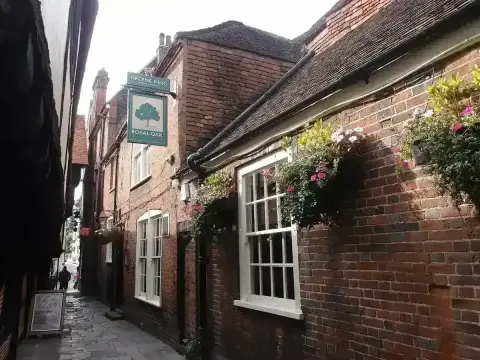
On record from 1430; the building is dated to about 1450.
Grade C · Tradition
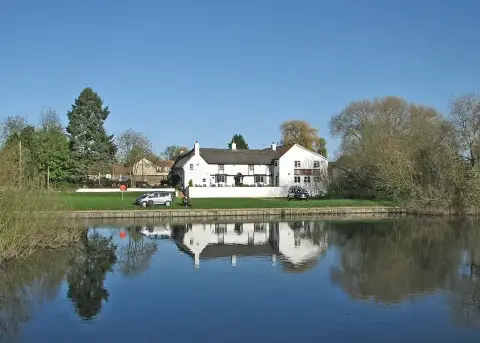
By claim, the oldest pub in the United Kingdom is the Old Ferry Boat Inn at Holywell in Cambridgeshire, which dates itself to AD 560. By evidence the answer lies elsewhere entirely. The earliest documentary reference on this page is to a taverner working at the Royal Oak in Winchester between about 1390 and 1430, and the strongest overall case belongs to the George Inn at Norton St Philip in Somerset, built as an inn by the monks of Hinton Priory and tree-ring dated to 1430–32. Asked instead as Britain's oldest pub, the answer is the same on both counts: Britain is the United Kingdom without Northern Ireland, and the oldest claim recorded there is Grace Neill's at Donaghadee, 1611.
"Oldest pub in Britain" is really four arguments conducted in four different archives. English claims are checked against Historic England's listing entries and the National Heritage List; Scottish ones against Historic Environment Scotland; Welsh ones against Cadw; and Northern Irish ones against the province's own listing grades and, in one case, tree-ring dating carried out at Queen's University Belfast. The four nations also arrived at licensing by different routes and at different dates, which is why an English pub can sometimes produce a quarter-sessions record where a Scottish house of the same age cannot. What holds across all four is the arithmetic on this page: most rest on tradition alone, a smaller group stands in a building of roughly the right age but is first mentioned in writing much later, and only a few have a record at or near the date they claim. The count at the head of the page carries the exact figures, which move as evidence turns up. That ratio, rather than any single winner, is the honest answer to the question.
Four nations, four kinds of evidence
England supplies most of the list and most of the argument, because it has both the
greatest number of surviving medieval inns and the greatest number of Victorian date-boards.
Scotland has the bluntest scholarly verdict against it: nothing there proven to
have been built as an inn is older than the seventeenth century. Wales has Cadw,
whose listing texts contradict pub claims in as many words. Northern Ireland
has the smallest list and one of the better pieces of physical evidence, in the tree-ring dating that places
the Crosskeys Inn’s thatched cottage before 1654.
Where the strongest cases are
Five pubs on this page reach grade A, and two of them are called the George.
The George Inn at Norton St Philip was raised by a Carthusian
priory to house the buyers at its wool fairs, and its function as an inn is documented alongside timbers
felled in 1430–32. The George Inn in Southwark is named as an inn on a map
of Southwark of about 1542, and its galleried range was rebuilt in 1677 after the great Southwark fire — it
is now the last galleried coaching inn in London. The other three are less known: the
King’s Head at Aylesbury, which a conveyance of 18 December 1455 describes
as newly built; the New Inn at Gloucester, raised in 1450 by the monk John
Twyning for St Peter’s Abbey to lodge visitors — an inn from the start rather than a house that later took
a licence; and the Groes Inn above the Conwy valley, which Cadw’s
listing finds already trading as the tavarne y Groes in a court order of 1578, five years after the date
the newspapers give it. None of the five is the pub most people would name first, which is rather the point. The whole list, ordered by the strength of the evidence rather than the boldness of the
claim, is in our top 100 oldest pubs, and the grading rules are set out in the
methodology.
The AD 560 date is tradition only; no early documentary source has been published. The listed building is 17th-century with an older cross-wing, and a continuous run of named innkeepers is recorded only from 1841.
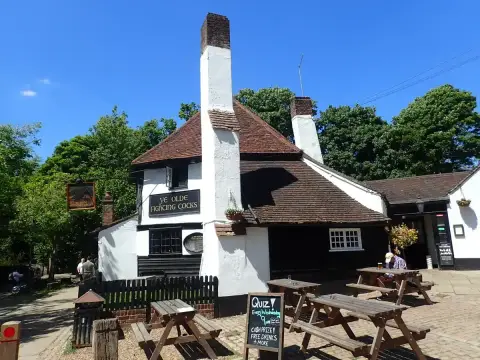
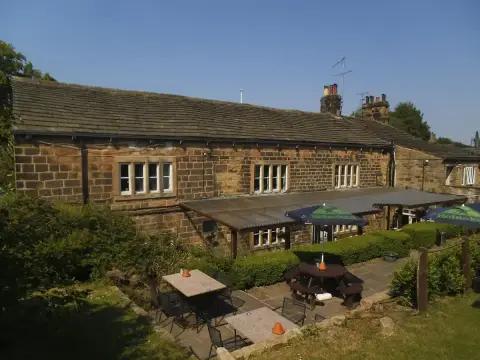
The 793 is the pub's own claim: its website says the original structure has been dated as far back as 793AD. Historic England notes the 793 date first appears on an early-20th-century postcard. Legal papers show the old pigeon house was rebuilt as the 'Round House' by 1622; the first firm record as an alehouse (the Three Pigeons) is 1756, and the Fighting Cocks name appears by 1806.
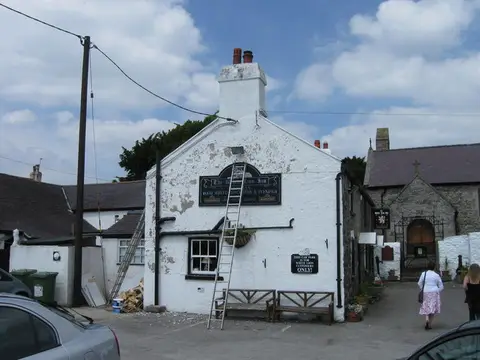
The 1,200-year claim has been traced to one place only: a 2024 holiday-letting blog, which attributes it to the inn itself. North Wales Live gives late 14th to early 15th century. Cadw's full report, read on 17 September 2026, gives the only reading of the building by anybody with the building in front of them: the White Lion Public House, listed Grade II on 2 July 1998, is a second-quarter 19th-century inn with
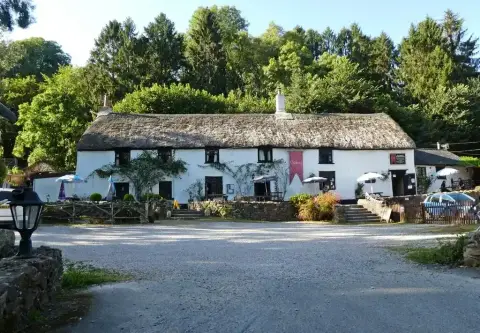
The building is a genuinely old listed Devon longhouse, but it was a farmhouse until it was made into a pub and restaurant in August 1982, which CAMRA's South Devon branch states as plainly as the inn does. Historic England lists it grade II, under the spelling Crideford Inn, and first listed it on 2 July 1986 — four years after the conversion, so the register knows the building as an inn and says nothing about how
The 947 is the house's own claim, though it has faded from its website: the current site says only 'England's oldest inn' and eleven centuries, while the history page archived in September 2020 gave the tradition that part of the building was a hospice built for Aethelmar, Duke of Cornwall in 947AD, quoting a local history published in 2000. The date rests on that tradition. The radiocarbon test usually cited in
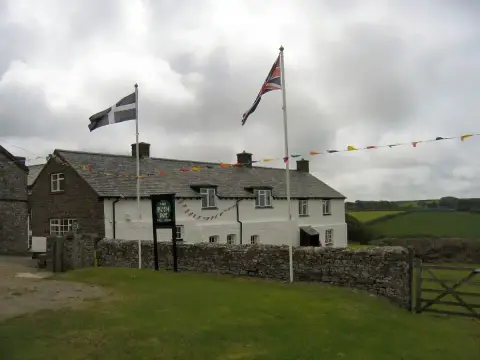
The pub cites hospitality from around 950 AD and a 13th-century building, and offers no documentation for either. Two searches on 12 September 2026 turned up nothing to support them and two blanks worth recording. Historic England's list holds 23 entries in Morwenstow parish - the church, six chest tombs, the vicarage, Tonacombe Manor, Hawker's hut, the ship's figurehead by the lych gate - and not the inn; the only
Historic England's listing and its 2022 'oldest pub' blog find a mid-18th-century building with a 1738 datestone and no evidence for a 10th- or 11th-century inn; no pubs appear in Domesday. The 953 date is unsourced tradition. 1738 is a building date, not a documented licence.
Claims AD 953; first recorded 1738; building c.1738.
The 11th-century date, tied to monks building the nearby church, comes from the pub and from tourism lists; no documentary or architectural dating was found. The pub's own about page is more careful than the lists that repeat it: it says the middle bar and kitchens were built in the 11th century as lodging for the monks, that the house is believed to have begun trading as a public house in the 15th century, and that
The link with Queen Emma's residence in 1002 is legend. Local historians cite records of an unnamed taverner here between about 1390 and 1430 and a 1637 schedule naming a tapster with a brewhouse, which gives it one of the better documented medieval tavern histories in Hampshire.
Claims 1002; first recorded 1430; building c.1450.
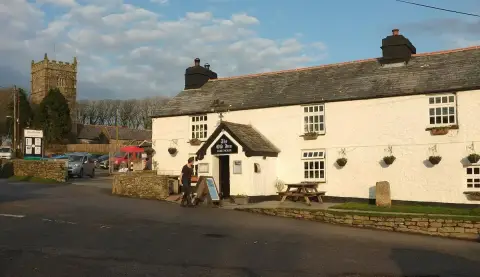
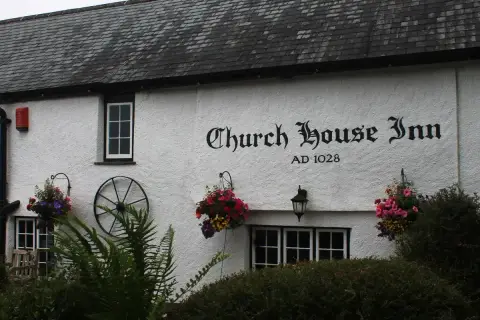
The 1028 date, tied to monks or masons building the parish church, is tradition and is not repeated on the pub's own website. The standing building is described by CAMRA as a listed 16th-century church house.
Claims 1028; no early record found.
The oldest in each nation
United Kingdom has 150 old pubs on this site, and every one of them sits in one of the nations below. This page is the comparison; each nation page carries its own full list, in the same order and graded the same way.
The photographs above are other people's work, used under an open licence. Every photographer, licence and source page is named in the image credits.
Common questions
Which is the oldest pub in Britain?
No pub can prove the title. Ye Olde Fighting Cocks, the Bingley Arms, the Old Ferry Boat Inn and Ye Olde Trip to Jerusalem all advertise dates before 1200, and none has produced a matching document. Historic England's own answer is that England's oldest surviving inns date from the late fourteenth and fifteenth centuries.
How many British pubs claim to be the oldest?
Twenty-three pubs on this page advertise a date earlier than AD 1200, and many more claim the title for their county, city or nation. Most of them rest on tradition alone, and only a few have a record at or near the date they claim — the count at the head of the page gives the split as it stands today.
Does Guinness World Records recognise an oldest pub?
Not any longer. Both the Bingley Arms in Bardsey and Sean's Bar in Athlone have cited Guinness recognition in the past, and the buildings archaeologist James Wright reports that Guinness no longer maintains an oldest-pub category at all, which removes the tie-breaker most claimants used to invoke.
Which British pub building is the oldest?
The George Inn at Norton St Philip is Grade I listed, with jettied upper floors tree-ring dated to 1430–32. Older fabric survives inside pubs that were something else first, including the medieval abbey dovecote at the core of Ye Olde Fighting Cocks in St Albans, and the sandstone caves behind Ye Olde Trip to Jerusalem.