The claim
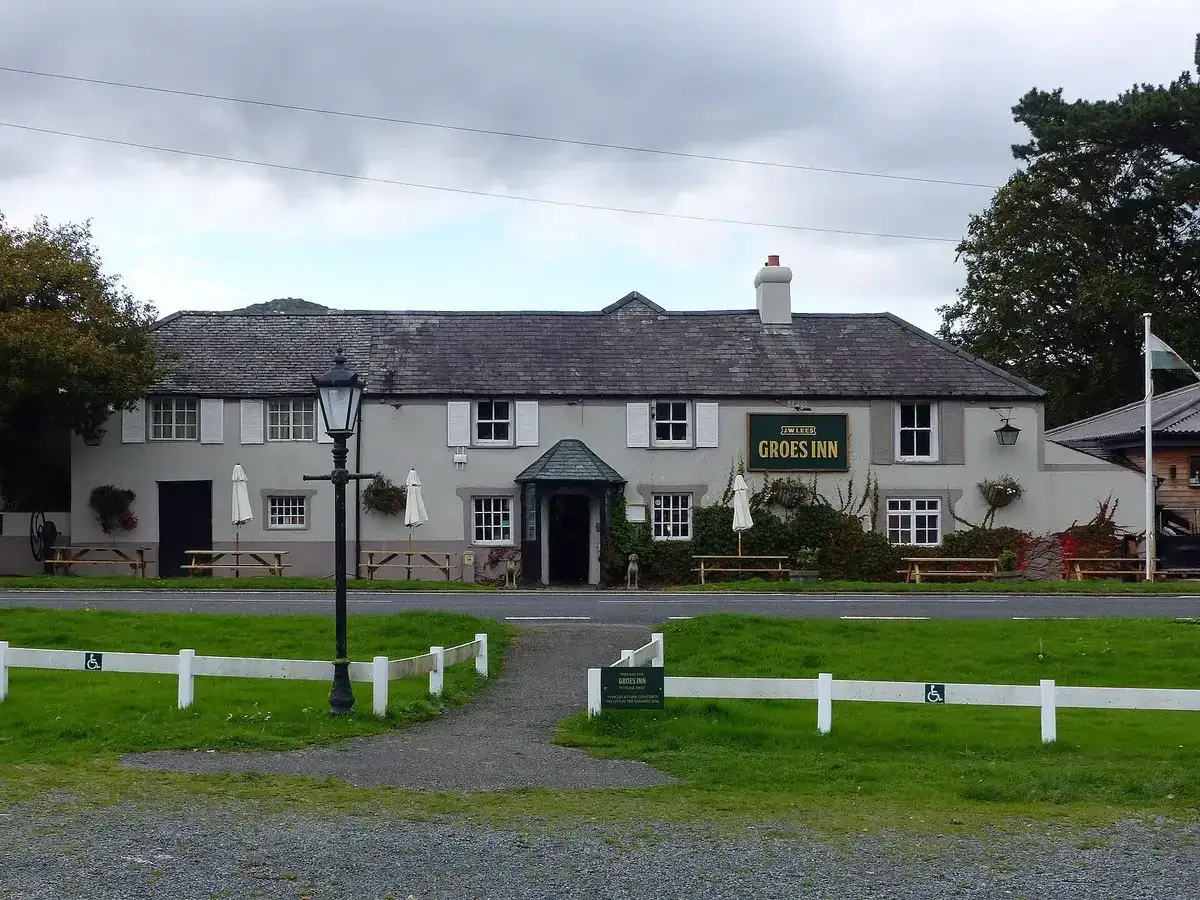
A roadside inn in the Conwy valley between the estuary and the hills of Tal y Fan, which calls itself the first licensed house in Wales. Cadw's listing gives it something firmer than a claim: the tavarne y Groes appears in a court order of 1578, and again under that name in June 1580. The painted 1400 on the front is a Victorian invention. A JW Lees house now, with food and dog-friendly rooms.
What the records show
Cadw's listing opens with a record rather than a tradition: the house was established as an inn by 1578, when the 'tavarne y Groes' is named in a court order, and it appears again under that name in June 1580. That is drink trade on these premises five years after the 1573 that North Wales Live gives as a first licence, which is why the grade is A. The licence itself has not been seen, and the 1573 is the newspaper's rather than the inn's: the inn's own pages claim to be the first licensed house in Wales but name no year. Cadw dates the present structure largely to the late seventeenth century, with a possible late sixteenth- or early seventeenth-century core in the inglenook and its ogee-stopped bressummer, and is blunt about the painted 1400 on the front, calling it an inaccurate late nineteenth-century pseudo-historical addition. The inn's own account adds a fifteenth-century two-storey house as the original, the name Commercial Inn at Groesynyd in the nineteenth century, and the deeds witnessed by the fourth Duke of Wellington in 1889. The Royal Commission on the Ancient and Historical Monuments of Wales, which keeps the national record of buildings separately from the register, is more cautious than Cadw about the same house. Its entry, number 26356, compiled by John Wiles in May 2007 from the Commission's Caernarvonshire inventory of 1956 and from the listing, calls the Groes a late sixteenth- or early seventeenth-century house or inn, possibly the tavern named in 1578, or else standing on its site: the document is not in doubt, the identification of the standing walls with it is. It describes a two-storey, three-bay original house with a large fireplace in the north wall, greatly extended from the nineteenth century onwards with ranges added north, south and west and outbuildings to the south converted, all now behind a long whitened facade under one hipped slate roof; the cottage that stood across the road was swept away by road widening. The Commission also had the timbers tested, and this is the hardest evidence on the page about the fabric. Six oak core samples were taken in June 2014 — from a ceiling beam and the fireplace lintel at the north end, the south end beam, the south intermediate ceiling beam and both principal rafters of the second truss — for the Oxford Dendrochronology Laboratory, commissioned by the charity Dating Old Welsh Houses with the Commission. Five of them cross-matched into a well-replicated 117-year chronology, and it failed to date against the reference curves. The laboratory's report of September 2014, by M. C. Bridge and D. Miles, says the building is thought to be quite late, probably eighteenth or nineteenth century, that its timbers were later in style than most of the houses the project looked at, and that the chronology may yet date when more local material of that period has been measured. Richard Suggett, writing the historical note for the Commission in November 2014, has the Groes as originally a storeyed house of the Snowdonian plan-type, possibly the tavern of the late-Elizabethan documents, keeping a large end chimney and a substantial beamed ceiling but extended and modernised in several phases, with a roof and stair that may be eighteenth-century. So the oldest thing on this site that can be dated is the court order, not the building; no tree-ring date exists, and two Commission readings and a laboratory all place the standing fabric later than the claim it carries.
| Year | What | Source |
|---|---|---|
| 1573 | Claimed founding | The press |
| 1578 | First record of a drinking house here | Cadw |
What to look for inside
- 'Tavarne y Groes' named in a court order of 1578 and again in June 1580
- Painted 1400 on the front is a Victorian invention, says Cadw
- Deeds witnessed by the fourth Duke of Wellington in 1889 hang at the top of the stairs
- Calls itself the first licensed house in Wales
Visiting
The Groes Inn is in Ty'n-y-Groes, Wales, at Llanrwst Road, Conwy LL32 8TN. We do not list opening times, because they change; the pub’s own site is the place to check before you set out.
Sources
- www.groesinn.com/
- www.dailypost.co.uk/business/business-news/north-waless-oldest-pubsand-ghosts-14818052
- www.northwalesholidaycottages.co.uk/other-information/blog/things-to-do/historic-pubs-of-north-wales/
- cadwpublic-api.azurewebsites.net/reports/listedbuilding/FullReport?lang=en&id=3198
- camra.org.uk/pubs/groes-inn-tyn-y-groes-115863
- ratings.food.gov.uk/business/60812
- coflein.gov.uk/en/site/26356/
- coflein.gov.uk/media/81/893/dcp2016_048.pdf
- www.groesinn.com/christmas
Know something we don’t?Suggest a correctionLast checked Sept 2026
Run this pub? There is a badge for it
Free to put on your own site, no permission needed. It shows what the pub claims and what the records support, and it changes when the data does.
How to use it, and how to change what it says — if you have a document we have not seen, we would like to read it.