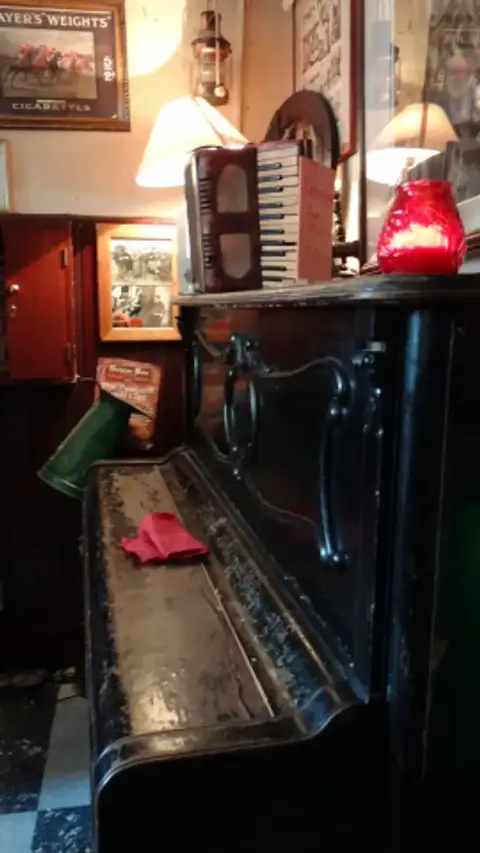
On record from 1639; the building is dated to about 1275.
Grade B · Building dated
By claim, the oldest pub in Ireland is Sean's Bar on Main Street in Athlone, which dates hospitality on its site to about AD 900. By evidence it is a different house in a different county: Kyteler's Inn in Kilkenny, whose stonework the National Inventory of Architectural Heritage dates to around 1250–1300 and which is recorded in use as an inn from 1639. Sean's own building is dated by the same inventory to about 1725.
Ireland's pub claims run older than almost anywhere, and they are harder to test than almost anywhere, for a reason that has nothing to do with drink. The Public Record Office of Ireland burned at the Four Courts in June 1922, at the opening of the Civil War, and with it went centuries of wills, deeds and administrative record that would otherwise settle these arguments outright. What survives is patchy: estate papers, newspaper notices, reports of licensing courts, and the National Inventory of Architectural Heritage, which dates buildings by looking hard at them. The inventory turns out to be the single most useful source on this page, because it repeatedly finds a well-built eighteenth-century house underneath a medieval story. That is the shape of the Irish evidence: a genuinely old trade, carried on for most of its history in premises that were later rebuilt, and recorded in documents that no longer exist. The pubs here are worth reading one at a time rather than as a league table.
Why the dates are hard to check
Almost every Irish claim on this page runs ahead of its fabric, and the gap is usually the same gap. At
Sean’s Bar the founding story belongs to Luain, the ferryman who gives
Athlone its name, and there is no record of him keeping a house of any kind. At
the King’s Head in Galway the building is said to be thirteenth-century
and the pub’s date is fixed instead by a story about the executioner of Charles I. At
Durty Nelly’s the 1620 date and the landlady it honours are both the
pub’s own tradition. None of that makes these poor pubs, and we have argued the Athlone case in full in
our look at whether Sean’s Bar is the oldest pub in the world.
What the inventory does to a claim
Three of the most recent additions show the same pattern from the other side.
The Norseman in Temple Bar dates itself to a first licence in 1696, and to a
tavern called the Wooden Man in the 1500s; the inventory dates its building to about 1900, cites Thom’s
Directory of 1862 for a vintner’s on the site, and records that Essex Street was not opened until 1674.
The Bleeding Horse on Camden Street claims at least the seventeenth
century in wording identical to its Wikipedia article, and the inventory does grant an earlier inn on the
site — without saying how much earlier. At Holohan’s in Enniscorthy the
owners have done the opposite of marketing: they have published a paper on their own house that lists the
records which survive, the records which burned, and the one estate survey in the National Library that
would show whether the Bear Inn was theirs in the 1740s.
The houses with something written down
Three stand out. Kyteler’s Inn has medieval walls, a documented
association with Dame Alice Kyteler’s 1324 witchcraft trial and a record as an inn from 1639.
The Brazen Head can be traced through a named property in 1613 to an
ale licence in 1661. The Man O’War near Balbriggan cites deeds of 1595,
which have not been published but are at least the right kind of document to look for. For the four
Dublin houses and what the architectural inventory found under them, see
the oldest pubs in Dublin; for pubs across the border, see
Northern Ireland; for how we weigh a story against a record, see the
methodology.
The 900 AD founding by Luain is tradition with no archival support. The NIAH dates the building to c.1725 and describes the wattle partitions found in the 1970s as possibly 17th-century, not 10th-century; the inn is recorded as The Three Blackamoor Heads in 1738. Guinness World Records named it Ireland's oldest pub in 2004 but reportedly no longer keeps an oldest-pub category. The present trade is on the state's own
Claims AD 900; first recorded 1738; building c.1725.
No record supports 1198. A property called the Brazen Head is documented in 1613 (Richard Fagan), an ale licence in 1661 and use as an inn by 1668; the present building was completed around 1754. The 1668 has a second reading behind it now: John Thomas Gilbert, in his History of the City of Dublin, written from the city's own records in the 1850s, says that the Brazen Head was an inn located from the year 1668 in a
The pub claims a 13th-century building, once a mayor's house, seized by Colonel Peter Stubbers, whom it calls the executioner of Charles I; that identification is unproven. When the house became a pub is undocumented. The claim names a century and no year, so the ranking sorts it from the century's first year. The national inventory has now been searched, and it holds no entry for the house at all: within fifty
The stone building has genuine medieval fabric (NIAH dates origins to c.1250-1300) and is associated with Dame Alice Kyteler, tried for witchcraft in 1324. That she ran an inn here is tradition, and the contemporary record of her prosecution gives it no help: the narrative edited for the Camden Society in 1843, with extracts from the Irish rolls beside it, shows the family as bankers and moneylenders rather than
Claims 1263; first recorded 1639; building c.1275.
The tavern markets itself as a 16th-century building but gives no licensing history or survey evidence; when it first became a drinking house is unknown. The claim names a century and no year, so the ranking sorts it from the century's first year. The building half of the claim now has an answer. The National Inventory of Architectural Heritage, read through its open data on 17 September 2026, carries record
The 1595 is published by Visit Dublin, which says there has been a pub on this hilltop since at least that year; a travel guide adds that the figure comes from deeds the pub itself cites. The deeds have not been published, and the pub has no website of its own we could find. The national inventory has now been read, and it puts the house two centuries later than the claim. The National Inventory of Architectural
The pub says the house goes back at least to the seventeenth century, when this was St Kevin's Port, and offers two accounts of the name: a farrier who bled horses at the inn, and a horse wounded at the Battle of Rathmines in 1649. The wording on its site is the Wikipedia article's, word for word, so those two are one source and not two. The independent record is the National Inventory of Architectural Heritage
Claims 1600; first recorded 1871; building c.1871.
The 1620 and the story of a landlady called Nelly are the pub's own tradition, and no documentary or architectural record of that date has been traced. The National Inventory of Architectural Heritage, queried again on 18 September 2026, holds no entry for this house: within five hundred metres it records Bunratty Castle, the bridge beside the pub and the house now used as the Bunratty Castle Hotel, and nothing
The house's own history page says it was built on the foundations of a castle in or about 1650, that it was first called the Castle Bar and kept by the Coleman family of Scilly, and that it has been a pub almost ever since. The present name is recent by comparison: the owners took it in the 1960s for the Spanish commander at Kinsale in 1601. None of the seventeenth-century account has been traced to a record. The
The 1651 and the name Ye Signe of Ye Blackhorse are published by Visit Dublin, and a travel guide says the pub's own history is where the year comes from; no primary document was found and nothing the pub publishes was traced. The present name dates from the late 1800s, when drink was reportedly passed to soldiers through a gap in the park wall.
The house's own site does not give the year. Archived on 11 June 2026, it says the trade goes back as far as the 1600s and calls the Old Thatch Ireland's oldest thatched pub; the 1667 is IrishCentral's, and it is arithmetic on a document — at the Castlemartyr quarter sessions of 1867 the owner John Conway sought to renew his licence, saying the house had been licensed for more than two hundred years, and was refused
The year here is the travel press's and not the house's. Yay Cork, writing in November 2020, dates the serving to 1690 and calls it the oldest bar in Kinsale; the travel publisher The Irish Road Trip says the licence stretches back to 1690 and that the building is older than the licence. Neither names a record, and nothing has been traced for these premises — no licence roll, no deed, no dated map — so the year is
The pub's own account gives 1696 as the year the premises was first licensed, and says the house sold drink from the 1500s as the Wooden Man Tavern, named for a carved Viking figure on the corner. Neither statement has been traced to a record. The National Inventory of Architectural Heritage, read again on 18 September 2026 from the survey's published data rather than from an archived copy of its web page, dates the
Claims 1696; first recorded 1862; building c.1900.
The bar's own site says Cork's oldest since 1698, and Yay Cork reported the same year as the widely held local belief when the pub reopened in 2024. No record of 1698 has been traced, and nothing has been established about the age of the building. One thing the 2024 reopening did settle, through a local historian the new owners consulted: the first name over the door was the Old Bear, not The Gateway, which is what
The tavern's own account, archived in January 2024, dates the house to the seventeen-hundreds, when it was the King's Arms, and heads the page "over 200 years of heritage". It gives no year, and we have traced no record of either name, so 1700 stands here only as the first year of the century the pub itself names. This page also said there was no architectural inventory entry for the building, and that was wrong.
The bar claims the site of one of Limerick's oldest pubs, dating to 1724; no supporting documents were found. The holding page that was on its website has gone, and Limerick.ie listed full opening hours when we checked in September 2026. There is a licensing record as well, found on 18 September 2026: Revenue's register of liquor licences renewed for 2025/2026, standing as at 2 September 2026, carries a seven-day
The pub says it was founded in 1728 as a coaching inn and is Dún Laoghaire's oldest surviving premises; no independent document was found. Its licence is documented. Revenue's register of liquor licences renewed for 2025/2026, standing as at 2 September 2026, carries a seven-day ordinary publican's licence under reference S0302, held by Vor Purty Taverns Limited, at 3/4 Old Dunleary Road with premises attached at
The owners have published their own research, which concludes that the Bear Inn stood here by the 1740s. It points at real documents: the Bear Inn is named in reports of the 1743 Annesley inheritance case, and Sir Vesey Colclough's use of it as a meeting place appears in evidence to a Commons select committee on the Enniscorthy election of 1793. We have not read either against the originals, and the identification
Claims 1740; no early record found; building c.1775.
The 1745 is the house's own. Its earlier website told customers it had been serving the community since that year, and the Dublin press repeats it — 98FM, reporting the reopening on 16 July 2025, has the pub first opening its doors in 1745. No document for the year has been traced: no licensing record, no deed and no map, so the claim stands as tradition and the grade is C until somebody reads the Dublin licensing
Claims 1745; no early record found.
The photographs above are other people's work, used under open licences, or in the public domain. Every photographer, licence and source page is named in the image credits.
Common questions
Which is the oldest pub in Ireland?
By claim, Sean's Bar in Athlone, which says about AD 900. The architectural inventory dates its building to around 1725 and finds it recorded as the Three Blackamoor Heads in 1738. Kyteler's Inn in Kilkenny, with medieval stone and a record as an inn from 1639, is the better-evidenced answer.
Is Sean's Bar really the oldest pub in the world?
It was certified by Guinness World Records as Ireland's oldest pub in 2004, and Guinness reportedly no longer keeps that category. The buildings archaeologist James Wright points out that the wattle walling displayed in the bar was dated by the inventory to the seventeenth century, not the ninth.
Which is the oldest pub in Dublin?
The Brazen Head near Christ Church claims 1198. A property of that name is documented in 1613, an ale licence follows in 1661 and use as an inn by 1668, while the present coaching inn was completed around 1754. That makes it Dublin's best-documented old tavern rather than a medieval one.
Which Irish pub has the oldest licensing record?
The most striking single piece of testimony belongs to the Old Thatch at Killeagh in east Cork. At an 1867 licence hearing its owner told magistrates the house had been licensed for more than two hundred years, and was then refused a renewal over alleged Fenian sympathies. That is evidence of a claim, not a deed.