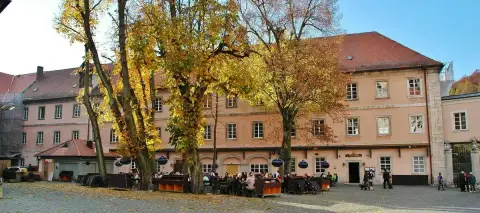
On record from 1411; the building is dated to about 1590.
Grade C · Tradition
By claim, the oldest pub in Germany is the Klosterschenke at Weltenburg Abbey on the Danube, whose Benedictine brewery advertises 1050 — a date that belongs to the brewery rather than to the baroque courtyard tavern, and that rests on monastic tradition rather than a surviving charter. By evidence it is a different house on a different river: Gasthaus Zum Riesen in Miltenberg, where a court record of 1411 names Conrad Trestram as innkeeper, although the towering half-timbered building there today was raised in 1590.
German drinking history is organised around brewing rights rather than around licences, and that changes what the records look like. A Bavarian village inn is very often a Brauereigasthof, the tap of a brewery housed under the same roof, so what survives in the archive is a grant of the right to brew, a monastic account book, or the name of a house in a property register. Documents of that kind are why the earliest firm date on this page comes from a court record of 1411 rather than from a publican's licence. The monasteries complicate things further. Weltenburg's Benedictines advertise brewing since 1050, a figure repeated everywhere and traceable to tradition rather than to a charter, and it describes the brewery rather than the courtyard where visitors now drink the beer. Germany also offers the clearest example anywhere of a different sort of continuity — a family rather than a building — in the eleven generations of Röhrls at Eilsbrunn.
Brewing rights, not licences
The German list is short because we have only included houses where something can be checked, and it skews
heavily to Bavaria for the same reason: Bavarian brewing archives are unusually good.
Gasthaus Zum Riesen holds the earliest surviving record of the
lot: the Miltenberg court book of 1411 names Conrad Trestram as its innkeeper. Its own claim is much
older, 1158, and its own history page explains why we cannot follow it — the documents that date was
drawn from no longer exist.
Schlenkerla is the most enjoyable, a smoke-beer tavern in a house first
recorded in 1405 whose Rauchbier is still drawn from wooden casks in a lane below the cathedral hill.
The Klosterschenke at Weltenburg is the most dramatic,
reached by boat through a limestone gorge on the Danube.
Two more houses were added in September 2026 on the same test.
Brauerei Spezial stands a few streets from Schlenkerla on the Obere
Königstraße and dates itself from a document of 1536 naming the cooper Linhard Großkopf; because that
document is about brewing rather than about a counter, the grade rests on the fabric instead, and the
Bavarian list of monuments puts the half-timbered front house in the sixteenth or seventeenth century. The
first landlord we can name held its brewery tavern from 1631. Zum Uerige
finally takes this page out of Bavaria: a Düsseldorf Altbier brewery whose own date is 1862, in a house where
the Heidelberger Fass was advertising lodging, stabling, wine and food by 1783, and where the drinkers still
stand out across the Rheinstraße in fine weather. Three modern accounts date that guest house to 1755; the
Düsseldorf chronicler Heinrich Ferber, who worked from the deeds, makes 1755 the year a Pfeilsticker daughter
married and brought her husband the house, and says nothing of anyone being served in it.
Old business, newer room
Germany’s twentieth century makes the fabric question sharper here than almost anywhere. The
Hofbräuhaus trades on a brewery founded in 1589 inside a hall of
1896–97 that had to be rebuilt after the war. That does not make it a fake; it makes it a business that is
much older than the room it occupies, which is true of a great many pubs on this site. For the same
distinction in a neighbouring beer country, see Czechia; for pubs that brew their own,
see our list of brewery taps; and for how we weigh fabric against paperwork, the
methodology.
The abbey advertises brewing since 1050, a date repeated by Wikipedia but resting on monastic tradition rather than a published charter; the date refers to the brewery, not to the present tavern. When the courtyard Klosterschenke first served the public is not documented in the sources checked.
The Bären calls itself the oldest inn in Germany and dates itself to 1120, the year the dukes of Zähringen founded Freiburg. What 1120 dates is the ground rather than the trade. German Wikipedia and the city's own tourist service both say the foundations, and the three-storey cellar with its arcades and pillars, belong to the manor house of the Zähringer court that stood here before the city did; the cellar can be
Claims 1120; first recorded 1387; building c.1120.
The house calls itself Germany's oldest inn and dates itself to 1158, the year it says Emperor Barbarossa lodged here. Its own history page traces that to an 1865 pamphlet by Dr Ph. Madler, which reported the Hof zum Riesen known from documents by the mid-twelfth century, and adds that the records Madler worked from no longer survive — nor do those behind the royal visits of 1314 and 1368. What survives is the
Claims 1158; first recorded 1411; building c.1590.
Bremen's council held the privilege of selling wine from 1330, and an ordinance of 1342 restricted the trade to wine lords the council appointed, which is how the city kept the price and took the duty. The house dates itself from 1405: with the building of the town hall that year the city's wine cellar moved into its vaults to supply the citizens, and two sorts of Rhine wine were poured, the common and the better
Claims 1405; first recorded 1405; building c.1405.
The 1405 record is a property matter: the house Zum Blauen Löwen was finally separated from Unter den Störchen and Fritz Vernbach appears as its owner. The brewery's own chronicle places the first documentary mention of the brewhouse as a business in its own right, with its own brewing and serving rights, in 1677/78, and admits the first landlord is disputed — the cupbearer Martin Bachalt or Jakob Schneider; by 1685
Two dates hang over this house and both are its own. The front page says since 1493, and the chronology behind it dates nothing to that year at all. That chronology opens with old house deeds naming a beer-tap house called the Waizenstüblein in 1431, later taken into the Röslein and still the name of its oldest room, and with the first mention of the Nuremberg sausage kitchen Zu den drei Rosen about 1480. The
The cellar sells itself as being there since 1525 and kept a five-hundredth birthday in 2025. What 1525 dates is a story rather than a deed: a folk tale has the magician Johann Georg Faust riding a barrel up out of this cellar in that year, and two panels painted about 1625 and given to Andreas Bretschneider hang in the Goethe room, which shows how old the telling is rather than how old the house is. The wine trade
The house dates itself from a document of 1536 that names the cooper Linhard Großkopf as the founder of the brewing house, and the German Wikipedia article says the same; the name Spezial arrives later, with Nikolas Delscher, called Spicial, who was a brewer and a cooper too. What 1536 dates is brewing, not a counter, so on its own it is no evidence of a drinking house in that year. The earliest account traced of
The 1589 is the founding of the Bavarian dukes' court brewery, which Duke Wilhelm V set up at the Alter Hof because his household was spending too much on beer brought in from elsewhere; his successor Maximilian I moved the brewing to the Platzl in 1607. Neither was a house serving the public. The City of Munich's own account is plain that ordinary Munich citizens were admitted in 1828, when Ludwig I allowed the
Claims 1589; first recorded 1828; building c.1896.
The house was first recorded in 1561, when it was a Wiekhaus — a small dwelling built against the town wall, and the last of them in old Berlin — and the date it prints is 1621, the year a riding groom of the Elector of Brandenburg opened a spirits room on the ground floor. Neither German Wikipedia nor the Berlin readers' site that retells the story names a document behind it, and the second attributes the account
In 1658 Andreas Röhrl married Susanna Hofmeister, daughter of the innkeeper Georg Hofmeister, so the inn was already there, and his family has kept it ever since; Guinness World Records recognised it in 2010 as the oldest continuously family-run inn. The Bavarian monument list, which protects the house under number D-3-75-199-22, describes an eighteenth-century mansard-roofed building whose core is probably older
Claims 1658; first recorded 1658; building c.1665.
The house dates itself from the brewery and not from the inn, which is why the record here is older than the claim. Its own chronicle sets out that on 4 January 1862 the widow Bender sold the Bergischer Hof to the innkeeper and brewer Wilhelm Cürten, who put a brewery in the cellar and the back buildings and was soon serving his own top-fermented beer in the ground-floor rooms; the regulars' word for his temper
Claims 1862; first recorded 1783.
The photographs above are other people's work, used under open licences, or in the public domain. Every photographer, licence and source page is named in the image credits.
Common questions
Which is the oldest pub in Germany?
Gasthaus Zum Riesen in Miltenberg calls itself Germany's oldest inn and has the best paperwork behind it: a court record of 1411 naming its innkeeper. The 1158 date it also uses refers to a visit by Frederick Barbarossa, not to the present building, which the carpenter Jakob Stoer raised in 1590.
What is the oldest brewery tavern in Germany?
Weltenburg Abbey claims the world's oldest monastery brewery, dated to 1050. Schlenkerla in Bamberg is documented as the house Zum Blauen Löwen in 1405, and German Wikipedia notes that the cooper Asmus Schneider probably opened a tavern and brewery there around 1538. Both are still pouring.
Which is the oldest family-run inn in the world?
Gaststätte Röhrl at Eilsbrunn near Regensburg, recognised by Guinness World Records in 2010. Andreas Röhrl married the innkeeper's daughter in 1658, so the inn already existed by then, and his family has run it for eleven generations. An inscription on the façade reads 1665.
Is the Hofbräuhaus in Munich an old pub?
The brewery behind it was founded in 1589 as the Bavarian dukes' court brewery, but ordinary drinkers were admitted only from 1828, under Ludwig I. The beer hall itself is a rebuild of 1896–97, restored after wartime bombing and completed in 1958.