A brewery tap is the brewery's own house: the rooms beside the brewhouse where what is made there is sold by the glass to whoever walks in. Bavaria has a word for the building — the Bavarian list of monuments enters Brauerei Spezial in Bamberg as a Brauereigasthaus, a brewery inn — and eleven houses here are taps.
They are mostly German, Czech, Polish and Austrian for a reason that has little to do with taste: in
much of central Europe the right to brew was property, granted, bought, inherited and written down, so
the surviving paperwork is about the brewing and not the bar. A tap’s date is therefore a brewing
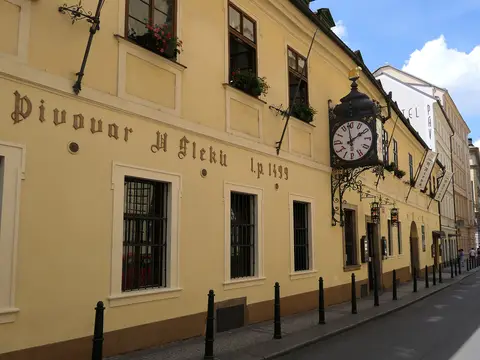
date. U Fleků in Prague dates itself to
1499, the year the maltster Vít Skřemenec and his wife Dorota bought the house — a purchase, in the
brewery’s own wording, and not a licence to sell drink.
Brauerei Spezial dates itself from a document of 1536 naming the
cooper Linhard Großkopf as founder of the brewing house, while the earliest account of drink being
served there is Nikolas Delscher holding the brewery tavern from 1631.
Brewing and serving being one business is why five of the eleven reach grade A, the best share of any
collection here — and why the gap, where it opens, is enormous. Munich’s
Hofbräuhaus grew out of the Bavarian dukes’ court brewery of
1589 but admitted ordinary drinkers only in 1828, so the famous date belongs to a brewery for the
court rather than to a public room.
None of this is a modern brewpub, a word that entered British use only after 1982, when David Bruce
spoke on the English brewpub at the American Homebrewers’ Association conference; before that, the
beer historians Boak and Bailey note, such places were home-brew houses. The Oxford Companion to Beer
calls the brewpub a modern model for an ancient practical concept. These houses are the concept
itself, still running: see them in context at the oldest pubs in Germany and
the oldest pubs in Prague.
Spread across Germany, Poland, Czechia, Austria, Australia. Ordered by the date each one claims, oldest first — which is not the same as the order of the evidence.
The abbey advertises brewing since 1050, a date repeated by Wikipedia but resting on monastic tradition rather than a published charter; the date refers to the brewery, not to the present tavern. When the courtyard Klosterschenke first served the public is not documented in the sources checked.
The house calls itself Germany's oldest inn and dates itself to 1158, the year it says Emperor Barbarossa lodged here. Its own history page traces that to an 1865 pamphlet by Dr Ph. Madler, which reported the Hof zum Riesen known from documents by the mid-twelfth century, and adds that the records Madler worked from no longer survive — nor do those behind the royal visits of 1314 and 1368. What survives is the
Claims 1158; first recorded 1411; building c.1590.
The vaults under the town hall sold strong Świdnica beer in the Middle Ages and the year 1273 is painted over the entrance, but no document for it has been traced. The city of Wrocław's own news service dates the gap this page could previously only call an interruption: trading stopped in 2017 and the cellar reopened on 2 July 2022 after five years shut, with a brewery newly installed in the vaults whose first beer
The 1405 record is a property matter: the house Zum Blauen Löwen was finally separated from Unter den Störchen and Fritz Vernbach appears as its owner. The brewery's own chronicle places the first documentary mention of the brewhouse as a business in its own right, with its own brewing and serving rights, in 1677/78, and admits the first landlord is disputed — the cupbearer Martin Bachalt or Jakob Schneider; by 1685
The house is documented in writing from 1404, but that entry names the house of the late Pavel Hubený and has nothing to do with drink: between about 1410 and 1433 his relatives, one of them Nicolaus the soap-boiler, appear to have boiled soap in it. Malt arrives in 1433, when Mikuláš the maltster bought the house and with it, probably, the right to brew, and from 1438 Jakub Starostka brewed here. Jan Nedvídek, who
Claims 1466; first recorded 1438; building c.1614.
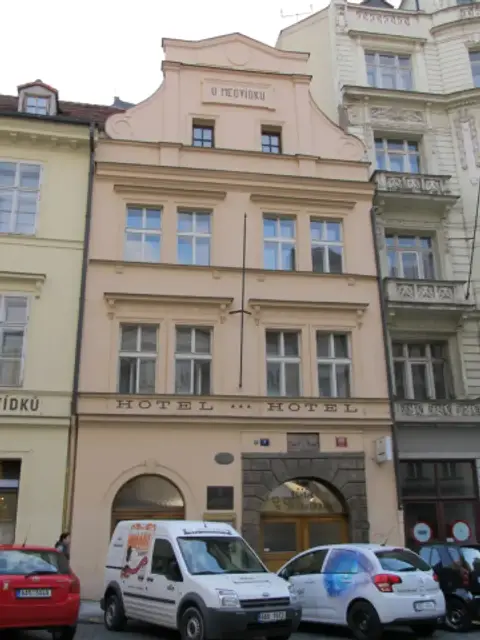
The house on Křemenec is first named in writing in 1430, when it belonged to a dyer called Petr. The 1499 the brewery gives is the year Vít Skřemenec and his wife Dorota bought the house called At the Two Magpies and began the malting trade in it — a maltster's purchase rather than a tavern licence, which is the house's own wording on its own history page. Brewing has gone on here since, the dark 13-degree lager
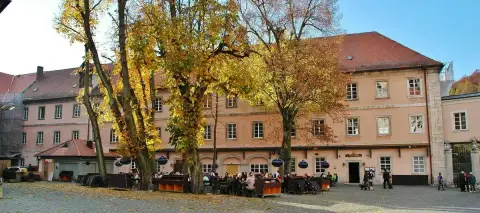
The house dates itself from a document of 1536 that names the cooper Linhard Großkopf as the founder of the brewing house, and the German Wikipedia article says the same; the name Spezial arrives later, with Nikolas Delscher, called Spicial, who was a brewer and a cooper too. What 1536 dates is brewing, not a counter, so on its own it is no evidence of a drinking house in that year. The earliest account traced of
The 1589 is the founding of the Bavarian dukes' court brewery, which Duke Wilhelm V set up at the Alter Hof because his household was spending too much on beer brought in from elsewhere; his successor Maximilian I moved the brewing to the Platzl in 1607. Neither was a house serving the public. The City of Munich's own account is plain that ordinary Munich citizens were admitted in 1828, when Ludwig I allowed the
Claims 1589; first recorded 1828; building c.1896.
Augustinian hermits from Munich took over the house at Mülln in 1605 and founded the brewery in 1621, selling their beer first at the friary gate and later through inns bought for the purpose — so drink was sold on these premises from the start. The Augustinians died out in Salzburg in 1818, the buildings served as barracks, and in 1835 the Emperor Ferdinand I passed them to the Benedictines of Michaelbeuern, who
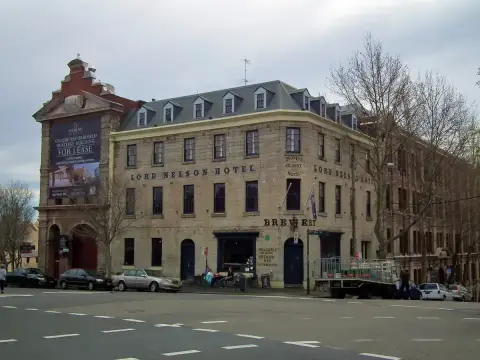
The land came from a Crown grant to the plasterer William Wells dated 14 May 1836 and part of a grant in trust to Richard Driver of 30 November 1840; Wells is believed to have lived here until 1842, when the liquor licence was granted. The State Heritage Register calls the Lord Nelson the oldest working licensed hotel in the city and dates it from that licence of June 1842, while the pub dates its own licence to 1
Claims 1841; first recorded 1841; building c.1836.
The house dates itself from the brewery and not from the inn, which is why the record here is older than the claim. Its own chronicle sets out that on 4 January 1862 the widow Bender sold the Bergischer Hof to the innkeeper and brewer Wilhelm Cürten, who put a brewery in the cellar and the back buildings and was soon serving his own top-fermented beer in the ground-floor rooms; the regulars' word for his temper
Claims 1862; first recorded 1783.
The photographs above are other people's work, used under open licences, or in the public domain. Every photographer, licence and source page is named in the image credits.