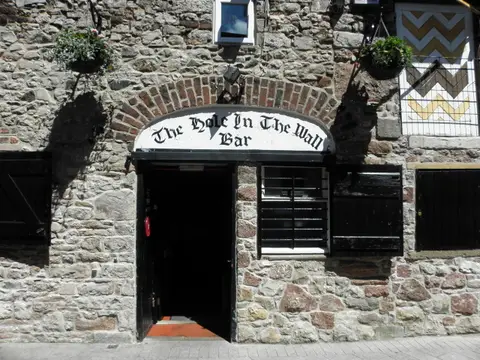
On record from 1693; the building is dated to about 1615.
Grade C · Tradition
By claim, the oldest pub in Northern Ireland is Grace Neill's on the High Street in Donaghadee, which says it opened in 1611 as the King's Arms; no licence or deed has ever been produced. By evidence it is McHugh's Bar in Belfast, where a 1997 survey is reported to have dated the building to about 1710 to 1715, making it the city's oldest known structure — though when it first sold drink is not established. Every other date on this page rests on what a house says about itself.
Northern Ireland has the shortest list of the four UK nations on this site and the thinnest evidence behind it. The shortness is partly archival: the destruction of the Public Record Office of Ireland in 1922 removed much of what would settle these questions anywhere on the island. It is also partly physical. Central Belfast lost a great deal of old fabric to the Blitz of 1941 and to bombing during the Troubles, so what survives of the seventeenth- and eighteenth-century town is largely the pattern of its narrow entries off High Street rather than the buildings standing in them. The result is a page of houses that date themselves. Only one has had its fabric surveyed and reported — McHugh's Bar, off the Custom House square — and the province's best-known old house, the thatched Crosskeys Inn in County Antrim, is dated two centuries apart by the statutory register and by the tree-ring result everyone cites and nobody has published. Donaghadee's claim, meanwhile, makes geographical sense whether or not the paperwork exists, because the town was the packet port for Scotland and travellers had to wait somewhere for the crossing.
The entries of old Belfast
Both Belfast contenders sit in the same piece of urban archaeology: the entries, the narrow lanes that still run
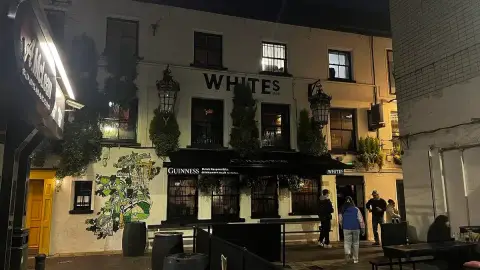
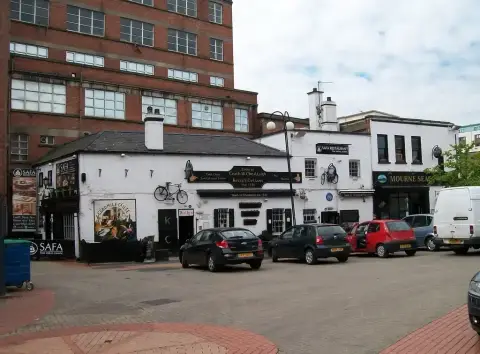
off High Street and Ann Street and preserve the street plan of the merchant town. White’s Tavern
is in Winecellar Entry, a name that does its own historical work, and has grown over the years into a tavern, a
beer hall, a garden and a shop. Kelly’s Cellars on Bank Street is the plainer and
the more political of the two, with an Ulster History Circle plaque recording that the United Irishmen met there
in the years before the 1798 rebellion. Neither can produce its founding licence, and both are unmistakably old
rooms.
A walled city and a village square
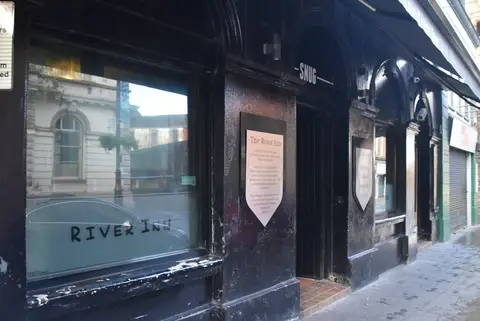
Two of the houses away from Belfast and the thatch are worth taking together, and they could hardly be less alike. The River Inn is on
the hill of Shipquay Street inside Derry’s walls and carries 1684 in its own web address: an inn’s licence for
punch, beds and stabling, by its own account, though no licence, deed or directory entry for the year has been
traced, and the historic buildings register that covers its neighbours holds nothing at its numbers.
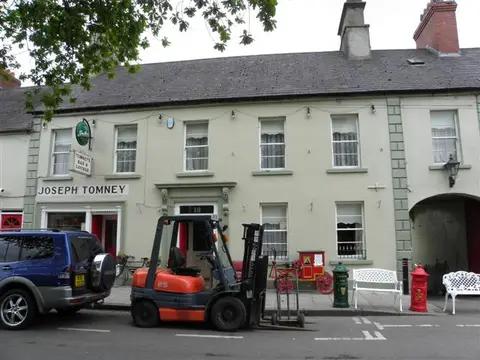
Tomney’s Bar is a warren of small rooms on the eighteenth-century square at Moy, listed
at grade B2 as a public house and dated 1765 in Mid Ulster District Council’s business directory — a year the
bar’s own website does not print.
A third house away from Belfast stands on the Derriaghy Road between Dunmurry and Lisburn, and it is the one to
see soonest. The Speckled Hen dates itself to 1660 and trades four days a
week, having reopened in April 2024 after a year shut; a bomb partly demolished the building in 1975 and a man
was killed in it. The historic buildings register holds the house as a record rather than a listing, and the
Department’s own note in the planning file says it was judged not to warrant a full survey — which is what left
it open to the application its owner won on 13 January 2026, for demolition and two detached houses. That consent
has not closed it: the bar was still serving, and still being inspected, through the summer of 2026.
Country inns and the Scottish crossing
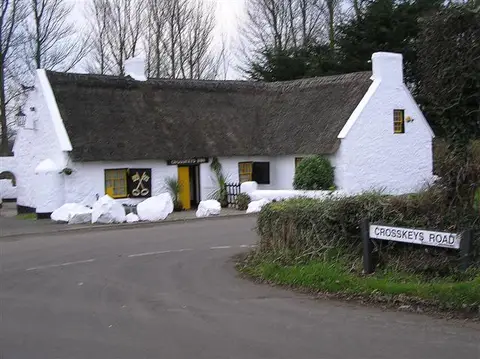
The Crosskeys Inn is the one to travel for: a low thatched building with
turf fires and Saturday night traditional music, listed Grade B1 and named Country Pub of the Year by BBC
Countryfile Magazine in 2017. Its 1654 is the most-repeated date in the province and the hardest to check —
the register dates the building to the 1820s, and the tree-ring survey everyone cites has never been published:
the tree-ring date nobody can read sets out what can and cannot be
established. Grace Neill’s keeps its old snugs and a reputation
as one of Ireland’s most haunted bars, on a street that once looked across to Portpatrick. For the pubs of the
republic see the oldest pubs in Ireland; for the wider British comparison,
the oldest pubs in the UK; and for more buildings under thatch, our list of
thatched pubs.
The 1611 date, originally as the King's Arms, is widely repeated (Wikipedia, tourism guides) but no licence or deed was found. Its reported Guinness 'oldest pub' listing is its own claim. The bar's own site is current rather than abandoned — it advertises tribute nights and a Christmas 2026 brochure — but its security certificate expired in August 2026, so a browser refuses the page: it is cited here as an archived
The date the bar keeps, 1615, is the year the building went up as Armagh's jail, where families passed food to prisoners through a hole in the wall, which is where the name comes from. Drinking came later: the same local account gives 1693 for the first licence as a public house, and that is the first record of a drinking house here rather than a prison. The Northern Ireland register of historic buildings has now
Claims 1615; first recorded 1693; building c.1615.
The tavern says Belfast's first tavern licence was granted on this site in 1630, and no licence record has been traced; the planning record calls it local tradition. What that record does document is the rest: the building standing now is largely the work of the wine merchant Valentine Jones, who rebuilt about 1790, and is known historically as Washington House. By the middle of the nineteenth century Neil & White
The inn brands itself as established in 1654, and that is where the date comes from; the address it used for its own site now leads to a page offering the domain for sale, so nothing it publishes can be read. Tourism NI and others cite tree-ring dating by Queen's University Belfast, reportedly in 2010, placing the building before 1654, while Wikipedia gives c.1740. No report of that dating has been traced, only
Claims 1654; no early record found; building c.1654.
The 1660 is the house's own. The Irish News, reporting the demolition application on 13 May 2025, says the pub in the parish of Derriaghy reportedly dates back to that year and attributes the claim to the house rather than to any record; no licence, deed or directory entry for 1660 has been traced, and the Troubles aside, Ireland's early licensing papers largely went with the Public Record Office in 1922. What the
The 1684 is the house's own: it is in the name of its website, and the page there says the premises met the three conditions for an inn's licence at the time — leave to sell punch, beds for travellers and stabling for horses — and calls itself the oldest sited bar in Derry. We traced no licence, deed or directory entry behind the year, and no earlier record of drink sold at these numbers on Shipquay Street. Visit
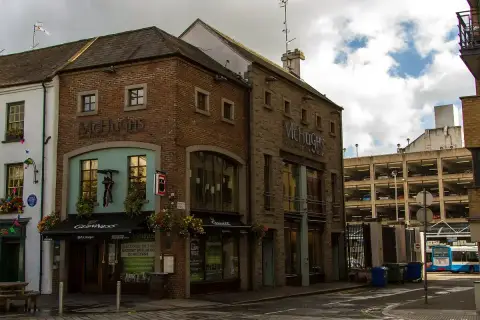
The 1711 is the figure the travel press uses — IrishCentral calls it the oldest pub in the oldest building in Belfast and dates it from 1711 — and the bar publishes nothing of its own that we could find. A 1997 survey by F. W. Hammond reportedly confirmed a build date of about 1710-15, making it Belfast's oldest known building. When it first became a pub is not established. Current trading status was not confirmed.
Dated 1711 in the press; no early record found; building c.1710.
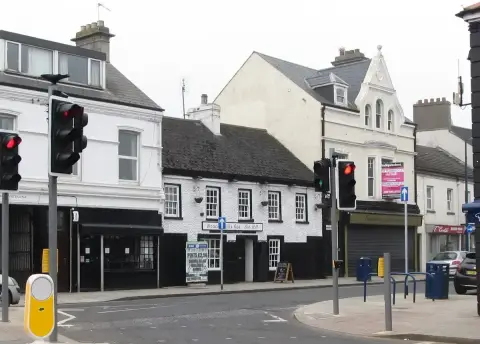
The claim is painted on the front of the pub: the fascia reads Teach Uí Cheallaigh — Kelly's Cellars, Estd. 1720, and a photograph of Bank Street shows it. The pub has no website we could find. Tourism NI repeats the 1720 build date without a cited record. An Ulster History Circle blue plaque marks meetings of the United Irishmen here in 1791-98, which supports 18th-century use. The register now supplies a date of
The 1765 is not on the bar's own website, which says only that it is one of the oldest pubs in Ireland. The year is published in Mid Ulster District Council's business directory, in a sentence that otherwise repeats the pub's own words, so we read it as the house's claim at second hand; the Belfast Telegraph and Belfast Live have used it too, on sites we cannot read. No licence, deed or directory entry for 1765 has
Grace Neill's in Donaghadee claims 1611, originally as the King's Arms, without a licence or deed to show for it. The best-evidenced building on this page is McHugh's Bar in Belfast, reported to have been dated by survey in 1997 to about 1710 to 1715, though the date it began selling drink is not established.
Which is the oldest pub in Belfast?
Two claim it. White's Tavern in Winecellar Entry says the city's first tavern licence was granted there in 1630, and Kelly's Cellars on Bank Street says it was built in 1720. Neither claim rests on a document we could find, though Kelly's has a blue plaque for United Irishmen meetings held there between 1791 and 1798.
Is the Crosskeys Inn Ireland's oldest thatched pub?
It is often described that way. Tourism NI and others cite tree-ring dating by Queen's University Belfast placing the building before 1654, while Wikipedia gives about 1740 and Northern Ireland's register of historic buildings dates the same house to between 1820 and 1839. No copy of the tree-ring report has been traced, only accounts of it, so we grade the 1654 as tradition rather than as a tested date. Its later life as a coaching stop, shop and post office is better attested, and it was restored after a serious fire in 2000.
Why are there only nine pubs on this page?
Because we list only houses where a date, a trading status and a source can each be checked. Northern Ireland's early licensing records are thin, and much of central Belfast's pre-Victorian fabric has been lost. Others are added here as evidence for them turns up, as the Derry and Moy entries were.