
The claim
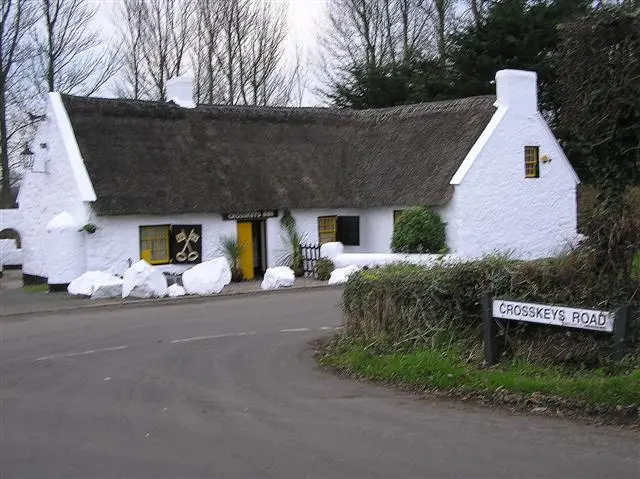
A low whitewashed cottage under thatch stands on the Grange Road between Toome and Portglenone, with turf fires inside and traditional music on a Saturday night. The Crosskeys Inn is generally described as Ireland’s oldest thatched pub, and it puts the year 1654 on its own material and on the whiskey it launched in 2017.
The date is not offered as tradition. It is offered as science. In 2010, the story goes, dendrochronologists at Queen’s University Belfast examined timber from the building — a fallen beam, in one telling — and concluded that the house pre-dates 1654, where it had previously been thought to be of the 1740s. Tourism Northern Ireland repeats it, local history sites repeat it, national newspapers repeat it, and it is a very good claim if it is true, because a tree-ring date is the one kind of evidence that settles an argument about a building outright.
We went looking for the report. We could not find it, and so far as we can tell nobody else has published it either.
What we can read, and what we cannot
Tree-ring dating produces paperwork. The laboratory reports we cite elsewhere on this site run to twenty pages: the number of cores taken, which timber each came from, the ring counts, the site chronology, the t-values against each reference curve, the sapwood estimate, the felling date and its margin of error, the authors, the commissioning body and the date of the report. That is what makes the method worth trusting. Anyone can check the working.
For the George & Dragon at Beaumaris, for instance, the report is on the Royal Commission’s own website: four felling dates between the winter of 1536/7 and the spring of 1541, listed timber by timber, signed by named dendrochronologists. We have written about what that settled. For the Crosskeys we have none of it — no report number, no laboratory, no sample list, no felling date, no margin. What circulates is a conclusion without its working, attached to a respected university, reported in good faith by everyone repeating it.
None of that means the dating did not happen. Queen’s University Belfast has one of the most distinguished tree-ring laboratories in Europe, and the pub is exactly the kind of vernacular building its work has dated across Ulster for decades. Work can be done and never written up, or written up and never put online, or filed in a report nobody has digitised. But an undated, unpublished result is not a document a reader can check, and this site does not treat it as one.
What the register says
There is a public record of this building, and it gives a different answer. Northern Ireland’s register of historic buildings holds the inn as HB07/09/011 A, at 40 Grange Road, Ardnaglass, Toomebridge, grade B1, in public house use now and formerly. Its date of construction is entered as 1820 to 1839.
Read on 20 September 2026 from the register’s own map service, that entry is nearly two centuries later than the claim, and later even than the 1740s the pub says it used to believe. It is not conclusive either: date fields in that dataset are often a surveyor’s assessment of the principal build, and a nineteenth-century rebuilding can sit on much older walls, which is one of the commonest stories in Irish vernacular building. What it does mean is that the only two dates on the public record for this house are 1654 and the 1820s, and they cannot both describe the same timbers.
The documentary history in between is thinner than either. The best local account of the house names its proprietors — the Misses Boyd in 1771, Patrick McAlane in 1837, George Neeson in 1858 — and traces its later life as a coaching stop on the Belfast to Derry road, a shop and, from 1857, a post office. Set aside the tree rings and 1771 is the earliest year with a name attached to it.
Why this one matters more than most
Most of the claims on our myths page are traditions: a year on a sign with nothing behind it, which is easy to weigh and easy to forgive. This one is different in kind, and more awkward. It invokes a scientific method, a real university and a specific year of testing, which is precisely the combination that stops people asking further questions. A date that arrives wearing a laboratory coat gets waved through.
The same problem has come up before. The Porch House at Stow-on-the-Wold has long cited a radiocarbon date on its oak beams; when the buildings archaeologist James Wright went looking for the report, the county archaeologist had no record of any samples having been taken, and we have written about where that left the claim. The lesson is not that pubs invent laboratory results. It is that a remembered test and a published test look identical once the story has been retold three times, and only one of them can be checked.
So how old is the Crosskeys Inn?
Unsettled, and honestly so. The house is a thatched Antrim cottage that has been a public house for at least two and a half centuries, badly damaged by fire in 2000 and rethatched, listed at grade B1 and named Country Pub of the Year by BBC Countryfile Magazine in 2017. It may well be seventeenth-century. We grade it C — tradition — not because we think the tree-ring date is wrong, but because our methodology requires a document a reader can go and read, and on this claim there is not one yet.
That grade would change the day the report surfaces. If the Queen’s University work exists in a file, a thesis, a laboratory list or a survey archive, we would like to read it and we will publish what it says, with the grade corrected in the same week. Until then the field is on our page for the oldest pubs in Northern Ireland, and how historians date an old pub explains what a tree-ring test can settle when its report can be read.
Sources
- services2.arcgis.com/BdBkthNLO9mzGAMO/arcgis/rest/services/Listed_Buildings_Centroid/FeatureServer/0/query?where=HB_Ref_No+LIKE+%27HB07%2F09%2F011%25%27&outFields=HB_Ref_No%2CAddress%2CCurrentGra%2CDate_Const%2CCurrentUse%2CFormerUse&returnGeometry=false&f=html
- belfastentries.com/places/the-crosskeys-inn/
- en.wikipedia.org/wiki/Crosskeys_Inn
- discovernorthernireland.com/listing/the-crosskeys-inn/68991101/
- irishnews.com/business/2017/04/07/news/crosskeys-inn-named-bbc-countryfile-country-pub-of-the-year-989983/
Found something wrong?Suggest a correction