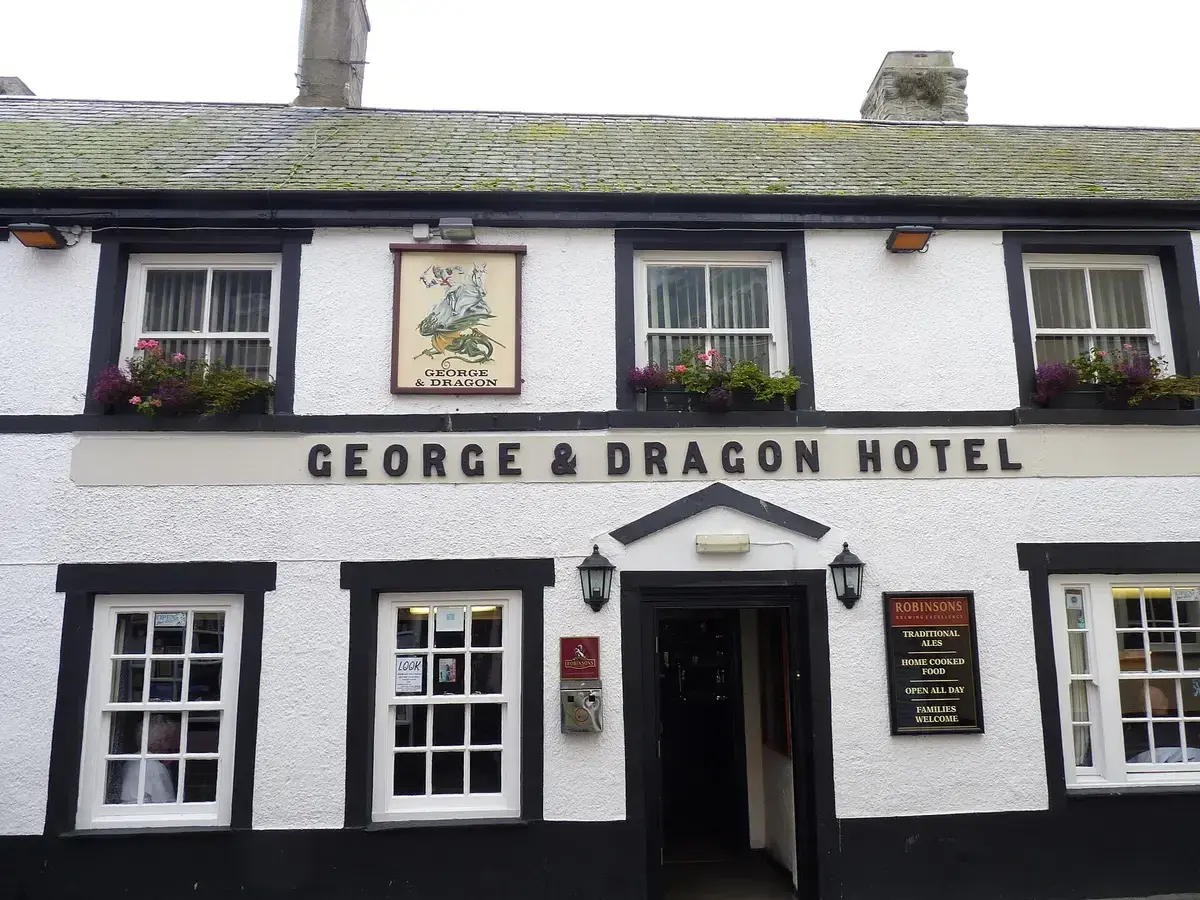

The claim
Beaumaris is a town built to a plan, laid out beside Edward I’s last and most perfect castle, and Church Street still has the shape the surveyors gave it. Halfway along, between the ground floor and the upper storey of a white-rendered pub, a band of raised lettering carries a date: 1410. The George & Dragon is described by its brewery as having been built in that year, and the figure is repeated in the North Wales press, in holiday guides and on the lists of Wales’s oldest pubs that circulate every summer.
Behind the render is something genuinely remarkable. This was a timber-framed, jettied range on a corner site, and enough of it survives inside to make the building one of the most interesting town houses in Anglesey: cross beams, a timber-framed partition with its wattle still showing, one of the brackets that once carried the overhanging upper storey, a lateral fireplace with a timber lintel, and upstairs an arched-brace truss, partitions with herringbone struts in the gable, and cusped wind braces. On one partition there are fragments of wall painting — two horned devils in a roundel, and a cross with a bleeding heart beneath the apex — above a beam carrying a restored Latin inscription beginning PAX DEUS VOBIS.
So this is not a case of a plain building with a grand date painted on it. It is a case of a very good building with the wrong date painted on it, and the reason we can say so with confidence is that somebody drilled it.
What the records show
Cadw listed the George & Dragon Grade II* on 23 September 1950, at the high grade, for its interest as an early seventeenth-century house later converted to a public house. Two dates appear in that entry and they are carefully distinguished. The register’s own dating is probably 1610, taken from a date recorded on a roof truss in the 1930s and since concealed. The 1410 on the front is recorded for what it physically is: a rendered inscription band with raised letters, listed among the exterior features alongside the sash windows and the cellar door, and not offered as the date of the fabric.
The Royal Commission on the Ancient and Historical Monuments of Wales, which keeps the national record separately from the statutory list, entered the house as NPRN 254 in December 2003 and dated it to the sixteenth century, altered in the seventeenth and again in the twentieth. It singles out the painted roof truss of 1610 as unusual because it combines a painting and an inscription, where most surviving examples have one or the other.
The pub itself is on the town plan of 1829 and on the Ordnance Survey of 1889, by which time a house and shop to the south had not yet been absorbed into it; the present neo-Georgian front is a twentieth-century remodelling made after the two properties were joined, when the jettied upper storey was under-built. The earliest record of drink being sold here that we have traced is from 1770, and the house history compiled for the dating project reports a publican’s recognizance of 1826 as the earliest licensing document found.
The building, dated by its timbers
In 2012 and 2013 the house was sampled for the Dating Old Welsh Houses project, working through the North-West Wales Dendrochronology Project in partnership with the Royal Commission, and the cores went to the Oxford Dendrochronology Laboratory. Tree-ring dating works by matching the pattern of wide and narrow rings in a timber against reference chronologies built from thousands of dated samples; where sapwood survives, it can give the season and year the tree was felled.
Here it did. The laboratory reported felling dates of winter 1536/7, winter 1539/40, winter 1540/41 and spring 1541, from an axial beam, a transverse beam and a group of joists, combined into a site chronology running from 1437 to 1540. Oak used for building was almost always worked green, within a year or two of felling, so a range built from timber cut across those four seasons went up around 1541 — in the reign of Henry VIII, not Henry IV. The laboratory noted that the upper floor was not sampled, and that the wall paintings up there are dated 1610.
That is the whole argument, and it is unusually clean. Of the three dates in circulation, the one painted on the front is 130 years too early, and Cadw’s 1610 belongs to the painted truss and the wall paintings rather than to the frame beneath them. The tree rings sit between the two and agree with neither.
Why the wrong date stayed up
Beaumaris was a walled town of merchants, and the local account has always been that this range began as a merchant’s house rather than as an inn. That is consistent with everything above: a substantial jettied town house of about 1541, given painted decoration and an inscribed truss around 1610, and turned into a public house generations later. Houses like it are common in the walled towns of north Wales — the Black Boy in Caernarfon and Ye Olde Bull’s Head, a few doors away, tell versions of the same story.
Where the 1410 itself came from, we cannot say. It is raised stucco lettering on a rendered band, and render of that kind is applied, not excavated; a date added to a Victorian or Edwardian refronting is the obvious explanation, and it would not be the first. Cadw makes the same judgement about a similar inscription elsewhere in north Wales, calling the painted 1400 on the front of the Groes Inn an inaccurate late nineteenth-century pseudo-historical addition. Two Welsh pubs, forty miles apart, wearing a painted medieval year in raised plaster on a rendered front, is a pattern rather than a coincidence.
So how old is the George & Dragon?
About 485 years old as a building, on the best evidence anyone can produce for any pub anywhere: a laboratory report naming the seasons in which the trees were cut. As a drinking house it is younger again, with the record beginning in the eighteenth century, which is why it grades C on our methodology despite the quality of the dating — the grade follows the drinking-house date, not the fabric.
It is worth saying what that buys the visitor. Nobody has to take this building on trust. The joists over the bar were oaks growing on this island while Henry VIII was dissolving the monasteries, and that is not a guess, a tradition or a brewery’s line. The rest of the field, including the houses with older claims and thinner evidence, is on our page for the oldest pubs in Wales, and how historians date an old pub explains how a tree-ring date is arrived at and what it does not settle.
The sign says 1410. The timber says 1541. Only one of them was there.
Sources
Found something wrong?Suggest a correction