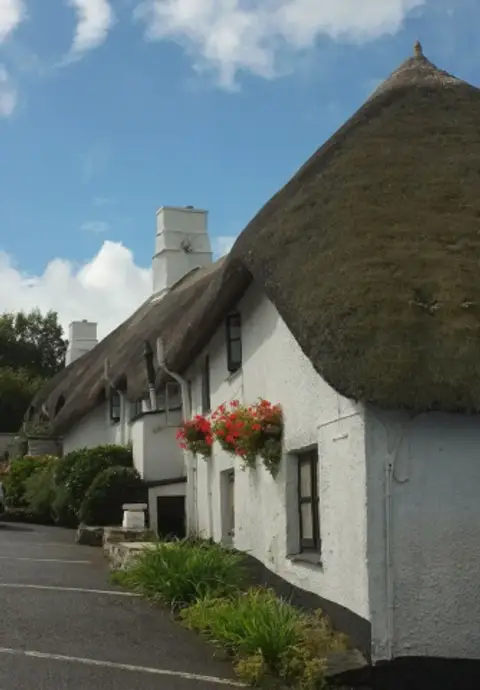
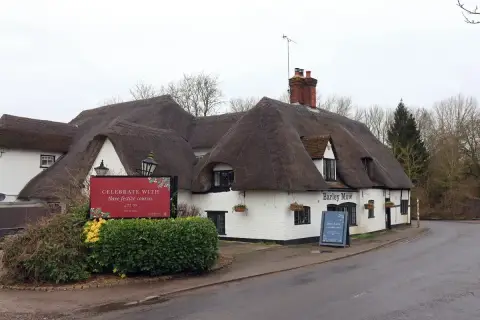
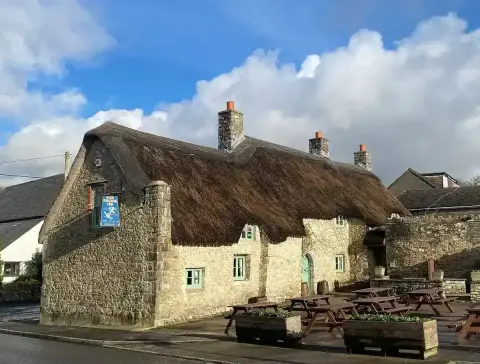
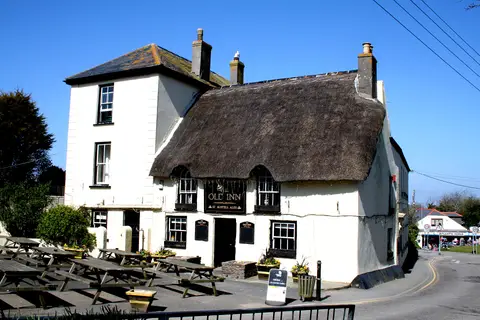
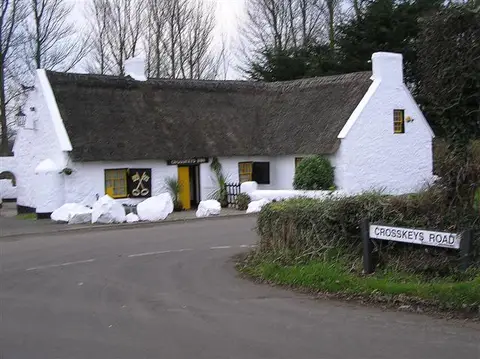
Thatch is a roof of straw or water reed, and it is usually re-coated rather than stripped, so a new surface can be laid over layers already centuries old. That makes it remarkable fabric and poor evidence: a reed roof says nothing about when drink was first sold underneath it. Fifteen pubs here wear one.
The roof can be the oldest thing on the site. Historic England’s advice on the conservation of
traditional thatch calls medieval smoke-blackened thatch the jewel in the crown — base coats laid
before houses had chimneys, blackened underneath by the smoke of an open hearth, and left in place
beneath every coat added since. Where one survives it can be dated, and it settles the age of the
timbers holding it up. It settles nothing about the trade below.
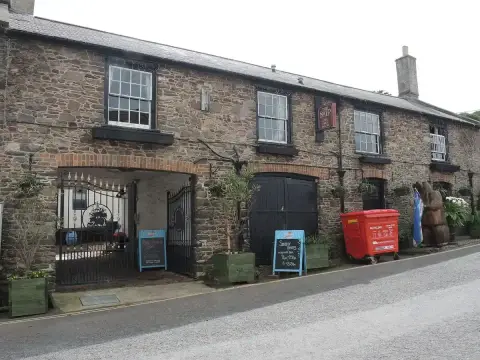
The Barley Mow at Clifton Hampden carries 1352 on a panel on
its own front, and its use as an inn is documented only from the Victorian Thames guides.
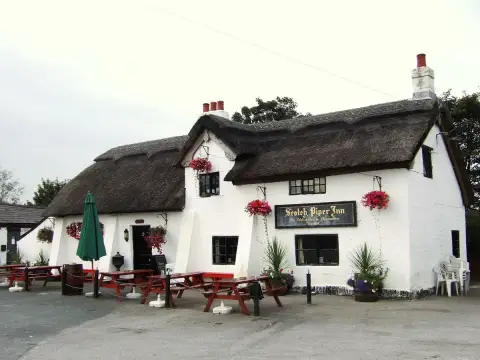
What the fabric can do, it does well. The Scotch Piper Inn at Lydiate
claims 1320 and holds a grade B because dendrochronology cited by CAMRA puts its cruck timbers in the
mid-sixteenth century — later than the claim, but tested, which counts for more here than an untested
early date. Eleven of the fifteen have no first record of drink being sold traced at all, and the
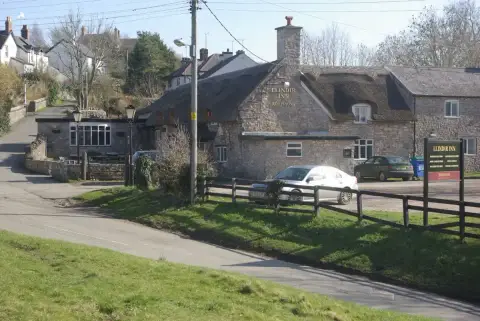
Blue Anchor at East Aberthaw has “Est. 1380” painted on a
wall Cadw dates to the middle of the 1500s.
Fire is the other thing a thatched roof brings. Three of the fifteen have burned within living
memory: the Blue Anchor lost its roof and part of its interior in 2004,
the Crosskeys Inn was restored after a fire in 2000, and
the Pandora Inn was rebuilt after one in 2011. Historic England
reports that fires in thatch-roofed buildings have risen markedly since the 1990s, with wood-burning
and multi-fuel stoves the likeliest cause. For how fabric is weighed against a claimed year, see
our methodology.
Spread across England, Wales, Ireland, Northern Ireland. Ordered by the date each one claims, oldest first — which is not the same as the order of the evidence.
The AD 560 date is tradition only; no early documentary source has been published. The listed building is 17th-century with an older cross-wing, and a continuous run of named innkeepers is recorded only from 1841.
The building is a genuinely old listed Devon longhouse, but it was a farmhouse until it was made into a pub and restaurant in August 1982, which CAMRA's South Devon branch states as plainly as the inn does. Historic England lists it grade II, under the spelling Crideford Inn, and first listed it on 2 July 1986 — four years after the conversion, so the register knows the building as an inn and says nothing about how
Cadw's listing describes a later-17th-century thatched house extended in the 18th and 19th centuries, with no medieval fabric noted. The Glamorgan-Gwent Historic Environment Record, now Heneb, agrees from its own file: record 02034m gives a 17th-century core with 18th- and 19th-century additions and a modern extension, two storeys under a thatched roof. The Royal Commission's National Monuments Record carries it as
Tradition holds the house was built about 1147 for the builders of St Michael's church and became an inn between the 14th and 16th centuries. Two published readings now stand against that year. The Victoria County History of Hampshire (volume 3, 1908) calls parts of the house at least 500 years old — about 1400, counted from when it was written — and dates the church's oldest fabric, the chancel, to the middle of
North Wales Live, Visit Wales and a 2024 holiday-cottage blog repeat a 13th-century date. Cadw's full report for the Llindir, read on 17 September 2026, gives a different reading: a storeyed building of several phases, the earliest probably late 16th-century, traditionally always an inn though perhaps beginning as a farmhouse, with a crow-stepped gable now swallowed by a raised roofline, the stone walling of the
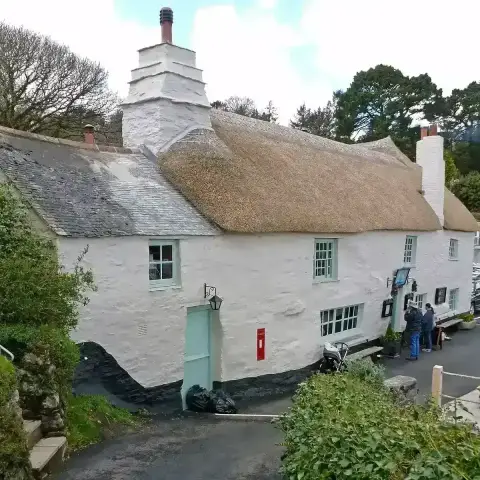
The inn's own page claims the 13th century for parts of the building, and says plainly what stood here then: a small farm on the edge of Restronguet Creek. So the claimed date dates a farm rather than a drinking house, which is why the grade is C. The page gives one real record: by 1488 the Restronguet Estate Accounts put the rent at 8s 4d a year, which it calls one of the earliest written references to the place.
The Ship advertises itself as a 13th-century coaching inn at the foot of Porlock Hill. Historic England lists it as an inn of C16 to C17 date, probably a three-room and cross-passage house, enlarged by a bay to the left and four bays to the right in the early to mid C19, its thatch half-hipped at one end. The Exmoor National Park Historic Environment Record, which keeps the record for this parish, reads it
Historic England says 'said to date from 1320, probably 16th century'. CAMRA cites dendrochronology suggesting mid-16th-century timbers. The thatched cruck house is genuinely early, but no medieval licence or alehouse record has been found; the name change to Scotch Piper is traditionally dated 1745.
The thatched house is long, low and genuinely old, and the 1320 with the story of Johannes Cott is the inn's own, repeated by CAMRA. Historic England, which listed it Grade II on 11 November 1952, dates it early in the 17th century or of earlier origins, remodelled later that century and extended at both ends in the 18th: a three-room-and-through-passage house with gable-end stacks, a plank-and-muntin screen
The 1352 is carved on the building: the listing records a panel dated 1352 to the right of centre on the front, so the date is the house's own assertion rather than Historic England's dating of the cruck frame, which the listing leaves undated apart from C19 and C20 alterations. The thatched timber-framed building is read as mid-14th century, but its use as an inn is only documented much later, notably in Victorian
Claims 1352; no early record found; building c.1352.
Cadw notes the 'Est. 1380' claim but dates the thatched limestone house to the mid-16th century. The Royal Commission on the Ancient and Historical Monuments of Wales records the same house as an inn in its national database and adds a reading of its own: it was probably built as a house, and its position and the way it grew suggest it became a public house early in its life. Two bodies therefore date the standing
CAMRA and the inn describe a 16th-century partly thatched house beside the church. Historic England's entry, read on 17 September 2026, reads it differently: a public house possibly of the late 17th century, with two mid-19th-century wings to the side and rear, the older part whitewashed stone rubble with a cob first floor under a thatched roof with gabled ends and eyebrow eaves, on a two-room plan with a central
The 1595 is published by Visit Dublin, which says there has been a pub on this hilltop since at least that year; a travel guide adds that the figure comes from deeds the pub itself cites. The deeds have not been published, and the pub has no website of its own we could find. The national inventory has now been read, and it puts the house two centuries later than the claim. The National Inventory of Architectural
The inn brands itself as established in 1654, and that is where the date comes from; the address it used for its own site now leads to a page offering the domain for sale, so nothing it publishes can be read. Tourism NI and others cite tree-ring dating by Queen's University Belfast, reportedly in 2010, placing the building before 1654, while Wikipedia gives c.1740. No report of that dating has been traced, only
Claims 1654; no early record found; building c.1654.
The house's own site does not give the year. Archived on 11 June 2026, it says the trade goes back as far as the 1600s and calls the Old Thatch Ireland's oldest thatched pub; the 1667 is IrishCentral's, and it is arithmetic on a document — at the Castlemartyr quarter sessions of 1867 the owner John Conway sought to renew his licence, saying the house had been licensed for more than two hundred years, and was refused
Dated 1667 in the press; first recorded 1867.
The photographs above are other people's work, used under open licences, or in the public domain. Every photographer, licence and source page is named in the image credits.