
The claim
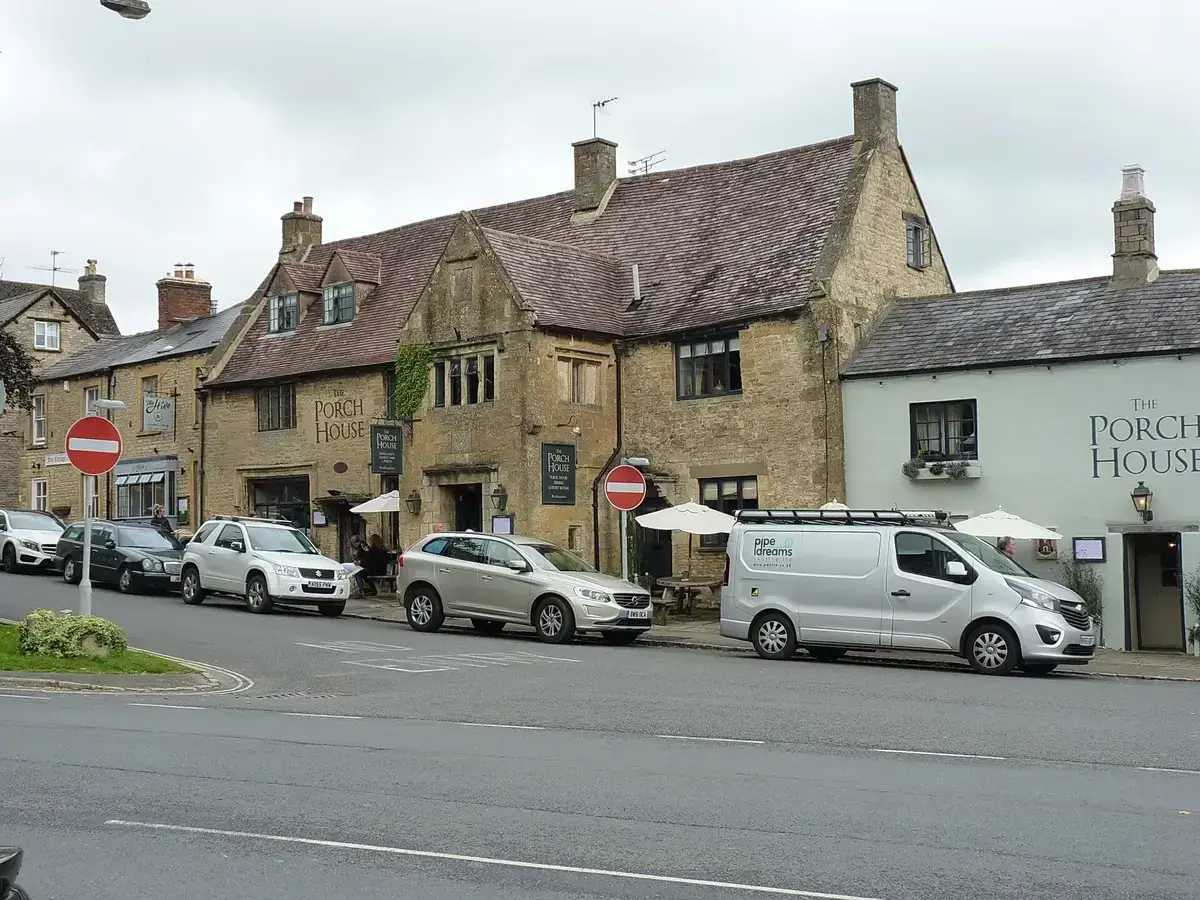
Above the door of a honey-coloured house on Digbeth Street, in the Cotswold hill town of Stow-on-the-Wold, is the line that draws people from three counties: England’s oldest inn, AD 947. The story behind it is precise and appealing. A Saxon nobleman — Aethelmar or Athelmar, Duke of Cornwall — is said to have founded a hospice here in 947 on land belonging to Evesham Abbey, and hospitality is said to have continued on the spot ever since, latterly under the names the Eagle and Child, the Royalist Hotel and now the Porch House.
The building itself does the claim no harm at all. There are inglenooks big enough to stand in, timbers black with age, apotropaic marks scratched near the hearth to keep ill luck out of the house, and a stone porch carrying the initials TS and the date 1615, added by Thomas Shellard. It is one of the most genuinely atmospheric old buildings you can drink in anywhere in the Cotswolds.
What the records show
The trouble starts with the town. Stow-on-the-Wold as a settlement is not documented until roughly 1086–1107; the borough was laid out by the abbots of Evesham on the hilltop, and the charter evidence belongs to the late eleventh and twelfth centuries. There was no Stow in 947 for an inn to stand in.
The 947 date appears to have been reverse-engineered from a genuine document: a land grant to Evesham Abbey dated 949. The buildings archaeologist James Wright, who examined the claim in detail, notes that the grant makes no mention of any settlement or structure — it is a grant of land, nothing more.
Aethelmar is worse. There was no Duke of Cornwall in the tenth century, because the Duchy of Cornwall was not created until 1337, for Edward the Black Prince. Wright traces the Aethelmar-and-hospice story to the Victorian antiquarian David Royce, and concludes it was “probably plucked out of thin air in a flight of whimsy” — the kind of confident local invention that nineteenth-century parish historians produced in quantity and that later writers repeated because it was in print.
The building, dated properly
| What | The Porch House |
|---|---|
| Claims | AD 947 |
| First record as an inn | eighteenth century (as the Eagle and Child) |
| Timber frame | fifteenth or early sixteenth century, on buildings-archaeology grounds |
| Stone porch | c. 1615, initials of Thomas Shellard |
| Listed | Grade II |
| Our grade | C — tradition |
English Heritage and CAMRA set out the counter-case in their 2005 book Licensed to Sell: the History and Heritage of the Public House: no record mentions the Royalist or the Eagle and Child before the eighteenth century, and the building itself dates from the fifteenth. Wright’s survey agrees on the fabric, dating the timber frame stylistically to the fifteenth or early sixteenth century, with the stone porch added around 1615.
The radiocarbon test is the part most often cited in the pub’s defence: oak beams said to have been sampled during 1970s alterations and dated to within fifty years either side of AD 1000. The figure circulates widely in local pub histories. Wright went looking for the underlying report and asked the county archaeologist, who had no record of any carbon samples having been taken from the building. A radiocarbon date with no laboratory, no reference number and no report is not a radiocarbon date; it is a remembered conversation.
Nor does the Guinness endorsement survive contact. Guinness World Records no longer maintains a category for the oldest pub or inn and, James Wright reports, has confirmed as much on its own social account. That is not the Porch House’s fault — more than one pub has cited Guinness recognition for the title over the years — but it does mean the claim now has no adjudicator behind it.
Where the 947 date came from
Wright’s own conclusion is carefully hedged. The origin of the claim, he writes, “seems to be a marketing strategy intended to sell on the property in the 1970s”, possibly alongside older local talk of a mediaeval hospital, and he allows only that it “may have been concocted” on the premise that history sells.
What is documented is the sequence. The house had been split into two dwellings, Porch House and Holmlea, in the mid-nineteenth century. Conversion to a hotel began in 1970. The earliest public statement of the 947 date that Wright could find is a newspaper article about the sale of the business in October 1974, when it became the Royalist Hotel. The Thompsons bought it in 2000 and opened a restaurant called 947AD; Brakspear acquired it in 2012 and reopened it as the Porch House in 2013. The date has appeared in the property’s own material under successive owners ever since.
We have found no published response from the Porch House or from Brakspear to Wright’s survey. If the radiocarbon report exists, we would like to read it, and we will publish what it says.
So what is England’s oldest inn?
Not this, on the evidence — and the same is true of most of the famous four-figure claims. Ye Olde Fighting Cocks in St Albans says 793 but is first recorded as an alehouse in 1756. The Bingley Arms near Leeds says 953 and carries a 1738 datestone. Ye Olde Trip to Jerusalem says 1189 and appears in the record in 1751.
Historic England’s own answer is that around a dozen purpose-built medieval inns survive in England and are still trading, and that the oldest of them are of the late fourteenth and fifteenth centuries. The clearest case is the George Inn at Norton St Philip in Somerset: built by the Carthusians of Hinton Priory to house buyers at its wool fairs, with upper timbers tree-ring dated to 1430–32. That is a medieval inn whose date, builder and purpose are all documented.
Judged on that scale, the Porch House is a late-medieval Cotswold house with a Jacobean porch that has been an inn, on and off, for something over two centuries. That is a good, true story about a beautiful building. We explain how we weigh claims like this in our methodology, and you can see where it lands in the top 100 oldest pubs and among England’s oldest pubs.
Sources
Found something wrong?Suggest a correction