Says 1630. No document from that date has been found.
Grade C · Tradition
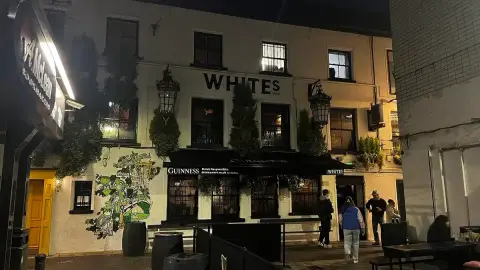
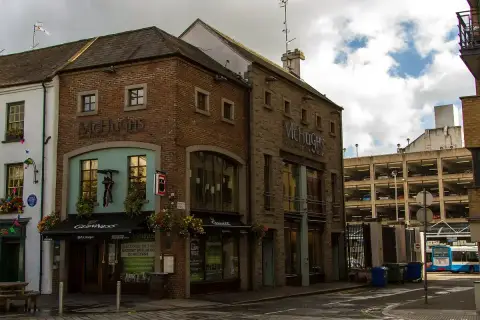
By claim, the oldest pub in Belfast is White's Tavern in Winecellar Entry, which says the city's first tavern licence was granted there in 1630; no licence record has been located. None of the three has produced a document, so the firmest date in the city is a building date: a 1997 survey by F. W. Hammond is reported to place McHugh's on Queen's Square at about 1710–15, which would make it the oldest known building in Belfast.
The three Belfast contenders are not really competing, because each claims a different superlative and all three can be true at once. White's claims the earliest licence, 1630. McHugh's claims the oldest building, about 1711. Kelly's Cellars claims, more simply, to be the city's oldest pub, and dates itself to 1720. Read them as measurements rather than as rivals and the list becomes much easier to use — one claim about paperwork nobody has produced, one about fabric a surveyor actually examined, and one about continuity attested by what happened inside rather than by when it began. The awkward consequence is that Belfast's oldest known building is not necessarily its oldest bar: when the house on Queen's Square first served drink has not been established, so its strong date certifies the walls and says nothing about the trade. Kelly's has the opposite shape. Its 1720 is repeated without a record, while the Ulster History Circle plaque on the wall, marking meetings of the United Irishmen between 1791 and 1798, puts eighteenth-century use beyond much doubt.
Three different superlatives
White’s Tavern makes the boldest claim and has the least to show for it: 1630,
as the first tavern licence granted in Belfast, unsupported by any record we could find, in a building whose own
date we could not establish. That is not a reason to dismiss it, only a reason to describe it accurately.
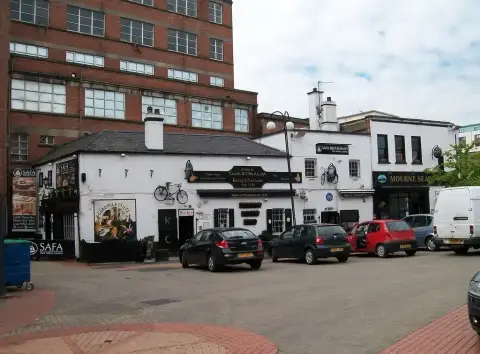
Kelly’s Cellars on Bank Street is the plainest and the most political of the
three, with a traditional bar, Irish food and a plaque that fixes it firmly in the politics of the 1790s.
McHugh’s on Queen’s Square, near the Lagan, is the only one whose age has been
assessed by anyone with a tape measure.
Where the evidence actually is
A pattern worth carrying around Belfast: the further a claim moves from paperwork towards fabric, the better it
holds. The city’s licensing archive cannot settle White’s 1630, and probably never will. A survey of oak beams
and a spiral staircase can date a merchant’s house to within a few years, which is what happened at McHugh’s,
and that is why it grades B while its neighbours grade C — the building is of the right age, and the first
mention of drinking in it comes later. The same reasoning is set out in
how to tell how old a pub is. For the province’s full list, including
the thatched Crosskeys Inn in County Antrim and its tree-ring date, see
the oldest pubs in Northern Ireland; for the pubs across the border,
the oldest pubs in Ireland.
The tavern says Belfast's first tavern licence was granted on this site in 1630, and no licence record has been traced; the planning record calls it local tradition. What that record does document is the rest: the building standing now is largely the work of the wine merchant Valentine Jones, who rebuilt about 1790, and is known historically as Washington House. By the middle of the nineteenth century Neil & White
The 1711 is the figure the travel press uses — IrishCentral calls it the oldest pub in the oldest building in Belfast and dates it from 1711 — and the bar publishes nothing of its own that we could find. A 1997 survey by F. W. Hammond reportedly confirmed a build date of about 1710-15, making it Belfast's oldest known building. When it first became a pub is not established. Current trading status was not confirmed.
Dated 1711 in the press; no early record found; building c.1710.
The claim is painted on the front of the pub: the fascia reads Teach Uí Cheallaigh — Kelly's Cellars, Estd. 1720, and a photograph of Bank Street shows it. The pub has no website we could find. Tourism NI repeats the 1720 build date without a cited record. An Ulster History Circle blue plaque marks meetings of the United Irishmen here in 1791-98, which supports 18th-century use. The register now supplies a date of
Claims 1720; no early record found.
The photographs above are other people's work, used under open licences. Every photographer, licence and source page is named in the image credits.
Common questions
Which is the oldest pub in Belfast?
White's Tavern claims the earliest date, 1630, as the city's first tavern licence, and that licence has not been produced. Kelly's Cellars also calls itself Belfast's oldest, from 1720. McHugh's has the best-evidenced date of the three, but it is a building date rather than a drinking one.
Is McHugh's in Belfast's oldest building?
That is the claim, and a 1997 survey by F. W. Hammond is reported to have confirmed a build date of about 1710 to 1715 for the Queen's Square house, which would make it the oldest known building in the city. Original oak beams and a spiral staircase survive inside. When it first became a bar is unclear.
Is Kelly's Cellars from 1720?
Tourism NI repeats the 1720 build date without citing a record. What is documented is the blue plaque from the Ulster History Circle recording meetings of the United Irishmen on Bank Street between 1791 and 1798, before the failed rebellion — good evidence of eighteenth-century use, if not of 1720.
Can all three Belfast claims be right?
In principle, yes, because they measure different things: a licence, a building and a continuous business. That is why we grade each pub against its own claim rather than ranking the city. Two of the three rest on tradition; the third rests on a survey of its walls.
Why are only three Belfast pubs listed?
Because we list a pub only when its date, its trading status and a source can each be checked. Belfast's early licensing records are thin and much of the pre-Victorian city has gone, which keeps the list short. Others will be added as evidence for them turns up.