The claim
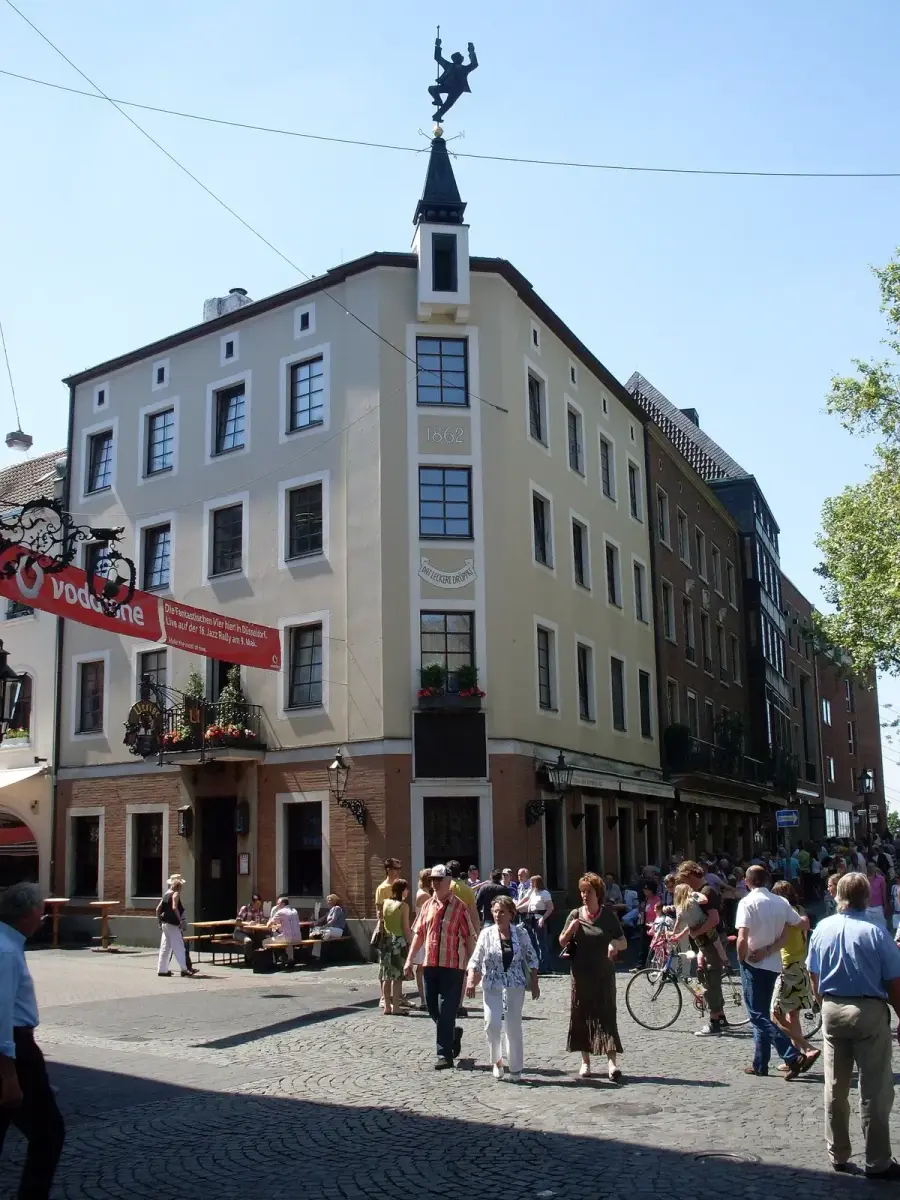
A corner house in the Düsseldorf Altstadt where a guest house called the Heidelberger Fass is recorded by 1755, and where Wilhelm Cürten, whose temper gave the place its name, put a brewery in the cellar in 1862. The Altbier is still brewed on the premises and carried round in trays by waiters called Köbesse; in fine weather the drinkers stand out across the Rheinstraße with a glass.
What the records show
The house dates itself from the brewery and not from the inn, which is why the record here is older than the claim. Its own chronicle sets out that on 4 January 1862 the widow Bender sold the Bergischer Hof to the innkeeper and brewer Wilhelm Cürten, who put a brewery in the cellar and the back buildings and was soon serving his own top-fermented beer in the ground-floor rooms; the regulars' word for his temper, uerig in the Düsseldorf dialect, became the name of the house and of the beer. The German Wikipedia article and the city magazine Duesseldorf-Magazin give the same day and the same names, and agree about what came before: owners are named from 1632, and by 1755, when Bertram Kesseler held the house, there was already a guest house called the Heidelberger Fass, a name still lettered over the door. A postmaster kept the imperial post here about the same time, with board and lodging for travellers, and the Juppens, the wine merchants who followed in 1783, sold wine on the premises. No archive document has been read for any of this; three accounts name the same people in the same years, and the Düsseldorf chronicler Heinrich Ferber, writing in 1890, is quoted on the yard as he remembered it. Nothing about the drinking is in doubt today: the beer is brewed on the premises and carried round by waiters called Köbesse, and in fine weather the drinkers stand out across the Rheinstraße. Heinrich Ferber's own book was read on 18 September 2026, in the Bavarian State Library's digitisation, and it changes what can be said about the years before 1862. On page 62 of the second volume of his walk through the old town of Düsseldorf, published there in 1890, he takes the Bergerstrasse house by house and begins at the corner of the Berger- and Rheinstrasse: number 1, the house called the Heidelberger Fass, was already the Pfeilstickers' in 1632, with one Martin Pütz living in it, and the widow Pfeilsticker was there with two daughters in 1663. In 1720 Johann Bernard Pfeilsticker pledged his share of the family house for a hundred Reichsthaler borrowed from his brother, and the reason he gave for wanting it was his cooper's trade — the family that held the house made barrels, which is worth knowing beside a sign naming the great vat of Heidelberg. The 1755 that three modern accounts print as a guest house is, in Ferber, a wedding: Wendelina Elisabeth Pfeilsticker married the Palatine councillor Bertram Goswin Joseph Kesseler that year and brought him the house, and Ferber says nothing about anybody being served in it. What he does record is 1783, when the wine merchant Leonhard Juppen gave notice that he had left his quarters on the Neubrück for his mother's house, the Heidelberger Fass on the Bergerstrasse, and that travellers on horseback or with a carriage would find lodging, stabling, good wine and food there at the cheapest price; and 1790, when the Grubens bought the house and kept a guest house in it. The host Lambert Gruben sold it in 1800 to Lambert Mertens; Johann Bender had it afterwards and ran a fruit trade beside his guest house from 1802; his widow still owned it in 1858; and Ferber, writing in 1890, says it then belonged to the widow of Wilhelm Cürten. That last line is an independent sighting of the Cürtens at this address twenty-eight years after the year the house gives, from a publisher that is neither the brewery nor an encyclopaedia. Two things Ferber has not got. There is no postmaster and no imperial post at number 1 in his account, though the modern ones put both here; and there is no brewery, no Wilhelm Cürten's cellar and no Uerige, because he is writing a history of title and not of trade. His silence about the brewhouse is therefore not evidence against it. What his pages do argue is that the earliest advertised drinking at this address is 1783 and not 1755, and that the 1755 in circulation is a marriage read as a licence.
| Year | What | Source |
|---|---|---|
| 1862 | Claimed founding | The pub |
| 1783 | First record of a drinking house here | Wikipedia |
What to look for inside
- Altbier brewed in the house and served by waiters called Köbesse
- Named for Wilhelm Cürten's temper: uerig, Düsseldorf dialect for bad-tempered
- The older name Heidelberger Fass is still lettered over the entrance
- Drinkers stand out across the Rheinstraße in fine weather
Visiting
Zum Uerige is in Düsseldorf, Germany, at Berger Straße 1, Altstadt, 40213 Düsseldorf. We do not list opening times, because they change; the pub’s own site is the place to check before you set out.
Sources
- uerige.de/historie
- uerige.de/termine
- de.wikipedia.org/wiki/Uerige
- duesseldorf-magazin.de/essen-und-trinken/hausbrauereien-mit-ausschank/hausbrauerei-uerige
- www.digitale-sammlungen.de/en/view/bsb11836124?page=70
Know something we don’t?Suggest a correctionLast checked Sept 2026
Run this pub? There is a badge for it
Free to put on your own site, no permission needed. It shows what the pub claims and what the records support, and it changes when the data does.
How to use it, and how to change what it says — if you have a document we have not seen, we would like to read it.