
The claim
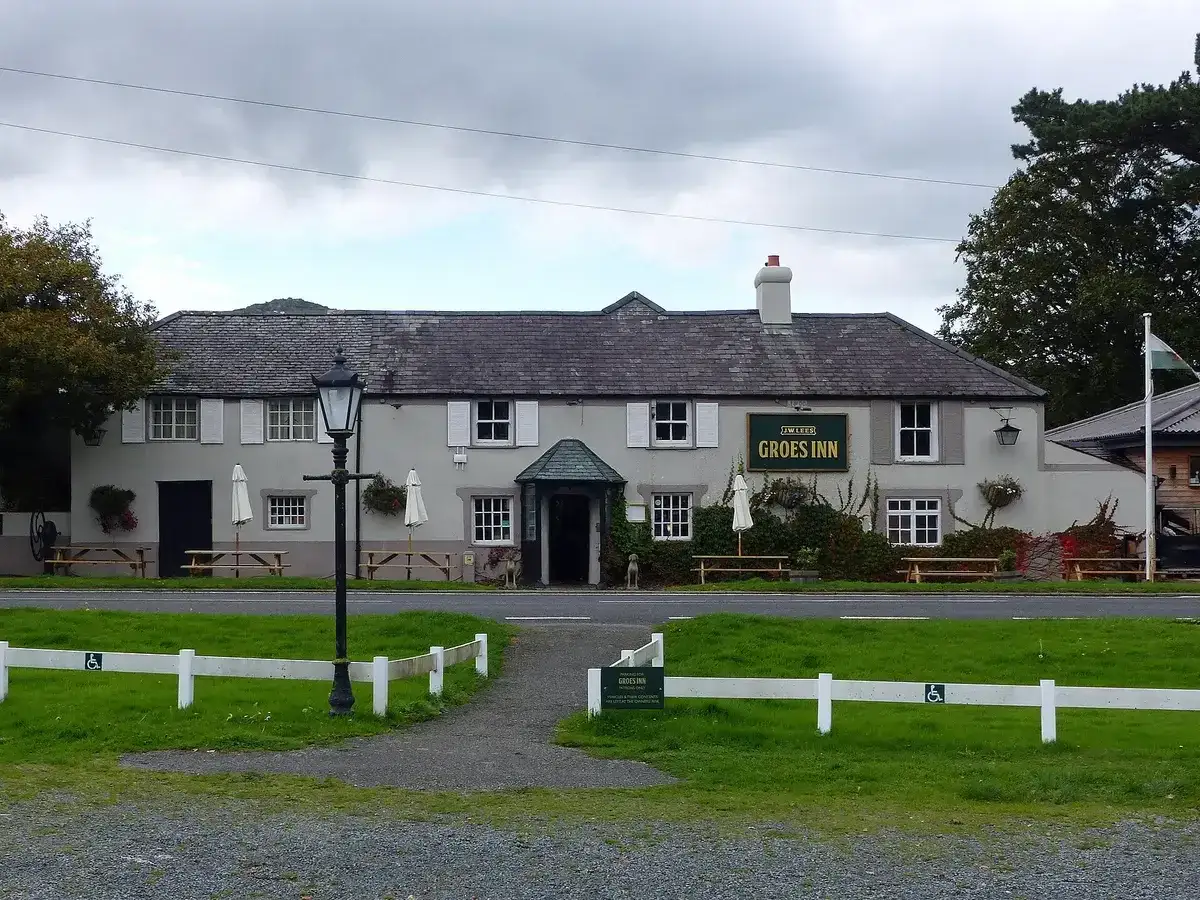
A long whitewashed building stands on the west side of the Llanrwst road above Ty’n-y-Groes, with the Conwy valley below it and Snowdonia across the water. The Groes Inn describes itself as the first licensed house in Wales. The inn’s own pages make that claim without naming a year; the North Wales press supplies one, 1573, and it has been copied from there into holiday guides and best-of lists ever since. Painted on the front, in raised stucco under the eaves, is a different number altogether: 1400.
This is a more interesting case than the usual pub-sign argument, because the claim is wrong in one direction and modest in another. The 1573 licence has never been produced by anybody. The 1400 is demonstrably an invention. And underneath both of them sits a real document, five years later than the claimed licence, which is among the best pieces of evidence any Welsh pub can put on the table.
What the records show
Cadw designated the Groes on 13 October 1966, and its list entry opens not with a tradition but with a record. The house, it states, was established already as an inn in 1578, when the tavarne y Groes is mentioned in a court order, and it appears under the same name again in June 1580. The reason for designation is given as an early recorded inn in a prominent roadside position.
That is a named house, in a named place, described as a tavern, in a dated legal document. It is the kind of evidence that almost nothing else in Wales can match, and it is why the Groes is the only Welsh entry on this site graded A. It also sits five years after the 1573 the newspapers give, which means the licence claim, if a licence exists, would be supported rather than contradicted by it — a house named as a tavern in a court order in 1578 was plainly trading before somebody wrote it down.
What we cannot do is confirm the 1573 itself, or the word first. No transcript, archive reference or repository has been published for a licence of that year, and “the first licensed house in Wales” is a claim about every other house in the country as well as about this one. Welsh licensing before the seventeenth century was administered through quarter sessions and manorial courts whose records survive unevenly, and the honest position is that nobody is in a position to say which Welsh house was licensed first. The inn’s own version is the more careful one: it claims the distinction and declines to date it.
The building, dated
Cadw dates the standing structure largely to the late seventeenth century, with a possible late sixteenth or early seventeenth-century core: the evidence for that core is the great inglenook fireplace in the former hall, with an ogee-stopped chamfer to its bressummer. The central section is the earliest part, and reads as a storeyed end-chimney house of a type common in that region, with the left-hand section a twentieth-century addition and a nineteenth-century wing behind. Inside there are chamfered joists and beams with run-off stops, the inglenook with its niches and later oven, a pine stair of about the early eighteenth century with flat shaped balusters, and a three-bay pegged collar-truss roof over the primary section.
Of the painted date on the outside, Cadw is blunt: raised stucco lettering reading 1400, which it calls an inaccurate late nineteenth-century pseudo-historical addition. That judgement is worth holding on to when you meet a medieval year painted on a rendered front anywhere else; the George & Dragon at Beaumaris, forty miles away, carries 1410 in raised letters on a rendered band, and tree-ring dating puts its frame a century and a third later.
The Royal Commission on the Ancient and Historical Monuments of Wales is more cautious than Cadw about the same house. Its entry, number 26356, compiled in May 2007 from the Caernarvonshire inventory of 1956 and from the listing, calls the Groes a late sixteenth or early seventeenth-century house or inn, possibly the tavern named in 1578 — or else a building standing on that tavern’s site. The document is not in doubt. What is in doubt is whether these particular walls are the ones it refers to.
What the timbers said, and did not
The Commission had the question tested. In June 2014, six oak core samples were taken for the Oxford Dendrochronology Laboratory, commissioned by the charity Dating Old Welsh Houses in partnership with the Commission: a ceiling beam and the fireplace lintel at the north end, the south end beam, the south intermediate ceiling beam, and both principal rafters of the second truss.
The result was a negative one, and negatives are worth publishing. Five of the six samples matched each other and were combined into a well-replicated site chronology 117 years long — and that chronology failed to date against the reference curves. The laboratory’s report of September 2014, by M. C. Bridge and D. Miles, concluded that the building is thought to be quite late, probably eighteenth or nineteenth century, that its timbers were later in style than most of the houses the project examined, and that the sequence may yet date when more local material of that period has been measured. Richard Suggett, writing the historical note for the Commission that November, described a storeyed house of the Snowdonian plan-type, possibly the tavern of the late-Elizabethan documents, extended and modernised in several phases, with a roof and stair that may be eighteenth century.
So the oldest datable thing on this site is the court order, not the building. That is an unusual shape for a pub argument and an instructive one: the documents are strong and the fabric is weak, where the normal pattern on this site is the reverse.
So what is the Groes Inn’s real claim?
Two of the three things said about it hold up in different ways, and one does not.
The house was a tavern under this name by 1578 and again in 1580, on the register’s own reading of a court order. On our records that is the earliest dated notice of a Welsh drinking house we have traced, which is a considerably better claim than most of the houses that outrank it on the signs — the Skirrid Inn with about 1110, the Old House at Llangynwyd with 1147 in its name, or the Blue Anchor at East Aberthaw with its painted Est. 1380.
The first licence in Wales, and the year 1573, are unproven. Not disproved: unproven, which is a different thing, and the difference is that a document could still turn up. And the 1400 on the front is late Victorian plasterwork that the national register has already dismissed in print.
Our methodology explains why a court order outranks a painted date and why this house grades A when almost every pub on this page grades C. The rest of the field is on our page for the oldest pubs in Wales, and how historians date an old pub explains what a tree-ring test can and cannot settle — including, as here, when it settles nothing.
Sources
Found something wrong?Suggest a correction