The claim
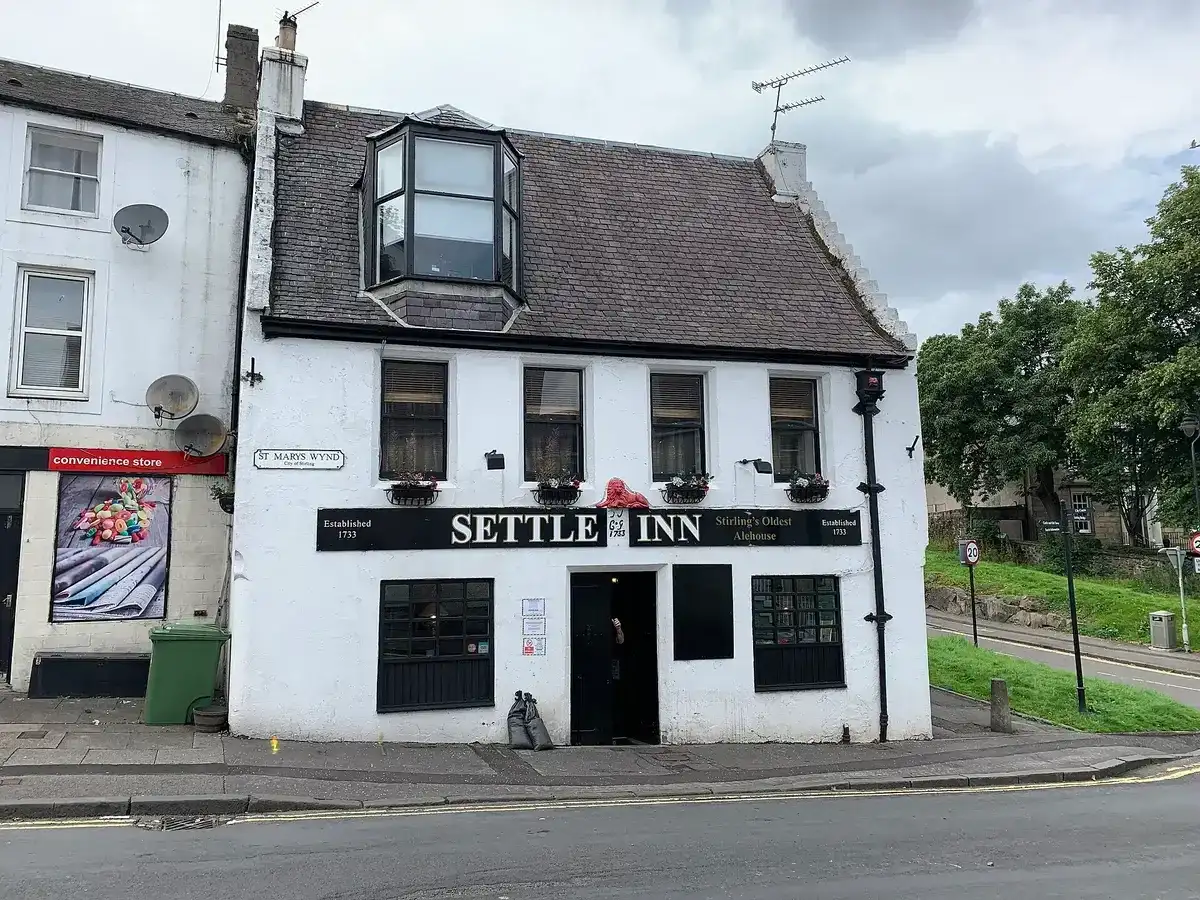
Reputed to be Stirling's oldest pub, the Settle Inn is said to date from 1733, and its listing records that year cut on the building with the initials G T E G. It is a small, traditional bar with folk music sessions, a low-ceilinged back room and a resident ghost story, in a crow-stepped house on St Mary's Wynd that Historic Environment Scotland notes was formerly the Red Lion Inn.
What the records show
The 1733 is CAMRA's: its entry says the Settle Inn was built in 1733 and is the oldest pub in Stirling, and a Scottish round-up repeats both. There is now a second and independent reading of the same year. Historic Environment Scotland listed 91 St Mary's Wynd, the Settle Inn, at category C on 3 February 1978, and its description opens by recording the house as dated 1733 with the initials G T E G — a datestone on the building itself — then describes two storeys and an attic, four windows wide, stuccoed, with crow-stepped gables, a large Victorian canted dormer and a slated roof, and notes the ground floor as badly altered as a public house. Its statement of special interest adds that the house was formerly the Red Lion Inn. So the fabric carries the claimed year and the register records inn use without dating it, which is a grade B: the walls are of the age claimed, and the first record of drink sold in them is later.
What to look for inside
- Reputed to be Stirling's oldest pub
- Known for traditional music sessions
Visiting
Settle Inn is in Stirling, Scotland. We do not list opening times, because they change; the pub’s own site is the place to check before you set out.
Sources
- lovetovisitscotland.com/what-is-the-oldest-pub-in-scotland/
- camra.org.uk/pubs/settle-inn-stirling-168471
- ratings.food.gov.uk/business/51967
- portal.historicenvironment.scot/designation/LB41467
Know something we don’t?Suggest a correctionLast checked Sept 2026
Run this pub? There is a badge for it
Free to put on your own site, no permission needed. It shows what the pub claims and what the records support, and it changes when the data does.
How to use it, and how to change what it says — if you have a document we have not seen, we would like to read it.