The Lima historic pub walk is a self-guided route of 6.18 km between 3 old pubs, about 1 h 23 min walking, with a GPX file to follow. Antigua Taberna Queirolo makes the oldest claim on it, 1880, and no stop on the walk yet has a document from at or near the date it claims.
The distance is the walked street route, not the straight line. These are history walks, not a drinking challenge: take it slowly, drink water between stops, and leave a pub out if the day is getting long.
Lima, Pueblo Libre to the old Desamparados station. East across Lima, from a corner in Pueblo Libre that the city grew out to meet, through the old centre, to a room beside the Government Palace. Not one of the three years on this walk survives the question this site asks of them. The taberna’s 1880 dates a grocery; the Cordano’s 1905 dates a bazaar; the Múnich has no founding year at all and is placed in the 1950s by a plate of sausage and chips. The taberna is out of the ranking altogether because of it, and the other two are ranked on years their own sources attach to a shop. None of which is a reason to walk past them.
Avenida San Martín 1090, corner of General Vivanco, Pueblo Libre, Lima
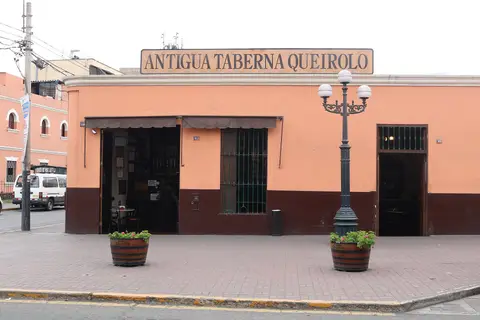
A corner taberna in Pueblo Libre, opened in 1880 by a Genoese immigrant as a grocery that sold wine and provisions to the estates around, and long since just the bar. Wine and pisco are poured at the counter with chicharrón and escabeche alongside. The house of the 1870s that holds it still stands, with one of Peru's first telephones and an old till kept in the room.
A bar on Jirón Quilca in the old centre of Lima, working since at least the 1950s, when a Swiss-German couple sold sausage and chips over its counter as the Piqueo Múnich and started Peru on the salchipapa. Beer comes in generous glasses, the piano is played live, and the room stayed open through the pandemic by sending its food out.
Jirón Áncash 202 (corner of Jirón Carabaya), Cercado de Lima
A time-worn bar-restaurant opposite the old Desamparados railway station in Lima's historic centre, opened by Genoese immigrants in 1905, first as a bazaar and then a salon. Mud walls and worn granite floors frame three rooms seating around 150. Owned by its staff since 1978, it was declared part of Peru's cultural heritage in 1989.
This is a walk between three counters, and the interest in each of them is what it sold first.
Antigua Taberna Queirolo starts it at the corner of Avenida
San Martín and General Vivanco. The Queirolos reached Lima from Genoa about 1877, and in 1880
Santiago Queirolo Raggio opened what the house calls the typical pulpería of the period here:
groceries, wine and preserves sold to the estates around Magdalena Vieja. The corner came in time to
be only the taberna, and the house names no year for that change, which is why it keeps its page and
stays outside the ranking. Look above the door on Avenida San Martín for the Blue Shield: El
Comercio reported in July 2026 that this was the first Lima tavern to hang the emblem, without
naming the decision that granted it.
Piano Bar Múnich on Jirón Quilca is the one stop here with no date
of its own at all, and it earns its place another way. Nobody publishes a founding year for it. What puts a working bar in the room by the 1950s is a dish: the published account of the
salchipapa, drawing on El Comercio and a Lima food blog, has sausage and chips sold over this counter
as the Piqueo Múnich by a Swiss-German couple called Hans and Helga, before the thing reached the
streets and became one of Peru’s emblematic fast foods. The 1950 on its row is the decade’s first
year standing in for a date nobody has, not a finding.
Bar Cordano finishes the walk on Jirón Áncash. Spanish Wikipedia has the
house founded on 13 January 1905 by the Genoese Vigilio Botano with the brothers Luis and Antonio
Cordano — as a bazaar, which became a salón-restaurante later, and none of the sources consulted
dates that change either. What is firmer than the founding is everything after it: the staff have
owned the business since 1978, Peru declared the premises part of the nation’s cultural heritage in
1989, and the Lima daily Trome marked the house’s 121st year on 13 January 2026, describing a room in
full trade with the butifarras and the pisco sours still going.
Three counters, three shops that turned into bars, and no document behind any of the years: the
country’s page sets out why every Peruvian grade on this site is a C, at
the oldest pubs in Peru. For the difference between a counter in a grocery and
a room built for drinking, see inn, tavern or alehouse;
for how a claim is weighed against a record here at all, the methodology.