The London historic pub walk is a self-guided route of 9.7 km between 6 old pubs, about 1 h 56 min walking, with a GPX file to follow. Prospect of Whitby makes the oldest claim on it, 1520; the oldest record on the walk belongs to The George Inn, from 1542.
Distances are walking estimates, 1.3 × the straight line at 5 km/h. These are history walks, not a drinking challenge: take it slowly, drink water between stops, and leave a pub out if the day is getting long.
A walk through London’s genuinely old pubs. Six London houses that came through what the city did to its drinking: the fires of the 1660s and 1670s, the railway's appetite for the inn yards of Southwark, and the working of the river east of the Tower. Four of them are reached down a yard or a court off a main street. Two face the water instead.
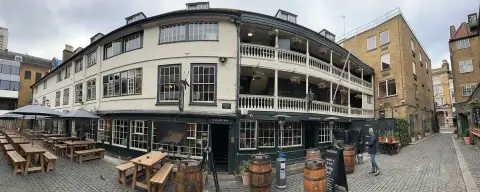
Hidden in a cobbled yard off Borough High Street, the George is London's only surviving galleried coaching inn. An inn stood here by the 1540s; the present wing, with its wooden balconies, dates from rebuilding after the great Southwark fire of 1676. Owned by the National Trust, it keeps panelled bars, a Parliament clock and a busy courtyard.
Dated 1542 in the press; first recorded 1542; building c.1677.
145 Fleet Street (Wine Office Court), London EC4A 2BU
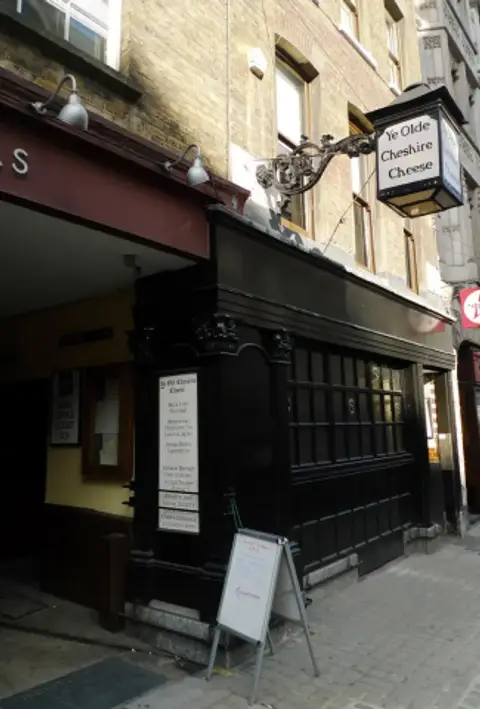
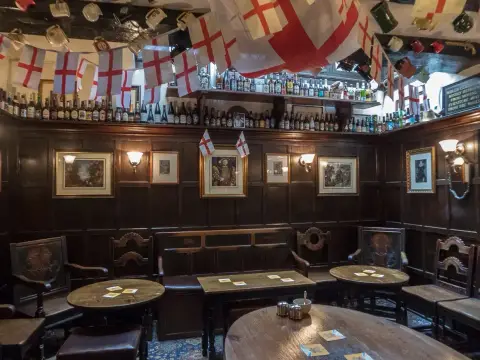
Down a narrow court off Fleet Street, the Cheshire Cheese is a dim, fire-lit maze of panelled rooms and vaulted cellars rebuilt after the Great Fire. The 1538 claim is unproven — the listing dates the house to the late seventeenth century — but it was certainly trading by 1680. Its literary regulars are legendary, and a famous swearing parrot, Polly, entertained drinkers for some forty years.
Claims 1538; first recorded 1680; building c.1667.
1 Ely Court, Ely Place, Hatton Garden, London EC1N 6SJ
Reached by a slender alley off Hatton Garden, Ye Olde Mitre feels like a secret. It stands on the former estate of the Bishops of Ely, and legend gives it a 1546 foundation, though the snug panelled rooms date from the 1770s. Look for the preserved cherry-tree trunk said to mark an old property boundary.
Claims 1546; first recorded 1791; building c.1772.
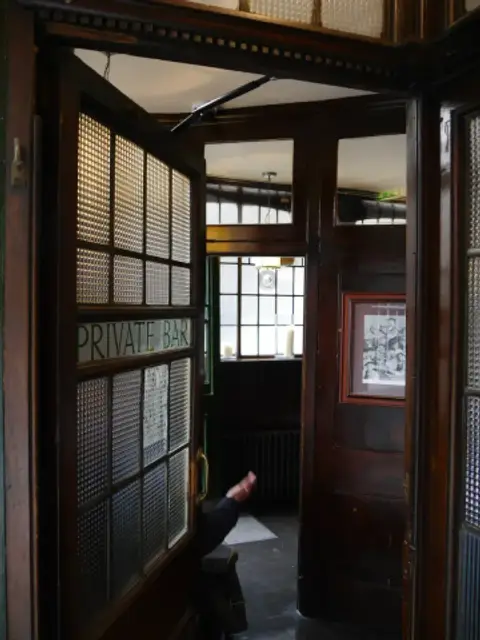
A Victorian corner local near Smithfield Market, the Hand & Shears keeps its old multi-room layout with separate doors into small bars around a central servery. Its name recalls Bartholomew Fair, opened when the Lord Mayor cut cloth with shears. The claimed 1532 origin is tradition, but the interior is a treasured survivor.
Claims 1532; no early record found; building c.1896.
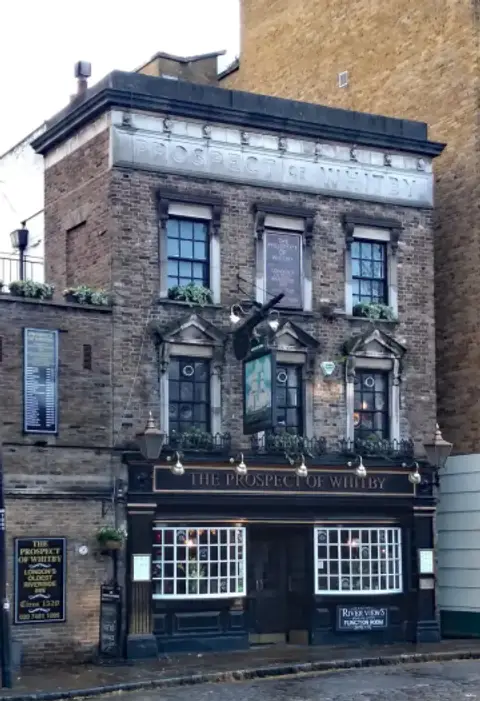
Perched on the Thames at Wapping, the Prospect of Whitby markets itself as London's oldest riverside tavern. The 1520 date is unproven and the building is Georgian and Victorian, yet the atmosphere is irresistible: flagstones, a pewter-topped bar and a terrace facing the river near the old execution site described by John Stow.
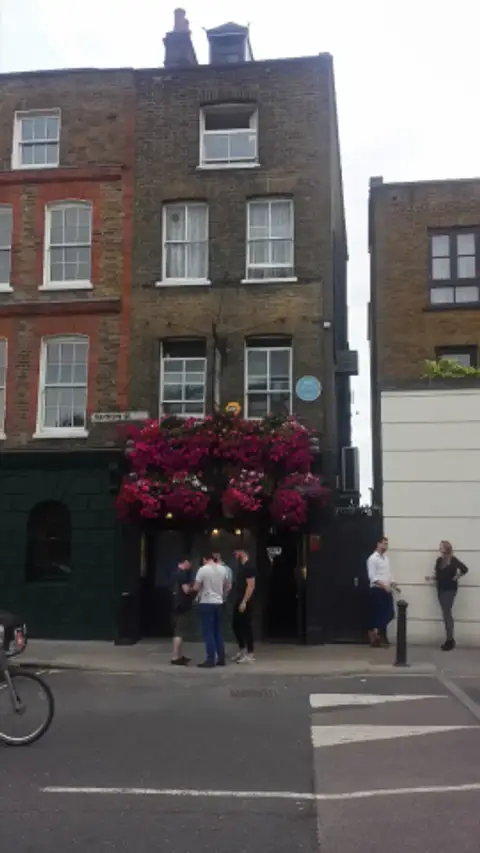
A slim Georgian pub on Narrow Street with its back to the Thames, the Grapes claims an ancestry going back to 1583. Dickens knew it and is thought to have drawn on it for the riverside tavern in Our Mutual Friend. Co-owned by Sir Ian McKellen, it keeps a Gandalf staff behind the bar and a tiny river terrace.
Claims 1583; first recorded 1805.
The photographs above are other people's work, used under open licences. Every photographer, licence and source page is named in the image credits.
Almost every stop on this walk is approached sideways, and that is a survival rather than a
quirk. Historic England’s entry for the George Inn describes an
inn once ranged around a quadrangle, of which the galleried south range is all that is left: the
north range went in 1874 and two more wings in 1889, when the railway wanted the ground for
warehousing. The yard you stand in is the working part of a coaching inn with the buildings
taken off three of its sides.
The middle of the route is the City rebuilding itself twice over.
Ye Olde Cheshire Cheese went up around 1667 in the wake
of the Great Fire, and the oldest thing its listing names is the late seventeenth-century vaulted
cellar under the small courtyard. Ye Olde Mitre belongs to the
clearance of the Bishop of Ely’s estate after the Crown took it in 1772. The
Hand & Shears at Smithfield is a mid-nineteenth-century corner house
whose 1896 fitting-out kept separate doors into small bars around a central servery — the thing
to look at there, more than the date over the door.
Then the walk leaves the street pattern altogether and goes to the water, where the buildings are
Georgian and later however the signs read, and where each house is arranged around a terrace or a
veranda over the water rather than around its street door. The full argument over which of them is oldest is in
what is London’s oldest pub, really.