The Melbourne historic pub walk is a self-guided route of 1.1 km between 3 old pubs, about 13 min walking, with a GPX file to follow. Duke of Wellington Hotel makes the oldest claim on it, 1853, and it holds the oldest record too, from 1853.
Distances are walking estimates, 1.3 × the straight line at 5 km/h. These are history walks, not a drinking challenge: take it slowly, drink water between stops, and leave a pub out if the day is getting long.
Melbourne’s oldest pubs. Two corners on Flinders Street and a laneway off Collins. The three houses on this walk hold licences of 1853, 1861 and 1868, granted within a few minutes' walk of one another inside the city grid, and not one of them now looks the way it looked when it was licensed. That gap is what makes them worth walking between.
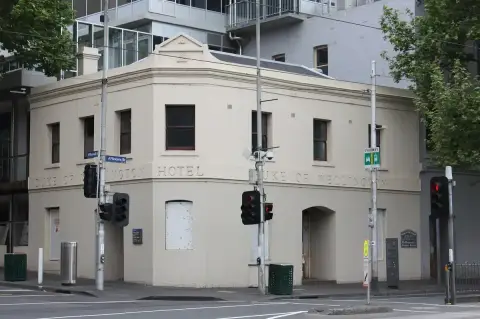
On the corner of Flinders and Russell streets, the Duke was built in 1850 and run as a boarding house until Richard Dalton took the licence in 1853 — the longest-running hotel licence in Melbourne, in Heritage Victoria's words. After a long redevelopment closure it reopened in 2013 over three levels: a traditional public bar, a dining room, a cocktail bar and a rooftop looking toward Federation Square.
1853 with no published claimant; first recorded 1853; building c.1850.
1-7 Swanston Street at Flinders Street, Melbourne VIC 3000
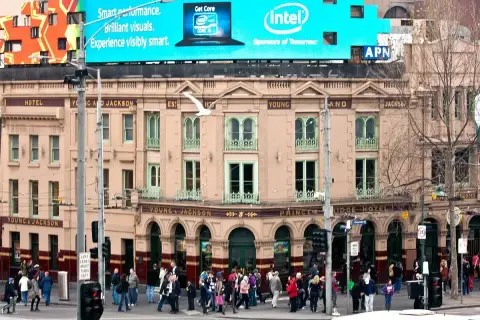
Melbourne's most famous corner pub faces Flinders Street Station and has poured beer since opening as the Princes Bridge Hotel in 1861. Upstairs hangs Chloe, Jules Lefebvre's life-size 1875 nude, bought in 1908 and damaged by a thrown beer in 1943. The heritage building now holds several bars, a dining room and a rooftop.
Claims 1861; first recorded 1861; building c.1853.
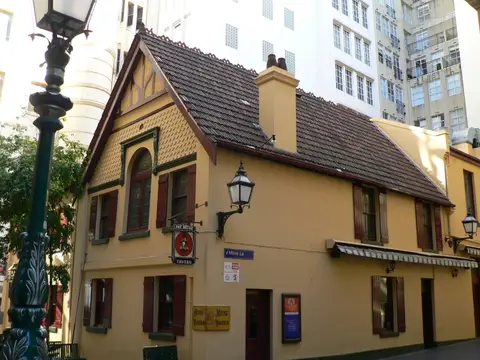
Down a narrow laneway off Collins Street, the Mitre occupies what the city counts as one of Melbourne's oldest buildings, a colonial house turned tavern in 1868. Low doorways, a Queen Anne remodel and a leafy beer garden give it an English feel. Early-twentieth-century artists made it a bohemian haunt, and upstairs there's a steakhouse.
Claims 1868; first recorded 1868.
The photographs above are other people's work, used under open licences, or in the public domain. Every photographer, licence and source page is named in the image credits.
These three are an exercise in reading alterations, and the Victorian Heritage Register supplies
the dates for all of them. The Duke of Wellington is
a two-storey rendered stone corner of 1850, designed by the architect Richard Dalton for the
carpenter Timothy Lane and added to in 1857 and 1904; its original pilasters and rusticated
banding were taken off or rendered over in 1969, and the later additions were demolished around
2004.
Young and Jackson is five buildings pretending to be
one. The bluestone corner of 1853 was built as a three-storey residence with a butcher’s shop
underneath; a shop to the north and two early bluestone stores to the west were absorbed over the
years; and in 1921 the hotel architect Richard B Whittaker united the frontages and added the red
glazed tile dado to fight the grime at street level. The outsized signs have been there since the
1920s.
The Mitre Tavern is probably the oldest fabric of the three, on
the register’s reading, and the most thoroughly dressed up: brick and render on a bluestone base that probably predates 1850, given its faintly
medieval look in the early twentieth century with shutters, Marseille terracotta tiles and
half-timbered gable ends, and largely stripped out inside in 1971. The city’s licence dates are
compared at the oldest pubs in Melbourne, and the state’s
earlier claims are at the oldest pubs in Victoria.