The Amsterdam historic pub walk is a self-guided route of 6 km between 7 old pubs, about 1 h 12 min walking, with a GPX file to follow. Café De Druif makes the oldest claim on it, 1585; the oldest record on the walk belongs to De Drie Fleschjes, from 1618.
Distances are walking estimates, 1.3 × the straight line at 5 km/h. These are history walks, not a drinking challenge: take it slowly, drink water between stops, and leave a pub out if the day is getting long.
Amsterdam’s oldest brown cafés. Seven rooms across the middle of Amsterdam, from a quiet square in the old Eastern Islands to the Spui, taking in two distillers' tasting rooms and five neighbourhood cafés on the way. The bars keep their dates on their signs and the houses keep theirs in their gables, and on this walk it is the gables that can be checked.
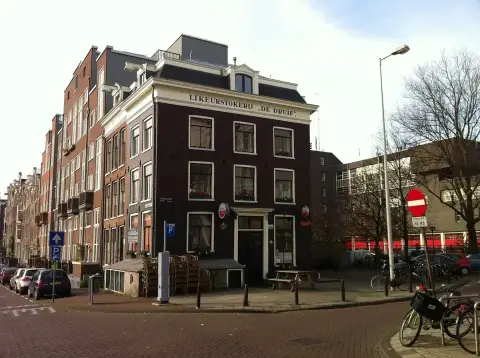
On a quiet harbourside square in the old Eastern Islands district, De Druif (The Grape) has long claimed 1585 and the patronage of the 17th-century admiral Piet Hein. Archive research dates the bar to 1863 instead, but its old counter, jenever bottles and neighbourhood regulars still make it one of Amsterdam's most characterful brown cafés.
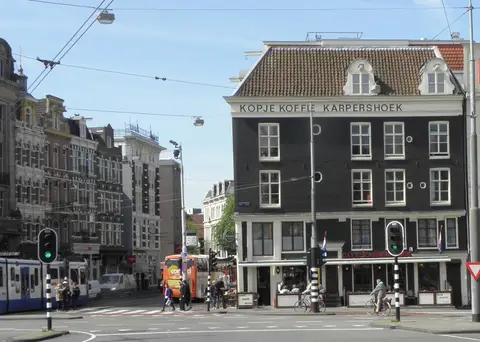
A short walk from Centraal Station, the Karpershoek has served sailors, travellers and commuters since at least 1641, when an inn called De Oldenburger Kelder was recorded on this spot. Dark panelling and big windows onto the Martelaarsgracht keep the mood of an old harbour tavern, and it still claims a founding date of 1606.
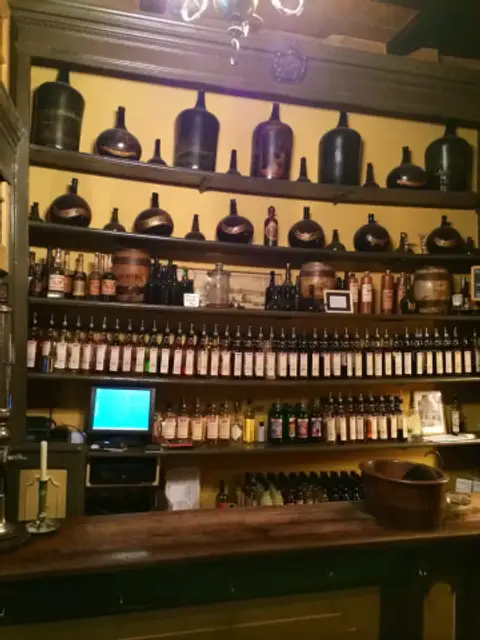
Down a narrow alley behind the Dam, this 17th-century distillery tasting room serves genevers and liqueurs made on the premises, poured to the brim so the first sip must be taken bent over the counter. The distillery dates from 1679; Wynand Fockink took it over in 1724, and the old copper stills still run behind the bar.
Claims 1679; first recorded 1860; building c.1679.
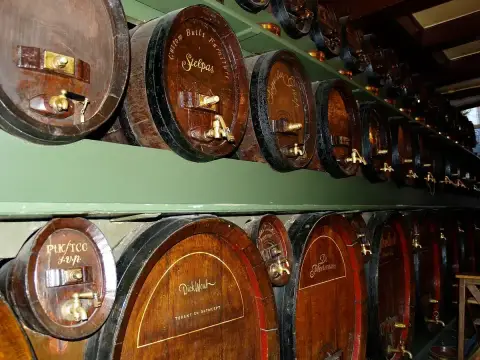
Squeezed behind the Nieuwe Kerk, this tiny jenever tasting room has no seats worth mentioning: drinkers stand at the counter and bow to sip brimming tulip glasses. Barrels line the walls, some with regulars' private casks. Archival research traced a drinking house on the spot to 1618, making it the strongest candidate for Amsterdam's oldest bar.
Claims 1650; first recorded 1618; building c.1888.
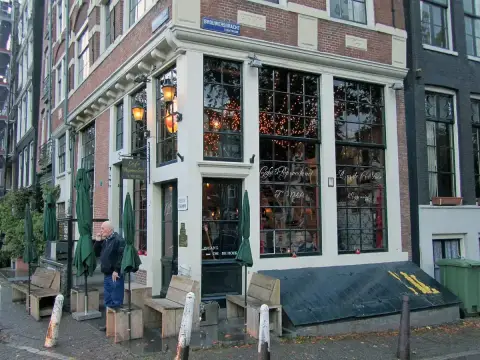
On the corner where the Brouwersgracht meets the Prinsengracht, this 1642 house is one of the Jordaan's most photographed brown cafés. Delft tiles, a potbelly stove and a cellar said to hold the entrance of a tunnel to a hidden Catholic church give it character; the homemade apple pie drew Bill Clinton in 2011.
Claims 1642; first recorded 1896; building c.1641.
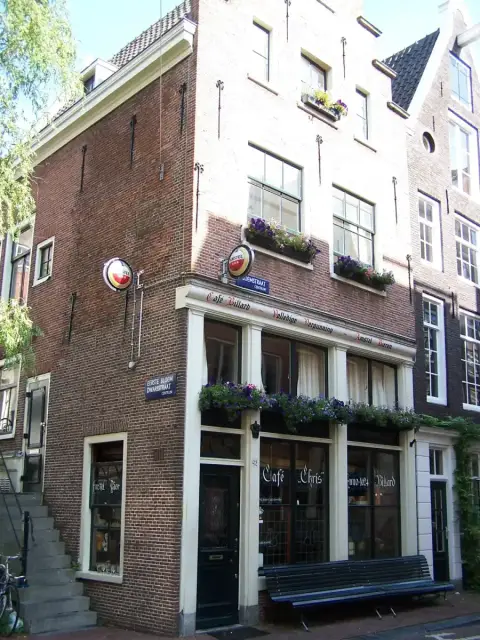
A cosy Jordaan corner bar with a good story: that the builders of the nearby Westerkerk collected their wages here in 1624. Historians have found no trace of a bar at the address before 1882, but Chris remains a genuinely old-fashioned neighbourhood brown café, known for its toilet that is flushed from outside the cubicle.
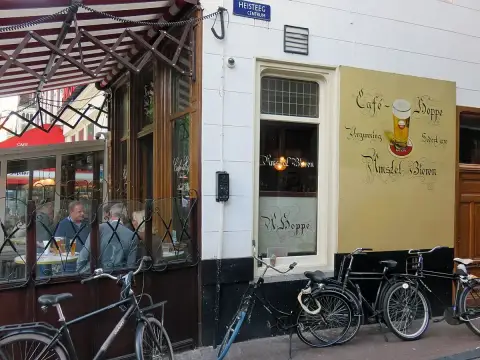
A fixture of the Spui since, it says, 1670, Hoppe is one of Amsterdam's best-known brown cafés, with a narrow standing bar in the old house at number 18 and a later seated room next door. Writers, students and office workers have all claimed it over the years, and on summer evenings the crowd spills out onto the square.
Claims 1670; no early record found.
The photographs above are other people's work, used under open licences. Every photographer, licence and source page is named in the image credits.
The Dutch national monuments register gives this walk something no pub sign on it can: dates that
somebody checked. Wynand Fockink stands at
Pijlsteeg 31, entered as Rijksmonument 4746 — a house with a bell gable of 1689 under a
nineteenth-century cornice, with a timber shopfront and an eighteenth-century shop interior.
Café ’t Papeneiland is Rijksmonument 718, a corner house
with stepped gables to street and side, decorated with heavy arched blocks and dated 1641. The
Papeneiland gable is a single year off the date its café gives itself; the Fockink gable is ten
years later than the distillery’s founding year of 1679, which is still closer than most claims in
this city come.
Café Hoppe is two houses rather than one, and the register lists
them separately: Spui 18, a seventeenth-century corner whose front was given a straight cornice in
the earlier nineteenth century, and Spui 20, a bell gable of the third quarter of the eighteenth
century. The narrow standing bar is in the older of the two.
So the thing to do on this walk is look up. Three of the seven stops stand in houses the register
has dated — four buildings between them — and each of those dates can be read against what the bar
says about itself. Where the two disagree here, it is the bar’s year that has nothing behind it. The exception is De Drie Fleschjes, where the
building is an 1888 replacement and the drinking is the old part: archive research found a
drinking house on that spot in 1618, under the name Het Sufflet. The rest of the city’s claims are
sorted out at the oldest bars in Amsterdam.