The Oxford historic pub walk is a self-guided route of 1 km between 3 old pubs, about 13 min walking, with a GPX file to follow. The Bear Inn makes the oldest claim on it, 1242; the oldest record on the walk belongs to The Chequers, from 1605.
Distances are walking estimates, 1.3 × the straight line at 5 km/h. These are history walks, not a drinking challenge: take it slowly, drink water between stops, and leave a pub out if the day is getting long.
Oxford’s oldest taverns. Three small rooms in the middle of the colleges: a corner house on a side street between Christ Church and Oriel, a bar built against the medieval city wall and reached by two alleys, and a tavern down a passage off the High Street. The walking is negligible. Finding the entrances is the walk.
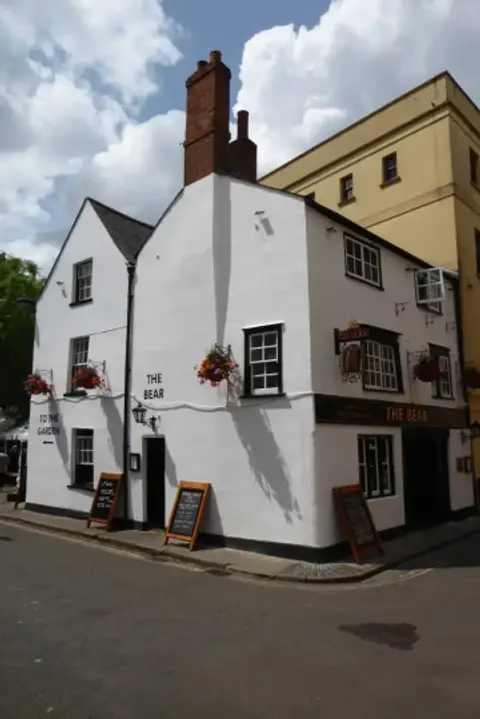
Tiny, timber-framed and hung with thousands of snipped-off neckties, the Bear sits on a corner between Christ Church and Oriel. Its 'since 1242' boast borrows the history of a lost medieval inn nearby, but the little rooms are genuinely old. A heated garden adds space, and the pub turns up in Colin Dexter's Morse novels.
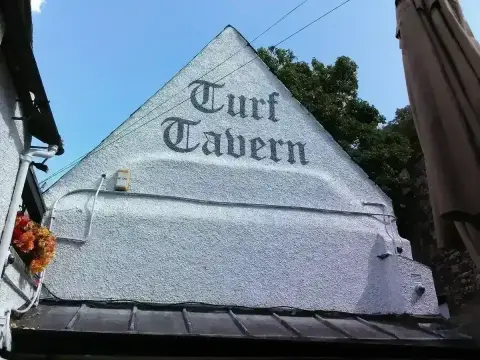
Reached through twisting alleys beneath New College's walls, the Turf is Oxford's best-loved hidden pub: a cluster of low-ceilinged rooms and courtyards backing onto a stretch of the medieval city wall. Its claimed 1381 origin is unproven, but generations of students, authors and future prime ministers have squeezed in for a pint.
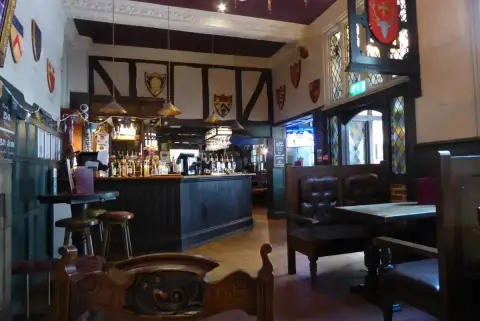
Down a narrow alley from Oxford's High Street, the Chequers opens into a tall, beamed and panelled interior that its owners date to a 16th-century rebuilding of a medieval moneylender's house. The chequerboard sign recalls the money-changers once based here, and in the 17th century curious animals and new inventions were put on show for paying visitors.
Claims 1500; first recorded 1605.
The photographs above are other people's work, used under open licences. Every photographer, licence and source page is named in the image credits.
Oxford’s colleges took the street frontages, and its old drinking went into the gaps. That is the
plainest thing this walk shows, and one of the stops says it outright: Oxford History’s survey of
the city wall has the Turf Tavern erected just outside the wall in
the eighteenth century, when land inside was scarce. A pub that cannot get a frontage builds
where there is room, and the room was a yard against the medieval defences reached by two alleys.
The Chequers is the same arrangement a few centuries earlier. Its
house stood in the fifteenth century as a moneylender’s — the chequerboard being the old sign of
the money-changing trade — was bought by All Souls College in 1466, and was rebuilt about 1500 as
a tavern by Alderman Richard Kent, who gave it the name Kent’s Hall. From the High Street you see
a passage; inside, it opens tall, beamed and panelled.
The Bear is the smallest of the three and the only one on a corner,
on Alfred Street between Christ Church and Oriel, with more than 4,500 snipped-off tie ends in
cases on its walls, a collection begun in 1952. What it does not have is the history its sign
advertises, which belonged to a larger inn on the High Street that closed in 1801. The three are
compared at the oldest pubs in Oxford.