
The claim
London has more old-pub claims per square mile than anywhere in Britain, and they are unusually specific: 1430 at Holborn, 1520 at Wapping, 1538 on Fleet Street, 1546 in Ely Court, 1550 at Rotherhithe, 1593 in Whitechapel, 1602 in Holborn. Any of them, if true, would make that pub one of the oldest drinking houses in the country.
Historic England went through them in 2025 and found that almost every date is later than the sign claims, and that several of the buildings were not pubs at the time the sign says they were. This is not a scandal — London burned in 1666, was rebuilt, bombed, rebuilt again and redeveloped throughout — but it does mean the answer is not the pub most visitors are sent to.
What the records show
| Pub | Claims | What the record shows |
|---|---|---|
| Cittie of Yorke, Holborn | 1430 | present building rebuilt 1923–24 over seventeenth-century cellars |
| Prospect of Whitby, Wapping | c. 1520 | the 1520 date first appears in the 1950s; building is eighteenth and nineteenth century |
| Ye Olde Cheshire Cheese, Fleet Street | 1538 | first reference is a broadside ballad of 1680; building rebuilt c. 1667 |
| The George Inn, Southwark | inn by c. 1542 | map of c. 1542 records an inn here; surviving range rebuilt 1677 |
| Ye Olde Mitre, Ely Court | 1546 | established in the 1770s, after the Bishop of Ely’s estate was taken in 1772 |
| The Mayflower, Rotherhithe | c. 1550 | earliest fabric of the 1780s; rebuilt in the late 1950s after war damage |
| Hoop and Grapes, Whitechapel | 1593 | building probably late seventeenth century; converted to a pub in 1920 |
| The Seven Stars, Holborn | 1602 | probably built in the 1680s |
Two of those deserve a closer look, because they are the ones people argue about.
Ye Olde Cheshire Cheese puts 1538 on its lamp. Historic England finds no evidence for it. The earliest reference to a Cheshire Cheese on Fleet Street is a broadside ballad printed in 1680 called A New Ballad of the Midwives Ghost — which is charming evidence, and firm evidence, and 142 years after the claim. The building was put up around 1667, immediately after the Great Fire, which fits 1680 and does not fit 1538. Its vaulted cellars are traditionally said to belong to a thirteenth-century Carmelite house on the site; that attribution has never been documented. None of which spoils the pub, whose fire-lit warren of panelled rooms is one of the best interiors in the City, on CAMRA’s national inventory, and where a swearing African grey called Polly held court for around forty years until her death in 1926 drew obituaries in some two hundred newspapers.
The Prospect of Whitby advertises itself as London’s oldest riverside tavern, from about 1520. Historic England notes that references to a 1520 foundation do not appear until the 1950s and “may have been related to a marketing campaign rather than historical research”. The building is Georgian and Victorian. It is also, still, a magnificent place to stand: pewter-topped bar, worn stone flags, and a terrace over the Thames at Wapping Wall.
The pub with the strongest claim
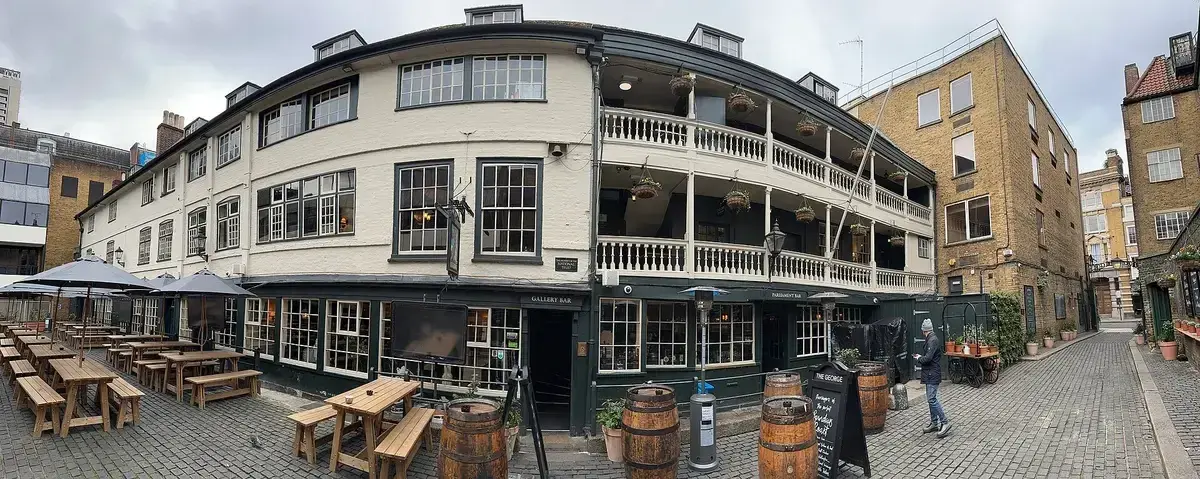
Historic England’s answer is the George Inn in a cobbled yard off Borough High Street, and the reasoning is worth following, because it turns on two things at once rather than one.
First, the document. A map of Southwark made around 1542 records an inn on this site — the earliest known reference to any of the London contenders, and a real cartographic record rather than a repeated date. Southwark was the coaching suburb at the London end of the road from Kent and the coast, and it was thick with inns; the George stood next door to the Tabard, where Chaucer began the Canterbury Tales.
Second, the fabric. The great Southwark fire of 1676 destroyed most of the borough, and the George was rebuilt in 1677. What went up then is still there: a timber-framed range with two tiers of open wooden galleries facing the yard, the last galleried coaching inn in London. Two of the other three sides were pulled down in 1889 when the railway wanted warehousing, which is why the courtyard now feels open on one side. Inside, the Parliament Bar keeps some of the oldest woodwork purpose-fitted for a pub anywhere, and a Parliament clock survives from 1797, from the year a tax on timepieces sent people to read the time in pubs instead.
It is the only one of the famous London claimants whose historic pub fabric has survived to the present day, which is why Historic England gives it the best claim. It has been owned by the National Trust since 1937, leased to a brewer, and is the only purpose-built pub in London listed at Grade I.
So what is London’s oldest pub?
On evidence rather than signage: the George Inn, Southwark — an inn on record by about 1542, in a building of 1677. That is the only London answer that survives both tests.
If you prefer the oldest continuously documented trade rather than the oldest building, the Cheshire Cheese runs it close from 1680, and does so in a building of 1667. If you want the oldest claim, the Cittie of Yorke’s 1430 wins and proves nothing.
None of this makes the others frauds. It makes them pubs that were reinvented, in a city that reinvents everything, and then had a date attached in an era when antiquity sold beer. We set out how we grade the difference in our methodology; the full field is on our page for London’s oldest pubs, which is also a good way to plan the London oldest pubs walk; and you can see how they place against the rest of the world in the top 100 oldest pubs.
Sources
Found something wrong?Suggest a correction