3 pubs checked · updated 18 September 2026
The oldest pub in Peru
By claim the earliest Peruvian date on this list is 1880, at the Antigua Taberna Queirolo in Pueblo Libre — but the year dates a pulpería, and the house's own history says the corner came to be only the taberna over the years that followed, without naming one. By record there is nothing: no Peruvian house here has a document, the Bar Cordano's 1905 dates a bazaar rather than a bar, and Piano Bar Múnich has no founding year at all, only a room that was serving drink by the 1950s.
Peru's three houses are all in Lima, all founded by immigrants, and all of them began as something other than a bar — which is the single most useful thing to know before weighing any date on this page. Two were opened by Genoese families. Santiago Queirolo Raggio reached Lima from Genoa about 1877 and opened a pulpería, a grocery selling wine, preserves and provisions to the estates around Magdalena Vieja, on a corner where the family also kept a wine and pisco cellar a few doors along; Vigilio Botano and the brothers Luis and Antonio Cordano opened a bazaar by the old Desamparados station on 13 January 1905, which became a salón-restaurante later. The third was a counter kept by a Swiss-German couple where sausage and chips were sold as the Piqueo Múnich, and Peru traces the salchipapa to it. In each case the founding year records a shop, and nobody publishes the year the shop became a bar. Nor is there a register to ask. Peru declares cultural heritage — the Cordano's premises were designated in 1989 — but the designation protects rooms rather than dating trade, so every year here arrives through a house's own history, the Spanish encyclopaedia or the Lima press, and every grade is C.
A corner in Pueblo Libre, a bar by the station and a room on Quilca
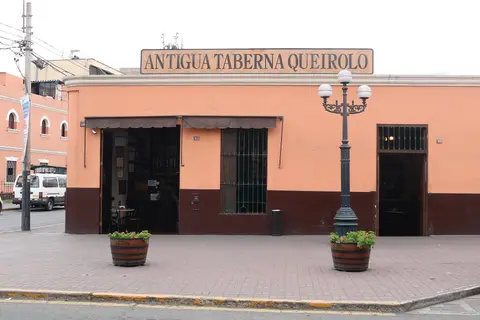
Antigua Taberna Queirolo stands on the corner of Avenida San Martín and
General Vivanco, in a house put up in the European manner in the middle of the 1870s and still standing. Wine and
pisco are poured at the counter with chicharrón and escabeche beside them, and the room keeps one of Peru’s first
telephones, a phonograph and an old till. The family’s vineyards moved south to Cañete in 1963.
Bar Cordano is the one in the old centre, on Jirón Áncash opposite the former
Desamparados railway station: adobe walls, worn granite underfoot, three rooms, and a business owned by the people
who work in it since 1978. Piano Bar Múnich is on Jirón Quilca and is the least
documented and the most affectionately written about — a bar with a piano played live in it, which El Comercio
reported in September 2020 was refusing to close during the pandemic and sending its food out instead.
Three houses, no paperwork
This site grades on what can be read, and in Peru almost nothing can. The Queirolo’s account of itself is detailed
and internally consistent, which is worth something and is not a document; Spanish Wikipedia’s article on the
district repeats the same year and the same pulpería. The Cordano has an encyclopaedia entry, a heritage
designation of 1989 and a founding date of 13 January 1905 that the sources themselves attach to a bazaar. The
Múnich has no year at all, and is placed in the 1950s only because a famous dish is traced to its counter. The
correct response to that is not to guess: two of the three carry the open question on their own pages, and the
grades stay at C. How a claim is weighed against a record here is set out in the methodology, and
why a shop that later poured is treated differently from a house built to pour in
inn, tavern or alehouse.
What the press has to do instead of a register
Peru keeps no searchable licensing record this research can reach, so the question of whether a bar is still open
has to be answered by reporting. Infobae’s survey of the historic bars of central Lima, published on 16 January
2025 under the heading of the classics still alive, is the most recent thing anybody has written about two of these
three houses, and it is where their status comes from. Twenty months is a long time in the life of a bar, and both
rows say plainly that the trade is believed rather than confirmed. That is a weaker position than a British pub
with a food-hygiene inspection date on it, and pretending otherwise would be the easy thing to do.
Where Peru sits in the wider list
Three houses, one city, and none of them older than the 1880s — this is a first pass at a country with four
centuries of colonial drinking behind it. Arequipa, Cusco, Trujillo and the picanterías of the south are entirely
unworked here, and so is every Lima house that has closed. For the nearest comparison, another Pacific country
whose old bars grew out of groceries and confectioners’ shops, see the oldest pubs in Chile;
for the city that protects its old rooms by law, Argentina. The full international
ranking is at the top 100 oldest pubs.