Says 1864. No document from that date has been found.
Grade B · Building dated
By claim, the oldest bar in Argentina on this list is Bar El Federal in San Telmo, which the Buenos Aires press dates to 1864, when it opened as a neighbourhood almacén selling groceries, wine and vermouth over the same counter. By evidence there is no winner: none of the three houses here has produced a licence, a deed or a directory entry, and the city's protection of them is a judgement about rooms and memory rather than a dating of them.
Argentina's entries here are all in Buenos Aires, all from the second half of the nineteenth century or later, and all three are on the city's official register of bares notables. That register is the reason the houses are still standing: the city legislature created it by its Law 35 of 1998, and it now names more than eighty cafés, bars, billiard halls and confiterías whose age, architecture or place in the city's life earns them protection. What it does not do is date them, which is why every Argentine grade on this site is C. The porteño drinking house came out of the pulpería and the almacén, the grocery with a counter where wine and vermouth were sold by the glass, and two of our three began that way on San Telmo corners before the wooden fronts and the tiled floors arrived. The third is a billiard hall on Avenida de Mayo, opened as that avenue was being cut through the old town. The register is wider than our list: it counts coffee houses and confiterías too, and the Spanish Wikipedia article on it names two older than anything here — La Biela, dated 1850, and the Café Tortoni of 1858. Ours takes houses where a drink is served at a counter without a meal.
From the almacén to the bar notable
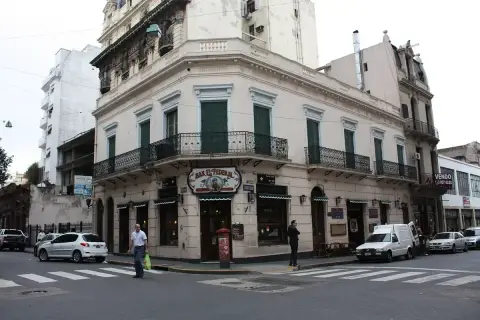
Bar El Federal and Bar Británico stand a
few blocks apart in San Telmo and tell the same story from different ends. El Federal opened in 1864 as a grocery
that poured wine, and kept its counter when the groceries went; it was declared a Sitio de Interés Cultural in 2004
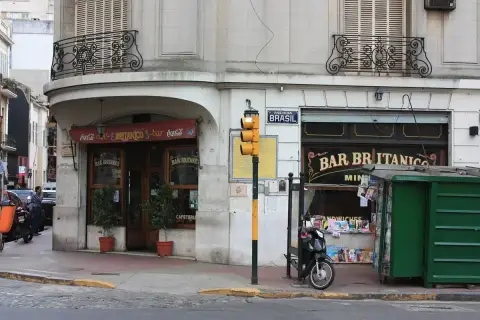
and its early twentieth-century fittings are the ones you see. The Británico took its name in 1928, on a corner
that had earlier been the pulpería La Cosechera, and has twice come close to going: evicted in 2006, reopened in
2007, shut again and reopened in 2014. Both are the kind of room the 1998 law was written for, and both were saved
by people who noticed in time.
The billiard hall on Avenida de Mayo
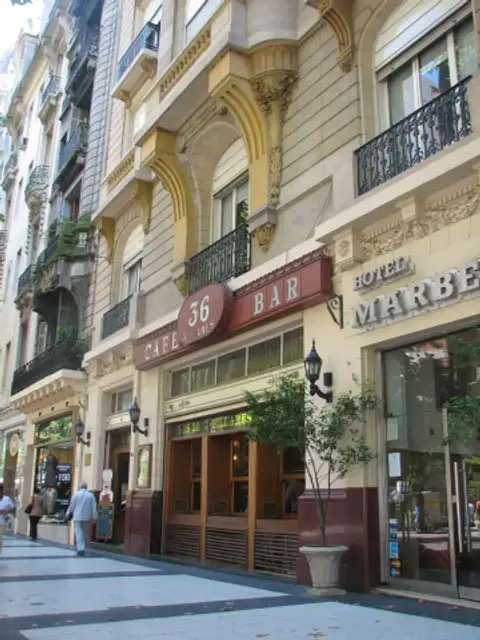
Los 36 Billares is the outlier and the busiest. It dates itself to 1894, when
Avenida de Mayo was still being cut through Monserrat, and it has been a billiard hall for as long as anyone can
show — eight tables more than a century old, restored in 2014, and nine newer pool tables beside them. A pizza
chain bought the business in 2013 and the room reopened the following year after a restoration that won a city
prize for work in the historic quarter, which is a happier ending than most bars in this position get. It is also
the clearest case in Argentina of a house whose claim is older than its walls: the block it trades in was built in
1914 for an insurance company and now holds a hotel as well.
Where Argentina sits in the wider list
Three houses is a thin showing for a country with this much café life, and the gap is ours rather than the
country’s: the paperwork that would date a porteño counter — municipal licences, the almacén registers — is not
online in the way British and Australian records are, and Buenos Aires is not the only Argentine city with old
rooms in it. For the nearest comparison, the cantina as a civic institution, see
the oldest bars in Mexico. For how we weigh a claim against a record, read the
methodology, and the full international ranking is at
the top 100 oldest pubs.
The 1864 is the Buenos Aires press's, not the bar's, which publishes nothing a reader can open. La Nación writes that El Federal was born as a pulpería in 1864 on two dirt streets at the corner of Perú and Carlos Calvo, and Perfil, marking 160 years in 2024, has it opening that year and passing from pulpería to almacén de ramos generales before settling into the bar it is now. A pulpería sold drink across a counter
The 1894 is the house's own, printed at the head of the counter menu it publishes, which calls itself a pizzeria and a bar notable and puts the opening in the year Avenida de Mayo was being cut through the old town. The city's tourism service gives the same year, and the Spanish Wikipedia article credits Horacio Spinetto's Cafes de Buenos Aires, published by the city's heritage directorate in 2008. None of the three
Claims 1894; no early record found; building c.1914.
The 1928 is the city of Buenos Aires's: its guide to the notable bars says the Británico opened its doors in 1928, on the ground floor of a five-storey building, and that the corner had earlier been the pulpería La Cosechera. Trading has been interrupted: evicted June 2006, reopened February 2007, closed August 2014 and reopened November 2014. Status after that was not re-verified.
Locally dated 1928; no early record found.
The photographs above are other people's work, used under open licences. Every photographer, licence and source page is named in the image credits.
Common questions
Which is the oldest bar in Buenos Aires?
On the claims we can trace, Bar El Federal, which the press dates to 1864 as an almacén at Carlos Calvo and Perú. Two older houses on the city's register are coffee houses and not on this list, La Biela of 1850 and the Café Tortoni of 1858. No Argentine date here rests on a document we have read.
What is a bar notable?
A house protected by the City of Buenos Aires under its Law 35 of 1998, which set up a commission to name bars, billiard halls and confiterías whose age, architectural design or local importance gives them a value of their own. More than eighty hold the designation, and the city's cultural register lists each with its trade and address.
Why is every Argentine pub on this site graded C?
Because in each case the year comes from the house, the press or a city publication rather than a record. We found no licence, deed or directory entry for 1864, 1894 or 1928, and in one case the building is younger than the claim: Los 36 Billares says 1894, and the block it occupies went up in 1914.
Is Los 36 Billares still a bar if it sells pizza?
Yes, on the test this site uses: the counter menu it publishes runs from coffee through wine by the glass to beer and fernet with coke, none of it tied to a table, and the city's own register classes the house as a bar. The billiard tables, eight of them over a century old, are the reason most people go.