The South Devon historic pub walk is a self-guided route of 9.99 km between 3 old pubs, about 2 h 13 min walking, with a GPX file to follow. The Church House Inn makes the oldest claim on it, 1028, and no stop on the walk yet has a document from at or near the date it claims.
The distance is the walked street route, not the straight line. These are history walks, not a drinking challenge: take it slowly, drink water between stops, and leave a pub out if the day is getting long.
Two church houses and a thatched longhouse, Rattery to Dartington. The only walk here that is not a town walk, and the only one where the parish is the reason two of the buildings exist. Rattery and Harberton were both put up beside their churchyards so that the parish could brew and sell ale, and the national register says so in both entries; the Cott is a thatched longhouse on the old packhorse road to Totnes, and its medieval date is the one the register refuses outright. Loudest claim first, then the only one that holds, then that refusal.
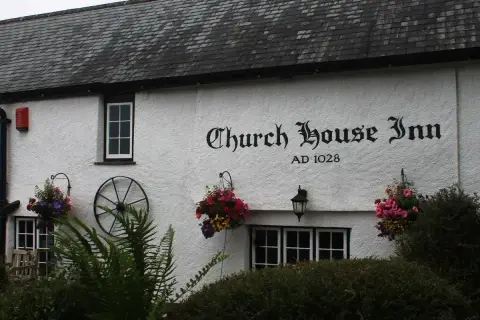
Beside the church in a hilltop hamlet above the Dart valley, this former church house is one of several Devon inns claiming Saxon-era beginnings, here around 1028. The present building is Tudor, with old stone fireplaces, ancient timber partitions and an opened-up bar. Local ales and cider from a mile away keep the village well served.
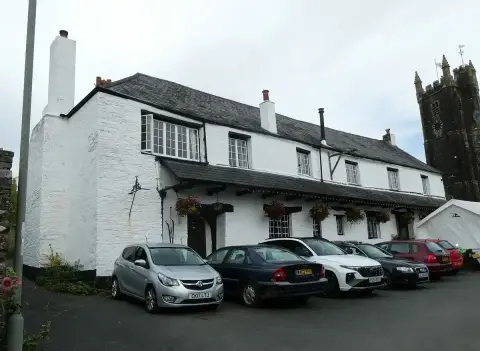
Tucked beside the church in a village near Totnes, this Tudor church house is said to have lodged the masons who built the church next door. It keeps a fine oak plank-and-muntin screen and old settles, though the bar counter came from a bank in 1985. It is a community local with cask ale, cider and monthly live music.
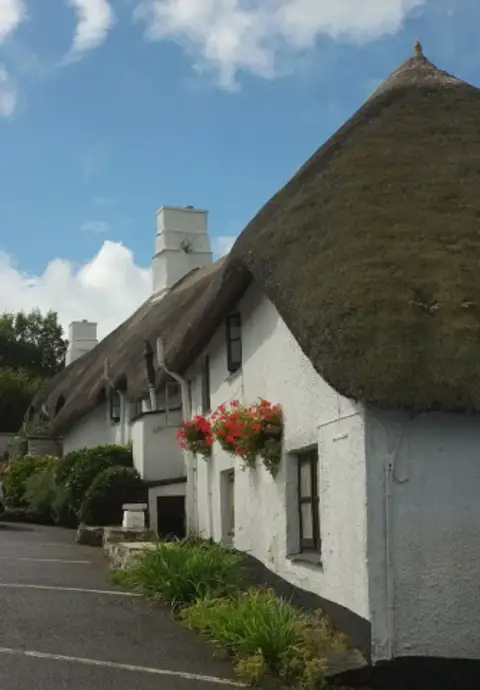
Under what is claimed to be one of Britain's longest thatched roofs, the Cott Inn has welcomed travellers on the old packhorse road to Totnes since, it says, about 1320. The cob-walled longhouse keeps rough-hewn beams and inglenooks. Named Great British Pub of the Year in 2019, it balances village local, dining pub and bedrooms.
Two of these three buildings were not built as pubs and were built for drinking, which is a
distinction worth keeping hold of. Historic England records the type in its own words here: Rattery
and Harberton are both entered as public houses, originally the church house, both at Grade II*, and
both were listed on the same day, 9 February 1961. What a church house was for is set out in
a short history of the British pub. A fourth survives at
Stoke Gabriel, too far east to join this route on foot.
The Church House Inn at Rattery carries AD 1028 painted in
black on its front, a year traditionally tied to the monks or masons who built St Mary’s next door.
The register is long on this building and silent on that century: a rectangular plan of eight bays, a
stair turret at the south-west corner with slate treads cut into the newel, seven axial beams every
one of them with step stops, and nine roof trusses with cranked feet and morticed apices over three
intact tiers of threaded purlins. All of it sixteenth-century. The painted year stands five hundred
years beyond anything an inspector has found in the walls, which is why the grade is C.
The Church House Inn at Harberton claims the least of the
three and is the only one the record agrees with. Its entry dates the house circa mid to late
sixteenth century, the century the house claims, and describes a four-light moulded window frame of
that date in the front, with four-centred arched heads and roundels in the spandrels and a doorway
later cut through two of its lights. Eleven roof trusses, probably raised crucks. A screen whose butt
stops sit high up where a bench has been taken away. A church house was built for the parish’s ales,
so drinking here is plausible from the start; nothing traced records it, and the twelfth- and
thirteenth-century origins that circulate have nothing behind them. That is grade B.
The Cott Inn ends the walk under its thatch, and its c. 1320 with
the story of the merchant Johannes Cott is the date the surveyor declines. Entry 1291403, listed on
11 November 1952, reads the house as early seventeenth century or of earlier origins, remodelled later
that century and extended at both ends in the eighteenth to make the long range a walker sees from the
lane. The plan is three rooms and a through passage, and the bar went into the middle room in the
twentieth century. The entry then weighs whether that middle room was once an open hall and finds no
evidence for one — while the list’s own index of monument types files the building as an open hall
house. Nothing in it reaches 1320.
Three buildings, three surveyors’ entries and not one document about drink: how a house is dated from
its joinery and its roof is in how historians date an old pub,
and the rest of the county is at the oldest pubs in Devon. For a walk
of much the same length on pavement the whole way, there is
London.