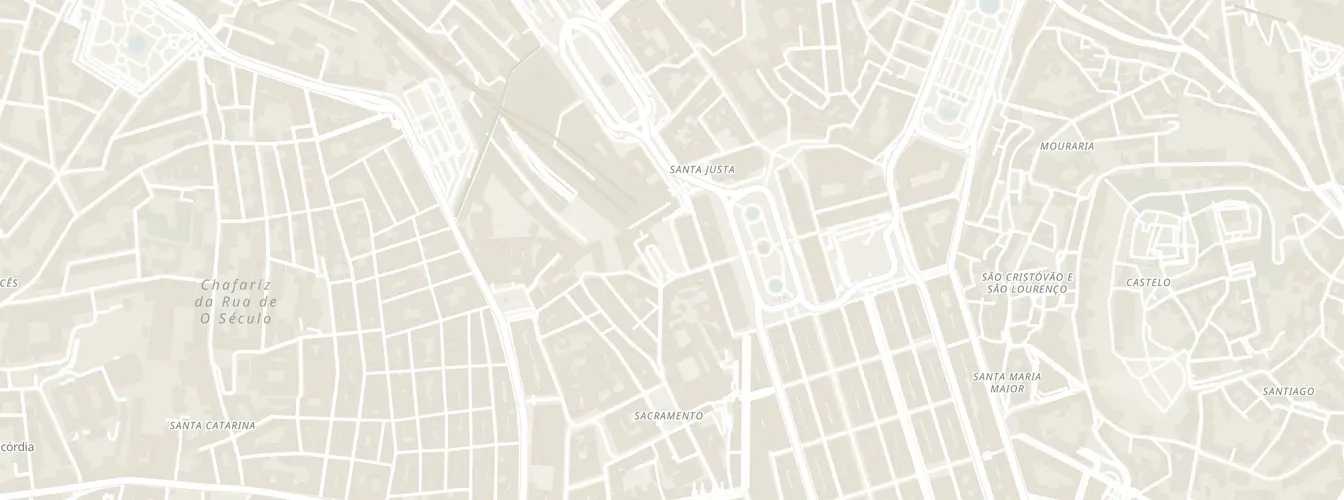
The Lisbon historic pub walk is a self-guided route of 0.66 km between 3 old pubs, about 9 min walking, with a GPX file to follow. Cervejaria Trindade makes the oldest claim on it, 1836, and no stop on the walk yet has a document from at or near the date it claims.
The distance is the walked street route, not the straight line. These are history walks, not a drinking challenge: take it slowly, drink water between stops, and leave a pub out if the day is getting long.
Lisbon in six hundred metres: a beer hall and two ginjinhas. Six hundred metres, which makes this the shortest walk on the site, and the shortness is the point: Lisbon's oldest surviving drinking is concentrated in three doorways within a few minutes of the Rossio. A beer hall in the refectory of a dissolved convent, and two counters that sell one liqueur and have nowhere to sit. Two of the three have no chairs at all, and the pavement is the room.
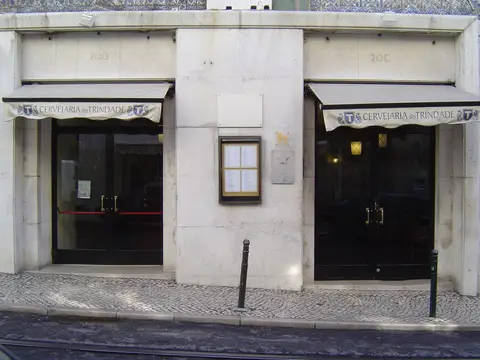
A beer hall of 1836 in the church, cloister and refectory of a Trinitarian convent closed when Portugal dissolved the religious orders. Manuel Moreira Garcia bought the ruins, brewed here from 1835 and opened the hall the year after, keeping the convent's tiles and adding painted panels of the seasons and the elements in 1863. Lisbon council placed the building in the city's heritage in 1986.
Largo de São Domingos 8, Santa Maria Maior, 1150 Lisbon
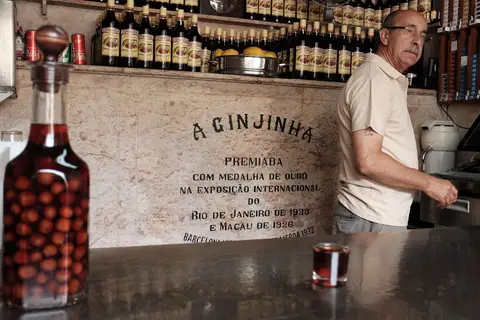
A single doorway on the square by São Domingos, open since 1840, selling one thing: ginja, the sour-cherry liqueur, poured at the counter into a small glass with or without a cherry in the bottom. There is nowhere to sit. Lisbon drinks it standing on the pavement outside, which is the custom the house says began here.
Rua das Portas de Santo Antão 7, Santa Maria Maior, Lisbon
A narrow doorway on Rua das Portas de Santo Antão with a counter and almost no room behind it, pouring ginja from eight in the morning until midnight. Drinkers take the small glass out to the pavement. The house makes its own Eduardino liqueur, named after a clown from the Coliseu next door, and supplies ginja to other Lisbon houses, including the Tendinha in the Rossio.
Three doorways, three completely different kinds of business, and one thing in common: none of them
can produce a document for its own founding year.
Cervejaria Trindade is the grandest and the strangest. The
Trinitarian convent on this site was closed when Portugal dissolved the religious orders in 1834;
Manuel Moreira Garcia bought the ruins in 1835, put a brewery in the church, cloister and refectory,
and opened the beer hall the following year. The room a drinker sits in is the refectory. He kept the
convent’s tiling and in 1863 commissioned the painted panels of the four seasons and the four elements
from Luís Ferreira — Ferreira das Tabuletas, named for the signboards he painted. Lisbon council’s own
heritage inventory differs from the house on three points worth knowing: it dates the convent to the
middle of the thirteenth century rather than 1294, it says the buildings were partly pulled down to cut
the Rua Nova da Trindade through the site, and it identifies the tiles on the front as lifted from the
convent’s own ruins.
Downhill to the square outside São Domingos, and A Ginjinha is a single
doorway selling one thing: ginja, the sour-cherry liqueur, poured into a small glass with or without a
cherry in the bottom. Desde 1840, it says on the front, and Lisbon council’s register of historic shops
carries the same year and the same founder, a Galician named Francisco Espinheira. The register adds
something the house does not claim for itself — that this counter and its neighbour across the square
were what introduced selling over the counter to the local trade, and that the practice spread from
here through the city.
Ginjinha Sem Rival is eighty metres away at the foot of Rua das
Portas de Santo Antão, founded at the end of the nineteenth century by João Lourenço Cima, grandfather
of the present owners, and probably fitted out in its Art Déco form in the 1920s. Besides ginja it
pours capilé, groselha and its own Eduardino, named after a clown from the Coliseu next door who is
said to have mixed it and registered as a trademark in 1908. Its label states that the house has never
entered an exhibition, at home or abroad.