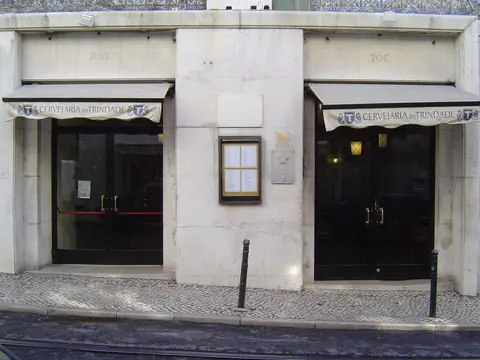
Says 1836. No document from that date has been found.
Grade C · Tradition
By claim the earliest Portuguese date on this list is 1836, at Cervejaria Trindade in the Chiado, where Manuel Moreira Garcia opened a beer hall a year after putting a brewery into the ruins of a dissolved convent. By record there is no winner: all three houses are graded C, because not one year on this page rests on a document anybody has read. The fullest account of any of them, Lisbon council's register of shops with a history, declines to name a year at all and says only the end of the nineteenth century.
All three Portuguese houses on this page are in Lisbon, and all three are nineteenth-century, which is less a failure of research than a fact about the city. The earthquake of 1755 took down the centre of Lisbon and the fires finished what it started, so the rooms a drinker can stand in today mostly begin after that; and the dissolution of the religious orders in 1834 threw an enormous amount of property onto the market at once, which is how a beer hall came to occupy the church, cloister and refectory of a convent founded in 1294. The two institutions to know are the cervejaria and the ginjinha. A cervejaria is a beer hall that also cooks, tiled and loud and built around draught beer and seafood. A ginjinha is something much smaller and much harder to find elsewhere: a doorway with a counter in it, selling ginja, the sour-cherry liqueur, in a small glass with or without a cherry in the bottom, with no chairs and no menu, so the drinking happens on the pavement outside. Counter sale was itself a novelty when these houses took it up, which Lisbon's own register of historic shops records. That register, the Portuguese encyclopaedia and the houses' own pages are the whole of the evidence here, and none of them cites a deed.
A convent, a doorway and a second doorway
Cervejaria Trindade is the grand one and the strangest. The Trinitarian convent
on the Rua Nova da Trindade was founded in 1294, burnt in 1704, wrecked by the earthquake of 1755 and burnt again the
year after; when Portugal dissolved the religious orders in 1834, Manuel Moreira Garcia bought the ruins, brewed in
the church, the cloister and the refectory from 1835 and opened the hall in 1836. He kept the convent’s tiling and in
1863 commissioned Luís Ferreira of the Viúva Lamego works to paint the panels of the four seasons and the four
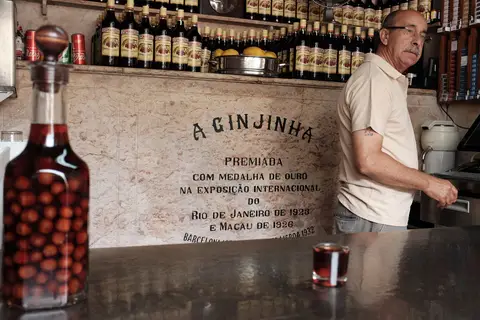
elements that are still on the walls. A Ginjinha is the opposite of grand: one doorway on
the Largo de São Domingos, open since 1840 by its own account, founded by a Galician named Francisco Espinheira,
selling one drink and nothing else. Ginjinha Sem Rival is a few steps away on the
Rua das Portas de Santo Antão, founded by João Lourenço Cima, still in his family, with Art Déco fittings it probably
took in the 1920s and a trade that starts at eight in the morning.
A city register that describes trade rather than dating it
Lisbon council keeps a register of shops with a history, and its entry for Ginjinha Sem Rival is the most useful
piece of writing about any of these houses — and it still will not name a founding year. What it does instead is
describe how the business worked: selling over the counter was new when the ginjinhas took it up, the rooms are too
small to stand in, so the drinking moved outdoors, and the house makes its own liqueur and supplies ginja to others
in the city. That is exactly the evidence this site needs for its first question, whether a member of the public can
be served a drink without ordering a meal, and exactly not the evidence it needs for a date. The result is three C
grades and no Portuguese entry in the ranking’s upper reaches, which is an honest outcome rather than a harsh one.
How the two questions are separated is set out in the methodology, and why a counter with no chairs
counts as a drinking house at all in inn, tavern or alehouse.
Where Portugal sits in the wider list
Three houses, one city, one century. Porto, Coimbra, Évora and the Alentejo are unworked here, and so is every
tasca — the small neighbourhood room that is Portugal’s commonest kind of bar and its likeliest source of older
dates. Even within Lisbon the list is partial: the Tendinha in the Rossio takes its ginja from one of the houses
above and has no row of its own yet. For the nearest comparison, an Iberian capital where a city survey and a
newspaper notice can place a counter in the eighteenth century, see the oldest pubs in Spain.
The full international ranking is at the top 100 oldest pubs.
Portuguese Wikipedia and the house agree on the story. The Trinitarian convent on this site was founded in 1294, burnt in 1704, wrecked by the earthquake of 1755 and burnt again the year after, and was closed when Portugal dissolved the religious orders in 1834. Manuel Moreira Garcia bought the buildings in 1835 and put a brewery in the church, cloister and refectory; the beer hall followed in 1836. He kept the
The date is the house's own, printed as "Desde 1840" on its front page, and Portuguese Wikipedia records the same: "Ginjinha Espinheira, fundada em 1840 pelo galego Francisco Espinheira" — founded by a Galician. No document has been traced behind it, so the grade is C. Lisbon city council's register of historic shops, Lojas com História, was read on 17 September 2026 and carries the house at Largo de São Domingos 8
Lisbon city council's register of shops with a history gives the fullest account: the house was founded at the end of the nineteenth century by João Lourenço Cima, grandfather of the present owners, keeps its original front, and probably took its Art Déco fittings in the 1920s, when that style was everywhere. Portuguese Wikipedia puts the year at 1890. Nothing documentary has been read behind either, so this is a C.
Locally dated 1890; no early record found.
The photographs above are other people's work, used under open licences. Every photographer, licence and source page is named in the image credits.
Common questions
Which is the oldest bar in Lisbon?
Every Portuguese house on this site is in Lisbon, so the question is the same one the page answers. Cervejaria Trindade gives the earliest year, 1836; A Ginjinha prints 1840 on its own front page; Ginjinha Sem Rival is put at 1890 by the encyclopaedia and at the end of the century by the city. None has a document behind it.
What is a ginjinha?
Both a drink and a kind of shop. Ginja is a liqueur made from sour cherries, and a ginjinha is the narrow doorway counter that sells it by the glass, usually with nowhere to sit. Lisbon drinks it standing in the street outside, which is the custom the Largo de São Domingos house says began with it.
Why do Portugal's oldest drinking houses start in the 1800s?
Because Lisbon was rebuilt. The earthquake and fires of 1755 destroyed the centre, and the dissolution of the religious orders in 1834 emptied the convents that had survived, which put whole buildings up for sale. The Trindade brewery of 1835 is a direct result, and so is the shape of this page.
Is the Trindade a pub or a restaurant?
Both descriptions fit and nobody we can read settles it in words, so the page says so rather than guessing. It is a beer hall with a restaurant and a room for petiscos, in rooms Lisbon council placed in the city's cultural heritage in 1986 for the convent fabric and the painted tiles of 1863.
What is Eduardino?
The house liqueur at Ginjinha Sem Rival, named after a clown who performed at the Coliseu next door and is said to have had a hand in mixing it. The name was registered as a trademark in 1908, and the label carries the boast that the house has never entered an exhibition, at home or abroad.