The Canterbury historic pub walk is a self-guided route of 7.3 km between 3 old pubs, about 1 h 38 min walking, with a GPX file to follow. Ye Olde Yew Tree Inn makes the oldest claim on it, 1348; the oldest record on the walk belongs to Ye Olde Beverlie, from 1740.
The distance is the walked street route, not the straight line. These are history walks, not a drinking challenge: take it slowly, drink water between stops, and leave a pub out if the day is getting long.
Canterbury, St Stephen’s Green to the Stour marshes. Two houses in the city and one out on a lane above the marshes — and the loudest claim in Canterbury is not on the walk at all, because the building is gone. What is left are three houses that each fail a different part of the test: one that is an old building rather than an old pub, one that has the record but not the year on its front, and one whose plague-year date nothing supports. Hours matter more than distance here, and the last leg is most of the walk.
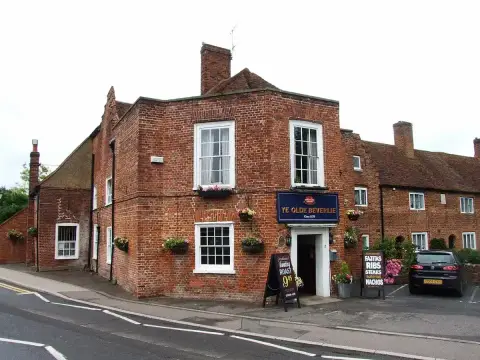
Beside Sir Roger Manwood's Elizabethan almshouses on St Stephen's Green, this brick-and-beam pub was built in 1570 and has been serving drinkers since at least 1740. Flagstones, oak beams and a large walled garden set the scene, and the garden is reputed to be where the Kentish game of bat and trap began.
Dated 1570 by CAMRA; first recorded 1740; building c.1570.
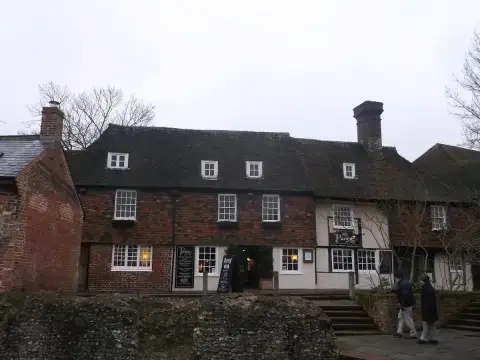
In Canterbury's St Radigund's quarter, with a fragment of old wall in front, the Parrot fills a timber Wealden hall house known as St Radigund's Hall. Its date is disputed: a regional heritage account gives about 1370, the city's own archaeological society the fifteenth century. It has only been a pub since 1987, and it is one of the oldest buildings in the city in which you can buy a pint.
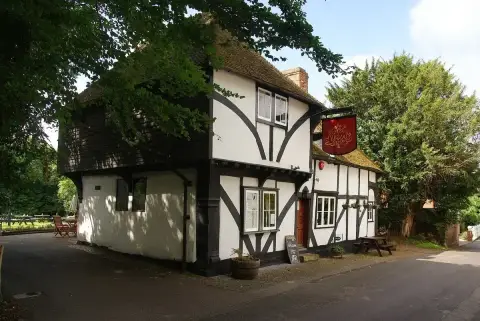
A weatherboarded and timber-framed inn on the lane through Westbere, above the Stour marshes east of Canterbury. Low beams, a carved corner post and a garden behind. It closes on Mondays and splits the day in two the rest of the week, with food at lunch and in the evening.
The missing house stood at 16 St Margaret’s Street. The
Royal Fountain traded on a story reaching back to
1029 — Earl Godwin’s wife lodging there, Becket’s four knights meeting in the house before the
murder — and that 1029 was already being set in print as fact in 1907. A German raid on 1 June 1942
destroyed the building, the licence went out to the Abbot’s Barton Hotel, and the frontage now holds an entrance to a shopping arcade.
Ye Olde Beverlie begins the walk on St Stephen’s Green, and
the 1570 it is dated to is not its own year. CAMRA credits the house to Sir Roger Manwood, who
built it along with the almshouses beside it, and Historic England lists inn and almshouses as one
group, saying the inn is said to be of the same date as the almshouses. The listing then narrows
the claim: the only fabric of that period visible from outside is the crow-stepped gable in the west
front, and the front itself is eighteenth-century. Use as an inn is recorded from 1740, when the
house was known as the Hospital. This is the only grade B on the walk.
The Parrot is here for its carpentry and not for its age as a pub.
It has only been one since 1987, which keeps it out of our ranking altogether, and that is worth
saying plainly rather than quietly. What it fills is St Radigund’s Hall, and even the hall is argued
over: a regional heritage account dates it to about 1370, while the Canterbury Historical and
Archaeological Society, which cites the studies behind its notes, reads it as fifteenth-century and
says virtually nothing of its early history is known. The society follows the building instead —
tenements by the early twentieth century, saved from demolition in 1937, then a girls’ club, an annexe to the art college
and a burger bar.
Out at Westbere, Ye Olde Yew Tree Inn gives 1348, the plague
year, which is the kind of date that gets repeated. Historic England reads the easternmost part of
the building as probably fifteenth-century and describes what a walker can stand and look at: a
moulded dragon post at the corner, diagonal braces at ground level, a jettied window bay and an
original arched doorcase. It says nothing about drinking. Neither does the county history — Edward
Hasted’s survey of Kent, volume nine of 1800, spends seven pages on the parish and names no inn,
alehouse or tavern in it. A blank is not a denial, and it is not evidence for 1348 either.
Two of these three signs open with “Ye Olde”, which means no more than “the old”:
what “Ye Olde” actually means. The county’s claimants are ranked
at the oldest pubs in Kent, and how an old building is told from an
old drinking house is set out in the methodology.