The Belfast historic pub walk is a self-guided route of 0.76 km between 3 old pubs, about 10 min walking, with a GPX file to follow. White's Tavern makes the oldest claim on it, 1630, and no stop on the walk yet has a document from at or near the date it claims.
The distance is the walked street route, not the straight line. These are history walks, not a drinking challenge: take it slowly, drink water between stops, and leave a pub out if the day is getting long.
Belfast’s three oldest bar claims. Eight hundred metres of the old town, and three claims to weigh on the way: 1711 at McHugh's, 1630 at White's, 1720 at Kelly's Cellars. Two of those years are offered as the age of a building and one as the date of a licence, which is why they cannot simply be ranked against each other. Ten minutes end to end, three different arguments.
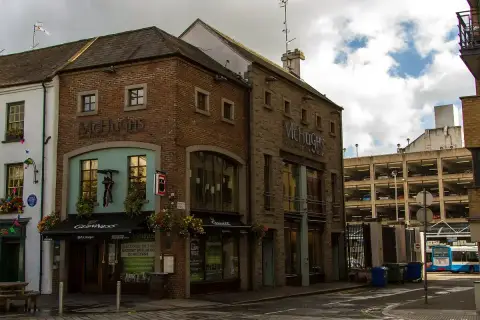
On Queen's Square near the Lagan, McHugh's occupies what is thought to be Belfast's oldest surviving building, dated to around 1711. Inside, original oak beams and a spiral staircase recall the early Georgian merchant town. It has been run as a bar and restaurant with live music, but when the premises first served drink is unclear.
Dated 1711 in the press; no early record found; building c.1710.
2-4 Winecellar Entry and 14-18 High Street, Belfast BT1 1QN
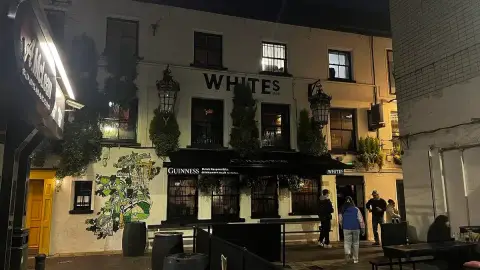
Tucked into Winecellar Entry, one of the narrow lanes of old Belfast, White's Tavern calls itself the city's oldest tavern and claims a licence of 1630. The historic tavern has since been joined by a beer hall, a garden and a shop, and it hosts regular live music. The early licence has not been independently documented, but the tavern is a Belfast institution.
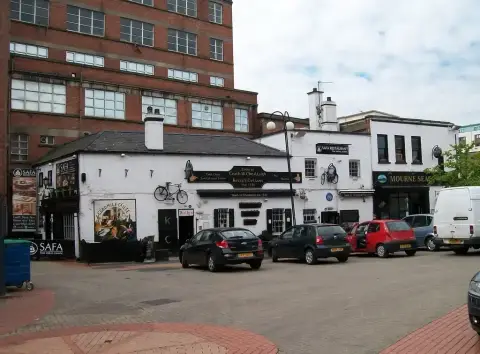
On Bank Street in Belfast city centre, Kelly's Cellars says it was built in 1720 and calls itself Belfast's oldest pub; the listed buildings register dates the fabric to between 1780 and 1799. An Ulster History Circle blue plaque records that the United Irishmen met here between 1791 and 1798, before their failed rebellion. It serves traditional Irish food and is proud of its Guinness.
The three Belfast claims are about three different things, which is the first thing to know
about them.
McHugh’s Bar claims 1711, and what that year dates is the house.
A survey by F. W. Hammond in 1997 is reported to have put the build date at about 1710-15, which
would make it the oldest known building in the city. When drink was first sold in it is not
established anywhere we have traced, and the bar publishes no history of its own; the 1711 is
the figure the travel press uses.
White’s Tavern claims the first tavern licence granted in
Belfast, in 1630. No licence record has been traced and the planning record for the premises
calls the date local tradition. What that record does document is everything after it. The block
standing now is largely the wine merchant Valentine Jones’s rebuild of about 1790, known
historically as Washington House; Neil & White kept it as a wine and spirit warehouse in the
middle of the nineteenth century, with part of it used as the Oyster Rooms by the fishmonger
John Walker; the premises moved from wholesale trade to a public house only in the late
nineteenth or early twentieth century; and the name White’s Tavern dates from 1962.
Kelly’s Cellars paints 1720 on itself. Northern Ireland’s
listed buildings register holds the house as HB26/50/101 at 30-32 Bank Street, grade B2, in
public house use then and now, and dates its construction to between 1780 and 1799 — sixty years
after the year on the fascia. The walls a drinker stands inside are later Georgian, and the
United Irishmen plaque belongs to that building rather than to the claimed one.
The register is also worth reading for what it leaves out. Forty-six listed buildings stand
within three hundred metres of Winecellar Entry, including the Northern Whig round the corner on
Bridge Street and the eighteenth-century Northern Bank on Waring Street, and not one of them is
White’s. The city’s contenders are ranked at
the oldest pubs in Belfast, with the rest of the
nation at the oldest pubs in Northern Ireland.