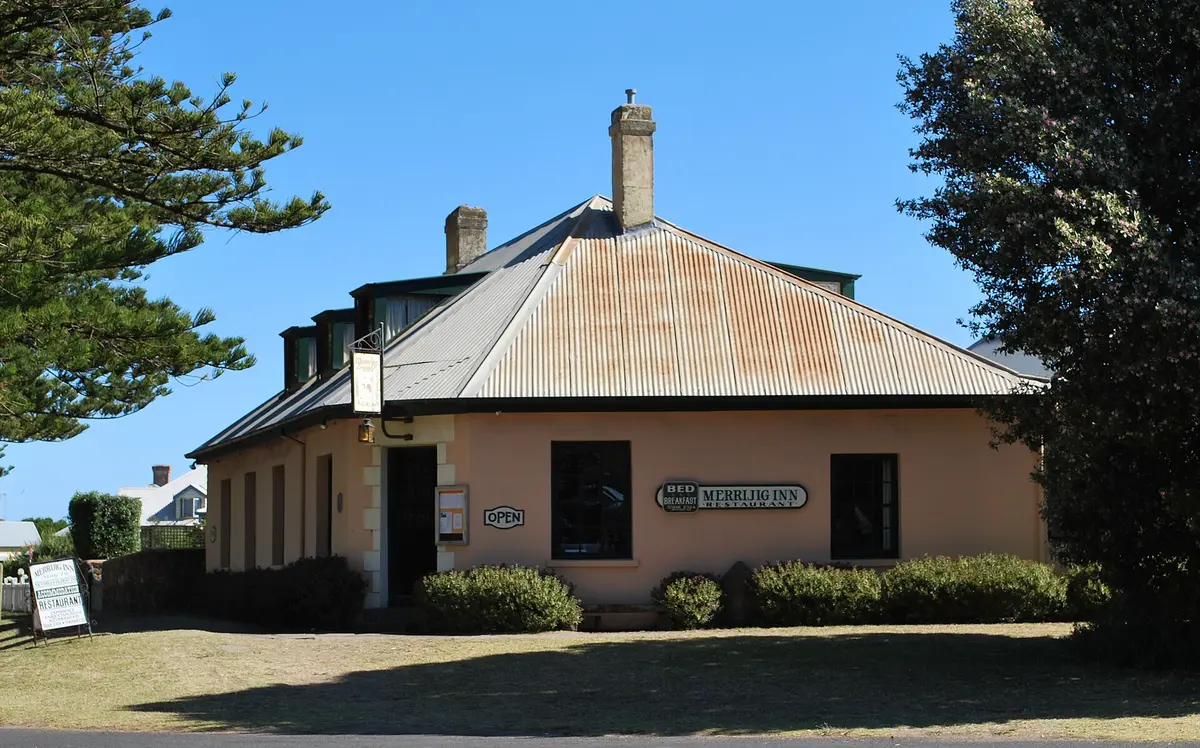
The claim
A whitewashed inn of 1845 facing the old jetty at Port Fairy, built for the whalers and sealers working the coast and trading by 1847 as the Royal Merrijig. It closed in 1852 and spent a century as police barracks, courtroom, offices and boarding house. A restaurant with four rooms since the 1980s, its front bar opens at three, two hours before the kitchen.
What the records show
The Victorian Heritage Register entry for the house, H0248, does two things worth separating. It dates the fabric: William Middleton executed a lease with James Atkinson for the corner of Campbell and Gipps Streets in September 1845 and apparently began building the inn then, and it was named the Royal Merrijig to tell it apart from an earlier Merrijig Inn that Archibald McNeill had built nearer the Moyne River before the town allotments were set out — so publishers who date this house to McNeill's licence of 1842 are dating a different building, and the site of that one is registered separately. And it records the trade: the Royal Merrijig was certainly in operation by 1847, in 1848 James Burns of the Steam Packet Hotel in Launceston advertised alterations for the comfort of gentlemen and families and a billiard table bought at considerable expense, and the house opposite the jetty became the headquarters of the coastal whalers and later of the merchant William Rutledge. Fire nearly destroyed it in 1850, the furniture was sold off and the hotel closed in 1852, and from 1853 the government leased it for police barracks and offices, with courts sitting until 1860 and the Belfast road board and municipality in it after that. It was a boarding house under Captain Frederick Trouten, then sold in three parts in 1901, and only in the 1980s was it renovated and reopened as a small private hotel. A second publisher now dates the fabric too, and not to the same year: Victorian Places, the gazetteer of the state's settlements produced by Monash University with the University of Queensland, says in its account of Port Fairy that parts of the Caledonian and the Merrijig hotels date from 1844 or possibly earlier. That is a year or more before the lease the register works from, which would make the standing house older than its own claim rather than younger, and no document is cited either way, so the page keeps the register's 1845 and says that the earlier reading exists. The same account confirms the setting the register describes: James Atkinson's private survey of eight square miles east of the river in 1843, his township survey of 1846, the town named Belfast, and the Belfast Road District proclaimed on 29 June 1853, the first municipal body in Victoria outside Melbourne and Geelong — the body the register has meeting in this building. Anyone may drink there now: the front and garden bars open from three in the afternoon until six, two hours before the kitchen does, and pour wine by the glass, beer, spirits and cocktails with bar snacks.
| Year | What | Source |
|---|---|---|
| 1845 | Claimed founding | The pub |
| c.1845 | Present building | https://vhd.heritagecouncil.vic.gov.au/places/4060/download-report |
| 1847 | First record of a drinking house here | Victorian Heritage Database |
What to look for inside
- One of the oldest surviving buildings in Victoria, on the Victorian Heritage Register as H0248
- Courts sat in the former inn until 1860 and the Belfast road board met in it
- A billiard table was bought at considerable expense for it in 1848
Visiting
Merrijig Inn is in Port Fairy, Australia, at 1 Campbell Street, Port Fairy, Victoria. We do not list opening times, because they change; the pub’s own site is the place to check before you set out.
Sources
- vhd.heritagecouncil.vic.gov.au/places/4060/download-report
- www.merrijiginn.com/our-story
- www.merrijiginn.com/drink
- www.australiantraveller.com/australia/oldest-pubs-in-australia/
- www.openstreetmap.org/node/597178567
- www.victorianplaces.com.au/port-fairy
Know something we don’t?Suggest a correctionLast checked Sept 2026
Run this pub? There is a badge for it
Free to put on your own site, no permission needed. It shows what the pub claims and what the records support, and it changes when the data does.
How to use it, and how to change what it says — if you have a document we have not seen, we would like to read it.