
The claim
Hurley is a lane of brick and flint running down to the Thames between Marlow and Henley, with a Norman church at the bottom of it and the remains of a Benedictine priory in the churchyard. The Olde Bell stands at the top of the lane, and its own history is unambiguous: it first opened its doors in 1135 as a guest house for visitors to the priory. In 2025 it kept an 890th birthday on the strength of that year, and it is regularly described in the travel press as the oldest hotel in Britain.
Over the door hangs the Sanctus bell, which the hotel describes as a sign of welcome and refreshment to travellers, and which gives the house its name. There is a tunnel from the cellar to the priory, said to have been used by Lord Lovelace when he was conspiring on behalf of William of Orange in 1688. It is a good story, told well, in a building that deserves one.
None of which is a document, and a claim of this size ought to have one.
What the records show
The Victoria County History of Berkshire is the obvious place to look, because its editors walked Hurley, measured its buildings and read its deeds. Two of its volumes are relevant, and neither says what the claim needs.
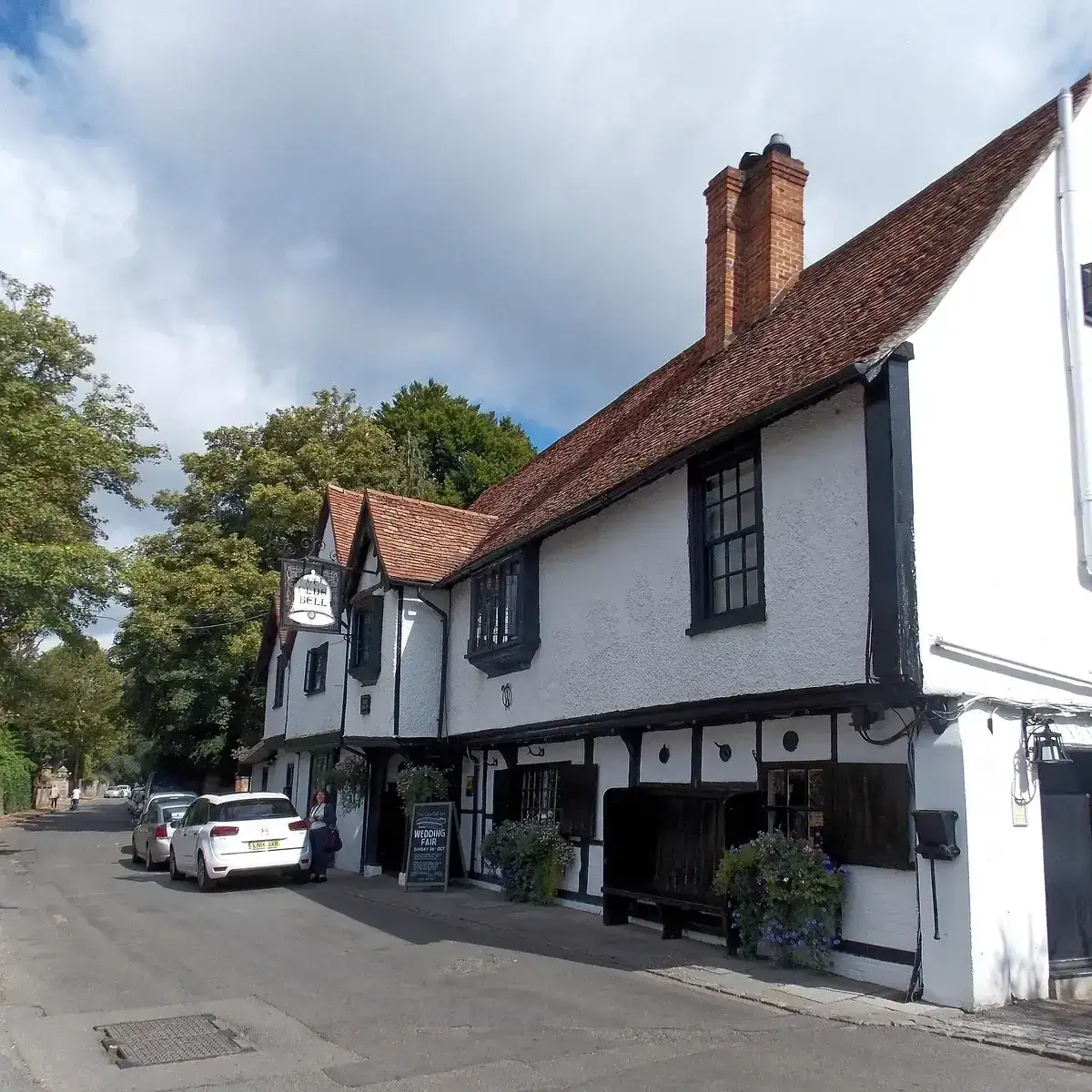
The parish survey describes the Bell as a two-storeyed half-timber building of the late fifteenth century, considerably modernised and added to in recent years, but still retaining a fair amount of original work: timber framing, four-centred arches, an oriel window with pointed lights, oak mullions. It is a careful description of an old house, by people who were unsentimental about dates. It says nothing about a priory guest house, nothing about 1135, and it is the only inn in Hurley the survey names at all.
The volume on the religious houses is equally unhelpful to the story. Hurley Priory was founded by Geoffrey de Mandeville towards the end of the Conqueror’s reign, and its foundation charter has the church dedicated in 1086 by Osmund, bishop of Sarum. The next dated event the account offers is around 1140, when William Constable of Chester made a gift to the priory. There is no mention of a guest house, a hospice or an inn — which is not the same as saying the priory had none, since a house of that size and position would certainly have lodged travellers. It is to say that the record we can read does not describe the arrangement the claim describes, and does not use the year the claim uses.
The building, dated
The national register designated the house on 25 March 1955, at Grade II*, as list entry 1156153, under the name Ye Olde Bell Hotel. Its description agrees with the county history to the century: a late medieval inn, timber-framed with painted brick infill and part of it encased in painted render, under old tile gabled roofs, altered in the seventeenth, nineteenth and twentieth centuries. The plan is the giveaway — three framed bays with a former screens passage, and a crosswing of three bays on the north, jettied on the west, of two storeys and attics.
A screens passage is the mark of a late medieval hall house rather than of a twelfth-century one, and the jetty is a fifteenth- and sixteenth-century fashion. Two independent surveys, seventy years apart, place this fabric in the late fifteenth century. That is the same sort of gap this site keeps finding: the George & Dragon at Beaumaris carries 1410 in raised letters on a rendered front that tree-ring dating puts a century and a third later, and the Groes Inn carries 1400 in stucco that Cadw calls a late Victorian invention.
A late fifteenth-century building does not disprove a twelfth-century inn. Houses are rebuilt, particularly houses that make money, and the Olde Bell has been rebuilt repeatedly since — most recently as a designed hotel, with interiors by Ilse Crawford. It does mean that the fabric can be no help to the claim, and the fabric was the only physical evidence anyone had.
Where 1135 comes from
The honest answer is that we cannot trace it to a document, and the trail we can follow is instructive.
The English Wikipedia article states the foundation flatly — the Olde Bell was founded in 1135 as the hostelry of Hurley Priory — and its citations for that sentence are four pieces of journalism: CNN, the Guardian, the Financial Times, and a book about the Thames by Stuart Fisher. Every one of those is a reputable publisher. Not one of them is an archive, a court roll, a licence or a survey. The hotel’s own history page states the year without a source, which is entirely normal for a pub and is not a criticism; it is simply not evidence.
What can be said is that 1135 does not line up with the priory it is attached to. The priory dates from 1086. If the guest house had gone up with the monastery, the number would be the 1080s. 1135 is the year Henry I died and the English succession collapsed, which is the kind of memorable year that attaches itself to buildings — the same way 1189 attached itself to Ye Olde Trip to Jerusalem because it is the year Richard I set out for the crusade.
Monastic ground, and what it proves
Hurley is one of a family of English claims that run on the same reasoning: the building stands on monastic ground, monasteries lodged travellers, therefore the pub is as old as the monastery. The Lord Crewe Arms at Blanchland makes a version of it, and so do a dozen others. In almost every case the first half is true and the second does not follow.
A monastic guest house was not a public house. It took in travellers as a religious duty, under the abbey’s rule, with no counter and no price list, and a member of the public could not walk in and buy a drink. That is the distinction our methodology turns on, and it is why a house whose drink-led trade begins later than its building ranks on the later date. The Olde Bell may well stand where Hurley’s monks lodged their guests. That would make the ground very old and the pub a separate question.
So how old is the Olde Bell?
Old enough not to need the number.
There is a late medieval inn here, timber-framed, with a screens passage, recorded by two surveys seventy years apart and protected at Grade II* since 1955. That puts it among the older inn buildings on this site and well ahead of most English houses that claim four figures. The 1135 is unproven rather than disproved: no archive has been produced for it, the priory’s own date is fifty years earlier, and the standing fabric is three and a half centuries later. A deed or a manorial account could still turn up and settle it, and if one does we will change the grade and say so on what changed.
Until then the fair description is the one the building itself supports: a fifteenth-century inn on ground that had been monastic for four hundred years before that. The rest of the field is at the oldest pubs in England, and the sign over the door is explained in why so many pubs are called the Bell.
Sources
Found something wrong?Suggest a correction