
The claim
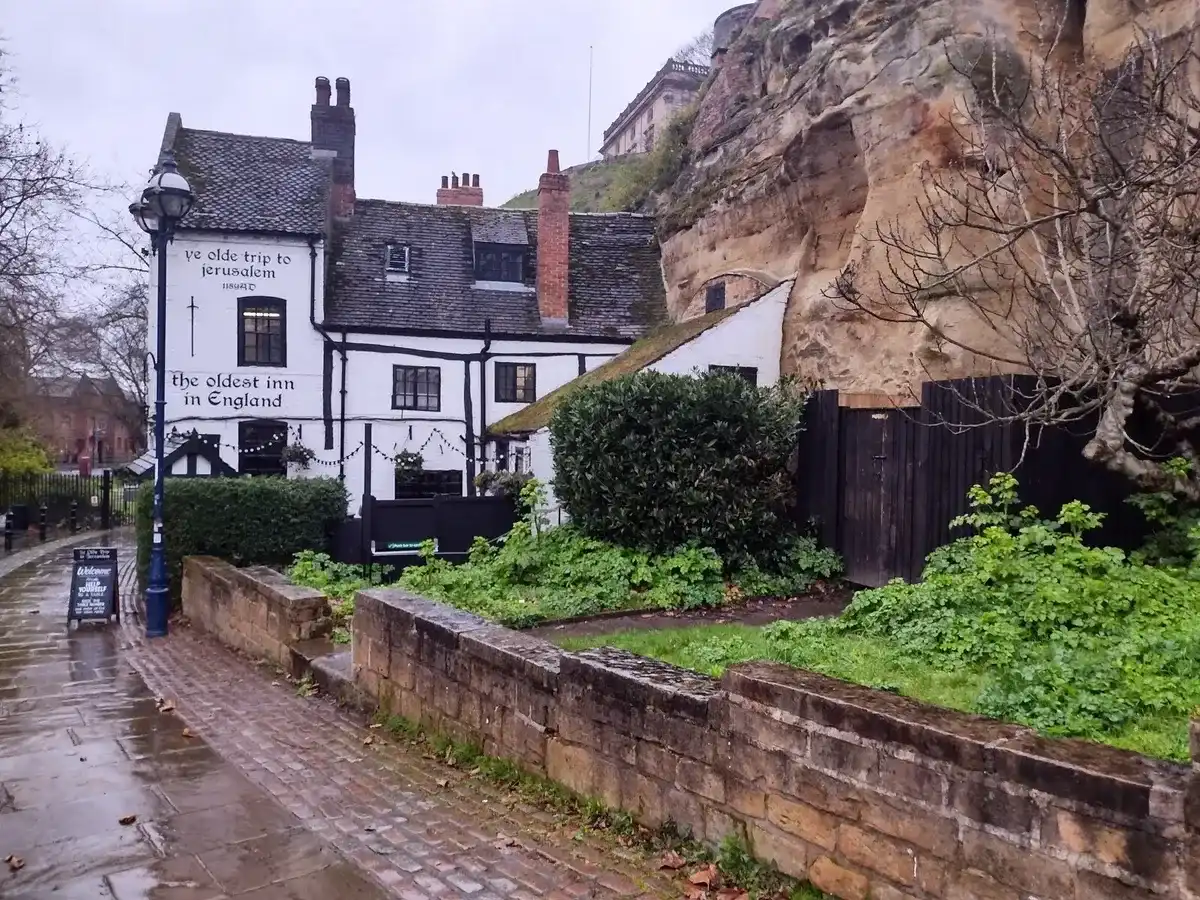
The number is not hidden. It is painted in large letters on the whitewashed gable at 1 Brewhouse Yard, under Castle Rock: AD 1189. The story attached to it is that men bound for the Third Crusade drank here before setting out for Jerusalem, in the year Richard I was crowned and Pope Gregory VIII’s call to the Holy Land was still fresh. That is where the name is said to come from — a “trip” in the older sense of a staging point on a journey rather than an outing.
It is a wonderful story and it fits the site perfectly. The pub is jammed against the sandstone cliff beneath Nottingham Castle, its upper room open to the rock, and the caves behind the bar were cut by hand. Everything about the place feels older than any paperwork.
What the records show
No document connects a drinking house on this site to 1189, or to any year in the twelfth century. Historic England’s own review of England’s oldest-pub claims puts the earliest reference to a pub here at 1751, when it traded as the Pilgrim. The name Ye Olde Trip to Jerusalem appears by 1799. Both of those are ordinary, checkable dates in the record of a busy Georgian town.
The 1189 date itself has a traceable origin, and it is not medieval. Historic England dates it to around 1910, when a landlord commissioned new signage and put the crusade on the wall to draw custom. That was standard practice: the late Victorian and Edwardian decades were the great age of pub antiquity marketing, when “Ye Olde” prefixes, invented founding years and heraldic signboards were added to buildings of every date.
| What | Ye Olde Trip to Jerusalem |
|---|---|
| Claims | 1189 AD |
| First record as a pub | 1751 (as the Pilgrim) |
| Present name recorded | 1799 |
| Standing building | c. 1650–1660 |
| Listed | Grade II, listed 1952 |
| Our grade | C — tradition |
What the building and the caves show
The standing building is not medieval either. The oldest parts of the structure date from about 1650 to 1660, and John Speed’s map of Nottingham, published in 1610, shows a building on the site — so there was something here before the present walls went up, but a building is not a licence.
The caves are the genuinely ancient part, and the pub is right to make a great deal of them. Nottingham sits on soft Sherwood sandstone that has been dug into for cellars, tanneries, maltings and storage for the best part of a thousand years. The caves behind the Trip are thought to have served as a brewhouse for Nottingham Castle, which was founded in 1067, and the name Brewhouse Yard preserves that use. So brewing on this spot may well be far older than 1751. Brewing for a castle is not the same thing as a public house, but it is a real connection to the medieval town, and it is more interesting than the crusade.
The competition in Nottingham
The Trip is not even the strongest claim in its own city, which is the awkward part of the 1189 story. Two other pubs a few minutes’ walk away have better-dated fabric.
The Bell’s timbers were dated by tree-ring analysis to around 1420, which matches its claimed age almost exactly, and its earliest documentary reference is a 1638 bequest of rental income by a former mayor of Nottingham. The Salutation’s core timbers have been reported at around 1360 following work by the University of Nottingham in 1992. Both of those are much closer to the medieval period than anything the Trip can show on parchment or in oak. We have set the three side by side in more detail in our look at Nottingham’s oldest pub dispute.
So is it England’s oldest inn?
No, and the honest version of the claim is more defensible than the painted one. England has around a dozen surviving purpose-built medieval inns still trading, and the earliest of them belong to the late fourteenth and fifteenth centuries. The strongest documented case is the George Inn at Norton St Philip in Somerset, built by the Carthusian monks of Hinton Priory, whose upper timbers have been tree-ring dated to 1430–32 and which was functioning as an inn for the priory’s wool fairs. That is a pub whose medieval purpose is documented rather than asserted.
The Trip belongs in a different category, and it is a category worth respecting: a seventeenth-century building over much older rock-cut cellars, trading under a name that has been on record for well over two centuries, in a spot that has had something to do with beer since the Normans built the castle above it. Read the ranking rules we use in our methodology, and you will see why we grade it C for the claim while still listing it among the top 100 oldest pubs on the strength of what it actually is.
Go for the caves, the panelling darkened by three centuries of fires, and the low room where the rock comes through the ceiling. Ignore the number on the wall. It was painted by a publican who understood his trade, and the beer is no worse for it.
Sources
Found something wrong?Suggest a correction