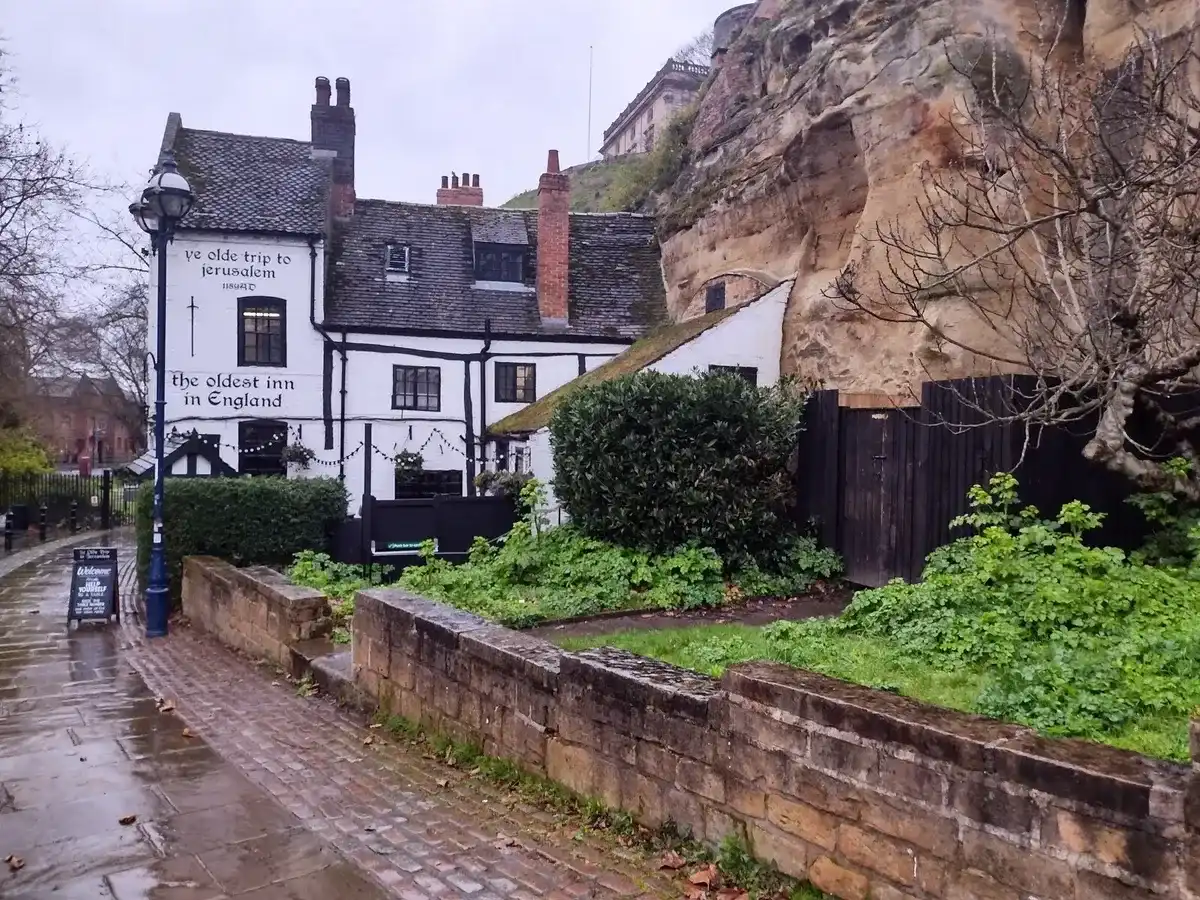

The claim
Nottingham is unusual. Most towns have one pub that says it is the oldest and nobody else bothers to argue. Nottingham has three, all within a ten-minute walk of each other, all with a date on the wall, and all with a following willing to defend it.
The three are Ye Olde Trip to Jerusalem under Castle Rock, which claims 1189; Ye Olde Salutation Inn on Hounds Gate, which claims about 1240; and the Bell Inn on the Old Market Square, which claims about 1437. What makes the argument genuinely interesting rather than merely noisy is that each of them is the oldest by a different and defensible measure.
The three side by side
| Pub | Claims | First record | Building | Grade |
|---|---|---|---|---|
| Ye Olde Trip to JerusalemNottingham | 1189 | 1751 | c. 1650-1660 (rock-cut caves older; a building on the site appears on Speed's map of 1610) | Grade C |
| Ye Olde Salutation InnNottingham | 1240 | — | Core timber frame reported as c. 1360 by dendrochronology (1992); listing describes 16th- and mid-18th-century fabric, heavily restored | Grade C |
| The Bell InnNottingham | 1437 | 1638 | Timber frame tree-ring dated to c. 1420 (Historic England: mid-15th century); Georgian frontage | Grade B |
The Trip: oldest rock, youngest paperwork
The Trip’s 1189 is the boldest date and the weakest case. Historic England’s review of English oldest-pub claims finds the first reference to a pub on the site in 1751, when it was called the Pilgrim; the present name is recorded by 1799. The 1189 date can be traced to a landlord around 1910 who had it put on new signage. The standing building dates from roughly 1650–1660, though John Speed’s map of 1610 shows something already there.
Where the Trip is unarguably the oldest of the three is underground. The caves cut into the Sherwood sandstone behind the bar are believed to have served as a brewhouse for Nottingham Castle, founded in 1067 — hence Brewhouse Yard, the address. If the question is “where in Nottingham has beer been made for longest”, the Trip has the best answer in the city.
The Salutation: oldest timber, no documents
The Sal’s tradition puts an alehouse here in about 1240 under a name honouring the Annunciation. Tree-ring dating carried out by the University of Nottingham in 1992 put the core of the present building at around 1360, which makes it, on the reported evidence, the oldest standing pub structure of the three. Beneath it are two levels of rock-cut cellars and a well shaft driven some 24 metres into the bedrock.
Its documentary case is the thinnest. Accounts of the pub repeat two attractive early references — Edward III’s retinue lodged here in 1336, and borough records noting a travellers’ hostel on the site in 1414 — but we have not been able to check either against a primary source, so we do not treat them as established. Local historians have also described the building’s original function as a tanner’s workshop with living quarters above, which is a very different thing from an inn. Fourteenth-century timbers over medieval caves is a real distinction. A fourteenth-century alehouse is not yet proven.
The Bell: best-dated fabric and the earliest record
The Bell hides behind a modest Georgian front put on by Jane Lart, who bought the freehold in 1803 and the leasehold in 1806. Behind it is a timber frame that tree-ring analysis dates to around 1420, with a rare crown-post roof — fabric that matches its claimed date of about 1437 more closely than either rival matches its own claim. That is why it is the only one of the three we grade B rather than C.
Its written record is also the earliest of the three. In 1638 the rental income from the premises appears in the will of Robert Sherwin, a former mayor of Nottingham, who left half of it to city churches for the relief of the poor. Accounts of the building link it to the Nottingham Whitefriars, whose friary was established before 1271 nearby, and say it passed into secular use as an alehouse after the Dissolution in 1539 — a plausible sequence, though the Dissolution date is tradition rather than a cited licence. The cellars hold two wells, one called the Monks’ Well. A later landlord, William Clarke, took the Bell in 1812 and went on to found the Trent Bridge cricket ground.
So which is Nottingham’s oldest pub?
There is no single answer, and anyone who gives you one has quietly chosen a definition without telling you.
- Oldest documented drinking house: the Bell Inn, on a 1638 bequest.
- Oldest dated standing building: the Salutation, on timbers reported at about 1360 — with the Bell close behind at about 1420 and far better documented.
- Oldest brewing site: the Trip, whose caves are tied to a castle founded in 1067.
- Oldest claim: the Trip, at 1189, on no evidence at all.
None of the three can produce a medieval licence, an inventory or a court roll naming a person selling ale in that building in that year. For comparison, the George Inn at Norton St Philip in Somerset can show tree-ring dates of 1430–32 for a building put up specifically as an inn by Hinton Priory, which is the kind of evidence that earns a grade A in our methodology.
The pleasant thing about Nottingham is that you can settle it yourself in an afternoon. The three stand within a few hundred metres, they are all still pouring, and each has something the others do not: caves at the Trip, medieval timber at the Sal, a crown-post roof and a Monks’ Well at the Bell. Our Nottingham page has the rest of the city’s old houses, and there is a walking route in the Nottingham oldest pub dispute trail.
Sources
Found something wrong?Suggest a correction