3 pubs checked · updated 18 September 2026

The oldest pub in Nottingham

The short answer

Oldest claim

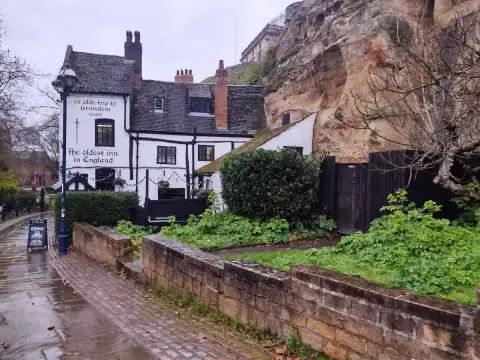
Ye Olde Trip to Jerusalem

Says 1189. The first record is 1751.

Grade C · Tradition

Oldest proof

The Bell Inn

On record from 1638; the building is dated to about 1420.

Grade B · Building dated

By claim, the oldest pub in Nottingham is Ye Olde Trip to Jerusalem beneath Castle Rock, which dates itself to 1189 and the crusaders gathering for Richard I. By evidence it is the Bell Inn on the Old Market Square, whose timber frame has been tree-ring dated to the mid-fifteenth century and whose documented use as a pub begins in the 1630s. Historic England traces the first reference to a pub on the Trip's site to 1751, when it was called the Pilgrim.

Nottingham is the best place in England to watch the oldest-pub argument conducted in public, because three pubs within a few hundred metres of each other all claim the title and each of them wins on a different measure. The city's geology is part of the reason. Nottingham stands on soft Sherwood Sandstone, which for centuries was cut into by hand to make cellars, maltings, tanneries and storerooms, so a pub here can genuinely sit above rock-cut chambers older than anything built above ground. That is what makes the Trip's caves so persuasive and so misleading at the same time: the caves are ancient, and they were not a pub. Both of its rivals, meanwhile, have had their timbers tested. The result is a three-cornered dispute in which the pub with the oldest claim has the latest first mention, the pub with the oldest tested timbers is marooned beside a ring road, and the pub with the plainest frontage has the best-documented medieval fabric. Everyone in the city has an opinion.

Three pubs, three measures

Ye Olde Trip to Jerusalem has the fame, the setting and the weakest paperwork: a building of about 1650–60 pressed against the castle cliff, with a first documented pub reference in 1751. Ye Olde Salutation Inn has the oldest tested timbers and the least glamour, cut off from the city centre by the ring road, with ten handpumps and two storeys of caves beneath. The Bell Inn has the best combination of the two: a dendro-dated medieval frame hidden behind a modest Georgian front on the Old Market Square, deep sandstone cellars with a well, and a former landlord, William Clarke, who founded the Trent Bridge cricket ground. We set the three of them against each other in which is Nottingham’s oldest pub.

What the caves prove, and what they do not

Rock-cut cellars are the most common evidence offered in Nottingham and the least conclusive, because a cave can be dug at any date and used for anything. Brewing, malting and cool storage are all plausible uses, and none of them makes the place above a public house. This matters for the Trip in particular, where the caves were associated with the castle’s brewhouse long before anyone was selling beer at street level. The detailed case is in is Ye Olde Trip to Jerusalem really from 1189; there is a short walk between all three pubs in the Nottingham oldest pub dispute; and the spelling on two of the three signs is explained in our guide to what “Ye Olde” actually means.

Nottingham

OpenFreeMap · © OpenMapTiles · Data © OpenStreetMap contributors

Open the full map

The contenders, oldest claim first

Order the contenders
  1. Nottingham, Nottinghamshire

    The 1189 is the pub's own, in black letters on the building and in print: the Greene King page for the house says its doors first opened in 1189, making it England's oldest surviving inn. No document supports it. Historic England notes the first reference to a pub here (as The Pilgrim) in 1751 and the Trip name by 1799; the standing building is mid-17th century, though the sandstone caves behind it are older.
    Claims 1189; first recorded 1751; building c.1650.
  2. Nottingham, Nottinghamshire

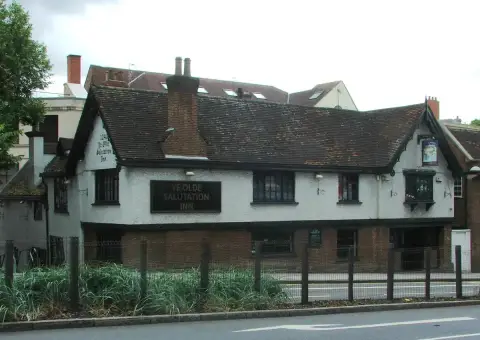
    The 1240 is on the building itself: CAMRA's national inventory description records a date of 1240 on the exterior of the jettied St Nicholas Street range, and reads the fabric as a combination of at least three buildings, most likely 16th- and mid-18th-century, heavily restored later. So the date is the house's own assertion rather than anyone's dating of it. Tree-ring work reported on Wikipedia puts the oldest

    Claims 1240; no early record found; building c.1360.
  3. The Bell Inn

    Grade B

    Nottingham, Nottinghamshire

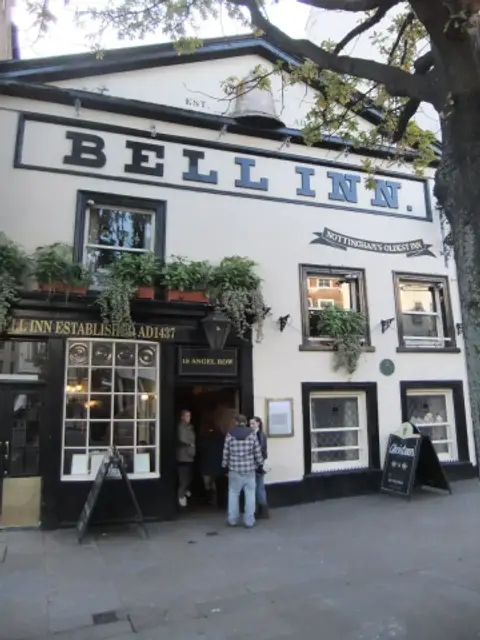
    The 1437 is the pub's own: the Bell's website, archived in 2016 before Greene King's pages replaced it, said the inn dates from around 1437 and is the oldest in the city, while giving c.1420 for the dendrochronological dating of its timbers. The listing, made on 12 May 1982 and drawing on Pevsner's Nottinghamshire, reads the fabric as late 15th-century behind an 1820s front, with substantial timber framing

    Claims 1437; first recorded 1638; building c.1420.

The photographs above are other people's work, used under open licences. Every photographer, licence and source page is named in the image credits.

Common questions

Which is the oldest pub in Nottingham?
All three contenders claim it. On the evidence the answer is the Bell Inn: tree-ring dating confirms a mid-fifteenth-century timber frame, and Historic England dates documented pub use to the 1630s. The Trip's 1189 has no document behind it, and its standing building is mid-seventeenth century.
Is Ye Olde Trip to Jerusalem really from 1189?
No document supports it. Historic England records the first reference to a pub on the site in 1751, as the Pilgrim, with the Trip name appearing in 1799, and traces the 1189 date to signage commissioned around 1910. The sandstone caves behind the bar are far older than the pub that uses them.
How old is Ye Olde Salutation Inn?
Its 1240 date is tradition. Tree-ring work puts the oldest timbers at about 1360, which makes them the earliest tested pub timbers in the city, and the two levels of sandstone cellars with their well shaft are older still. Claimed inn references of 1336 and 1414 could not be verified.
Which Nottingham pub has the oldest building?
Ye Olde Salutation Inn, on the tree-ring evidence, with timbers of about 1360. The Bell's frame is mid-fifteenth century behind a Georgian front, and the Trip's standing building dates from about 1650–60. All three stand over rock-cut cellars that are older than the structures above them.