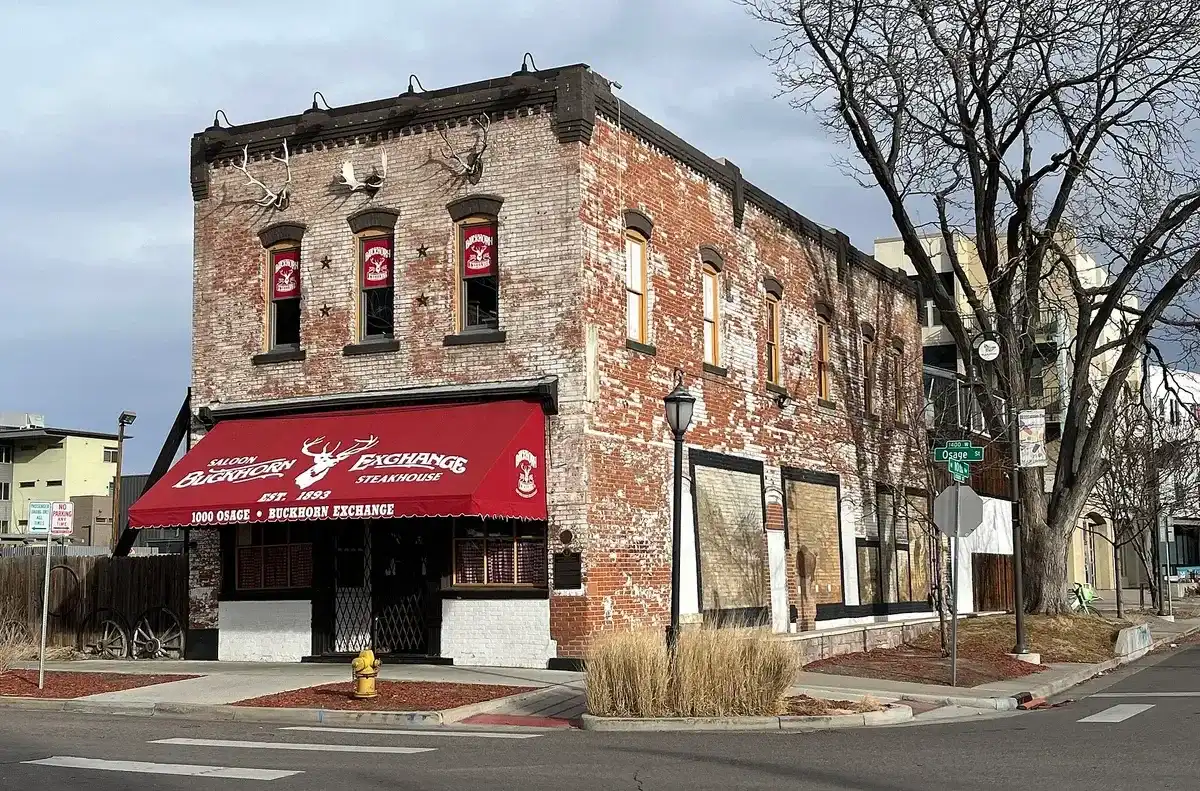
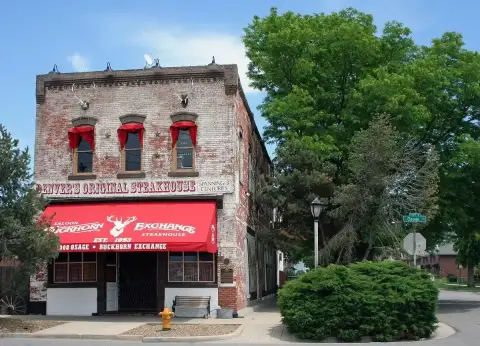
The claim
A saloon of the early 1890s across the street from the old Rio Grande railway yards, opened by one of Buffalo Bill's scouts and hung with some seven hundred mounted animal heads. Railwaymen cashed their pay here for a token good for a lunch and a beer. The 1857 oak bar from Essen went upstairs in 1978 and pours beneath Colorado liquor licence number one, issued the year Prohibition ended.
What the records show
Henry H. Zietz, a plainsman who had ridden with Buffalo Bill's scouts and was nicknamed Shorty Scout by Sitting Bull, opened a saloon at 1000 Osage Street in 1893 across from the Rio Grande railway yards, where he took railwaymen's pay cheques on a Friday and handed back a token for a lunch and a beer. That account, and the specific date 1893, are in the nomination the National Park Service accepted in April 1983 (ref. 83001292), which calls the house one of Denver's oldest restaurant bars and says the business has continued in its original use apart from Prohibition. The nomination's own earliest source for the 1893 is a Rocky Mountain News series of July 1936, and the earliest contemporary paper it lists is a Denver telephone and business directory of 1905, so no document of the 1890s has been read from here — the Colorado Historic Newspapers collection and the Colorado Encyclopedia both refuse an automated request. Denver Public Library's special collections tell it differently, and earlier: their file for the building has it put up in late 1885 or early 1886 for John M. Berkey, sold to the Neef Brothers Brewery and Investment Company in 1889, and trading as a saloon called the Rio Grande Exchange from November 1892 under Zietz, with the Buckhorn name arriving in the early 1900s and Zietz only buying the building in 1932. Nothing has been found to decide between the two accounts, and the difference matters: on the library's reading the drink here is a few months older than the claim and the sign a decade younger. The dated drink record that is not in dispute is later and is on the wall: Colorado liquor licence number one, issued in 1933 when Prohibition ended and the family reopened the grocery they had made of the saloon as a restaurant and bar. The white oak bar was made in Essen in 1857 and stood inside the front door until 1978, when new owners closed the upstairs lodging rooms and moved it up to make a second drinking room.
| Year | What | Source |
|---|---|---|
| 1893 | Claimed founding | The pub |
| c.1893 | Present building | https://npgallery.nps.gov/NRHP/GetAsset/NRHP/83001292_text |
| 1933 | First record of a drinking house here | National Register of Historic Places |
What to look for inside
- Colorado liquor licence number one, issued in 1933, hangs in the bar
- The white oak bar was made in Essen in 1857 and brought to Denver by Zietz's father
- Theodore Roosevelt called in from his train in the Rio Grande yards in 1905
Visiting
Buckhorn Exchange is in Denver, United States, at 1000 Osage Street, Denver, Colorado. We do not list opening times, because they change; the pub’s own site is the place to check before you set out.
Sources
- npgallery.nps.gov/NRHP/GetAsset/NRHP/83001292_text
- savingplaces.org/stories/the-buckhorn-exchange-in-denver-colorado
- visitdenver.com/blog/post/first-colorado-liquor-license/
- en.wikipedia.org/wiki/Buckhorn_Exchange
- www.buckhorn.com/history/
- www.openstreetmap.org/node/519549594
- history.denverlibrary.org/building/buckhorn-exchange
Know something we don’t?Suggest a correctionLast checked Sept 2026
Run this pub? There is a badge for it
Free to put on your own site, no permission needed. It shows what the pub claims and what the records support, and it changes when the data does.
How to use it, and how to change what it says — if you have a document we have not seen, we would like to read it.
.jpg)
