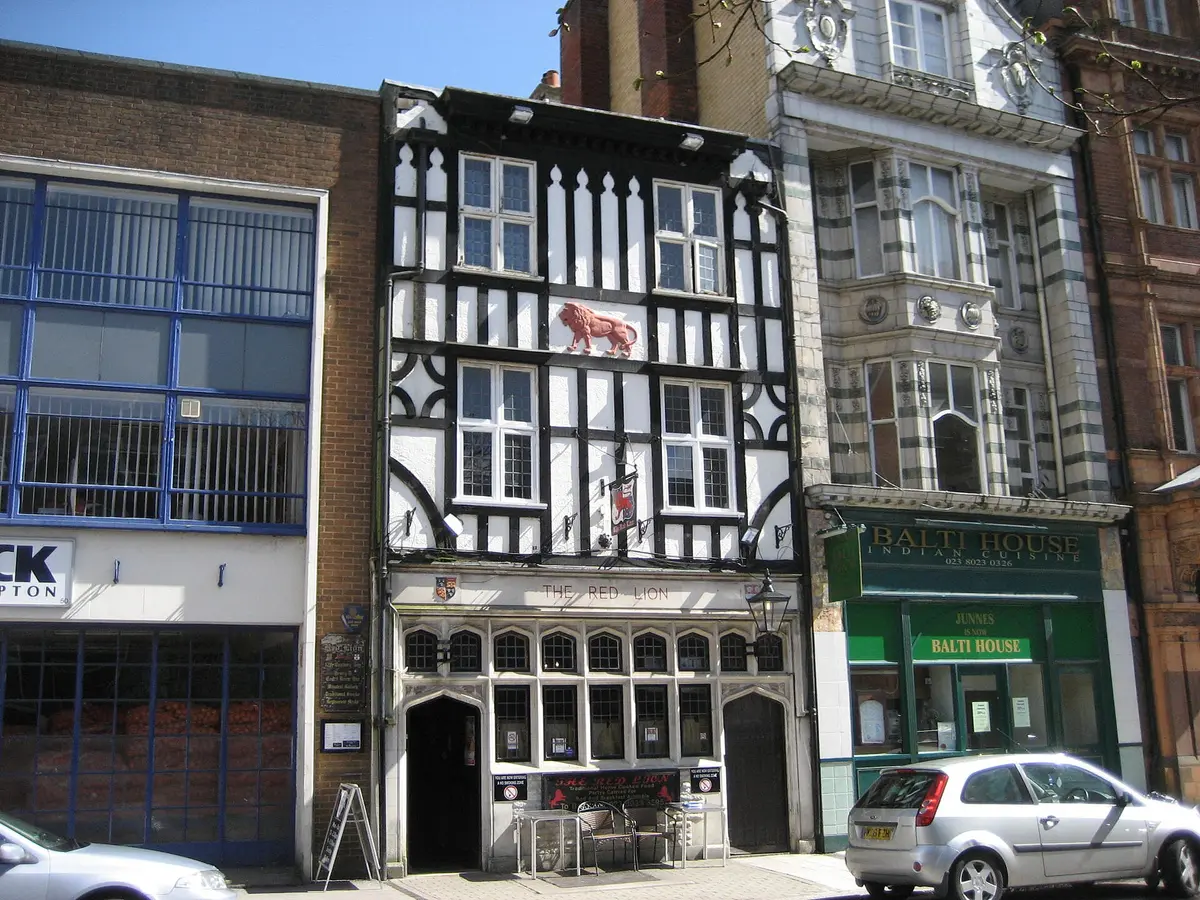

The claim
Behind a tall mock-Tudor front on the lower High Street in Southampton, the Red Lion opens into one of the best rooms in any English pub: a medieval hall, open the full height of the building to its tie-beam roof, with panelled galleries at first-floor level and the bar running up into the timbers. The upper room is signed as Henry V’s Court Room, and the story attached to it is specific and dramatic. In the summer of 1415, with the fleet for Agincourt gathering in Southampton Water, three men were tried here for conspiring to kill the king and put Edmund Mortimer on the throne. Richard of Conisburgh, Earl of Cambridge; Henry Scrope, Baron Scrope of Masham; and Sir Thomas Grey.
That is the Southampton Plot, and it is entirely real. Grey was beheaded on 2 August 1415 and the two peers on the fifth, all three in front of the Bargate, a few hundred metres up the same street. The question is only whether the hearing that condemned them happened in this building.
What the records show
It did not, on any reading of the evidence we can find, and the reasons are arithmetic before they are archival.
There is no contemporary record placing the trial at the Red Lion. The tradition is a local one, and local traditions about royal visits are the commonest kind in the English pub. What the sources do say is that the men were held in Southampton’s royal castle, that Henry V was himself staying there while the fleet assembled, and that the trial took place in the castle in the king’s presence — the account the historian Ian Mortimer follows, and the one the local history project Historic Southampton sets out in detail.
Put those together and the tradition asks a lot. Three prisoners of the first rank, one of them the king’s own cousin, held in a fortress with a great hall in it, with the king in residence, are said to have been walked several hundred metres down the town’s main street to be tried in a room above a merchant’s house. The castle had everything the occasion needed. Nothing suggests anyone thought the High Street a better venue, and no document says they did.
The building, dated
The decisive objection is that the room did not exist.
Historic England lists the house at Grade II*, designated on 14 July 1953, as list entry 1092055, and the title of the entry is itself worth reading: Red Lion Inn including medieval vault. The standing building is a late fifteenth or early sixteenth-century hall house, well preserved, one of the better survivals of medieval Southampton. Local accounts date it more precisely to the end of the fifteenth century — roughly seventy-five years after the plot. The timber-framed front is a twentieth-century addition, of the 1920s; the house was damaged in the Second World War and restored in 1952.
The vault below is the only part of the site that reaches back far enough to be in the conversation. Historic England describes it simply as medieval and says it probably belonged to an earlier building on the same plot; one local account puts it in the twelfth century. So there was something here in 1415, and it was somebody’s cellar under somebody’s house. The hall the Court Room sits above came later, and a room cannot host a trial three generations before it is built.
The 1148 that goes with it
The date the pub itself uses is 1148, and it belongs to that vault rather than to any record of drinking. Southampton’s local histories give the first licence to sell alcohol here as 1552 — four centuries after the claimed foundation and a century and a half after the plot.
That pattern is the most common one on this site: a cellar of one date, a house of another, a licence of a third, and a sign carrying the earliest of the three. Hampshire has it twice over, because the Red Lion at Chalton thirty miles away claims 1148’s neighbour, 1147, on an unrelated tradition about the men who built the church opposite. Two Red Lions with dates a year apart and no connection between them says more about how pub dates are arrived at than any argument could.
Why the room is still worth the walk
Nothing above should be read as a reason to skip it, and there is a reason to hurry.
The interior is on the Campaign for Real Ale’s National Inventory of Historic Pub Interiors, the short list of pub rooms judged nationally important, and the hall is the most impressive thing on this site’s Hampshire pages. It is also in trouble. Historic England’s Heritage at Risk register for 2025 assesses the Red Lion Public House at 55 High Street as being in poor condition, of medium vulnerability, with a stable trend, in priority category C: slow decay, no solution agreed. A Grade II* medieval hall in poor condition is a building on a clock.
Check opening times before travelling, because a house in that condition is a house whose hours can change, and read the page for the oldest pubs in Hampshire for what else is within reach.
So what happened at the Red Lion?
Six hundred years of drinking, and not a trial.
The honest account is this. There was a house on this plot in 1415, with a vaulted cellar under it. The hall above, the one shown to visitors, was built towards the end of that century. The first licence recorded here is 1552. The plotters were held in the castle, tried in the castle, and beheaded at the Bargate. The Court Room is a late medieval merchant’s hall that acquired a royal story, probably in the nineteenth century when every old inn was acquiring one, and it has kept it because the room is exactly the sort of place a treason trial ought to have happened in.
Our methodology explains why a legend of this kind is printed rather than deleted: the story is part of what the building is now, and a reader who has been told it deserves to be told what the record says as well. For the wider shape of the problem, how historians date an old pub sets out what a hall, a vault and a licence can each actually prove.
Sources
- historicengland.org.uk/listing/the-list/list-entry/1092055
- en.wikipedia.org/wiki/Red_Lion_Inn,_Southampton
- en.wikipedia.org/wiki/Southampton_Plot
- historicsouthampton.co.uk/duke-red/
- sotonopedia.wikidot.com/page-browse:red-lion-public-house
- historicengland.org.uk/listing/heritage-at-risk/search-register/list-entry/49859
- camra.org.uk/pubs/red-lion-southampton-188766
Found something wrong?Suggest a correction