By claim, the oldest pub in Hampshire is the Royal Oak in Winchester, which says parts of it date from 1002 and the household of Queen Emma. That is legend, and the same pub holds the county's earliest documentary record by a wide margin: local historians cite an unnamed taverner on the site between about 1390 and 1430, and a schedule of 1637 naming a tapster with a brewhouse. Nothing here can produce a licence from the twelfth century.
Hampshire's oldest-pub question has been argued in the local press, which is a fair reflection of how these contests usually work. The Petersfield Post set the Royal Oak in Winchester against the Red Lion at Chalton and left readers to choose. Look at the dates on the three pubs here and a coincidence stands out: two of them, in different towns and with no connection to each other, claim 1147 and 1148. Neither figure is a licence. Chalton's is the church-builders' tradition, the men raising St Michael's housed in a thatched timber-framed building across the lane; Southampton's belongs to a medieval vault below a hall house whose frame is late fifteenth or early sixteenth century, behind a mock-Tudor front of the 1920s. The pub with the real medieval paperwork is the one with the most decorative story attached, and the pub with the finest building has the weakest date. That inversion is the county in miniature, and the listings sharpen it: Historic England dates the Royal Oak's frame to probably the fifteenth century while its sign says 1002. The third, the Red Lion in Southampton, is Grade II* with an interior CAMRA counts among the most important in the country.
Winchester against Chalton
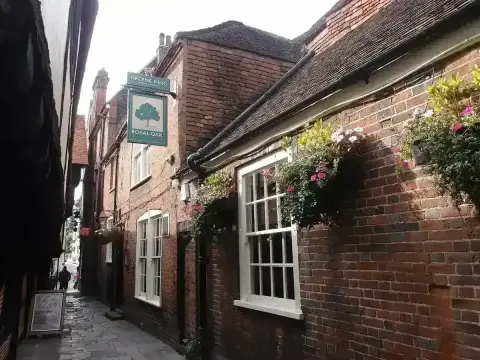
The Royal Oak is reached down Royal Oak Passage off Winchester High Street:
a low, panelled room of uncertain date with a small garden, quiz nights and Sunday lunches. Its Queen Emma
story is fanciful and its actual history is better than most — a taverner recorded here at the end of the
fourteenth century, and a brewhouse in the hands of a named tapster by 1637.
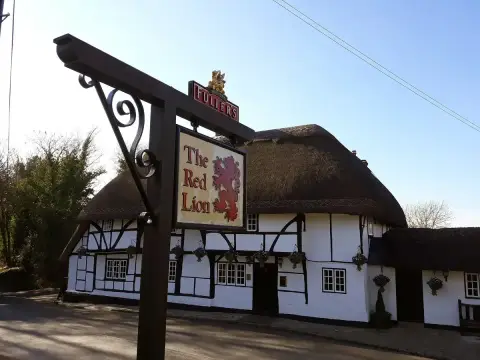
The Red Lion at Chalton is the more photographed of the two, thatched and
whitewashed opposite the church in a South Downs hamlet, with a great inglenook in the old public bar and a
modern dining room looking out over the downs. It was photographed as early as the 1850s, a print of which is
held in the National Gallery of Victoria, and that image is the oldest hard evidence anyone has offered for it.
The hall house on Southampton High Street
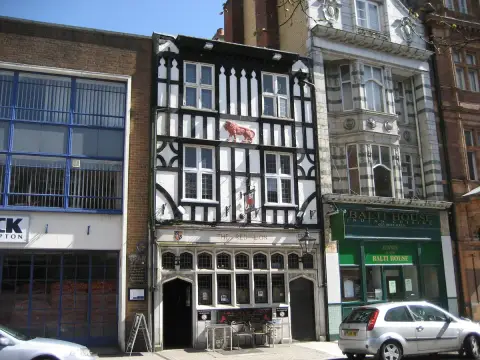
The Red Lion is the building to travel for. Behind a tall 1920s front on the old
High Street stands a late medieval hall, the bar running up the full height of it to the roof timbers, with
panelled galleries above and a vaulted chamber below. Two Red Lions with dates a year apart is a coincidence
that says something about pub naming rather than pub history, and
why so many pubs are called the Red Lion explains where the sign
comes from. For the county comparison see the oldest pubs in England, and for other
buildings under thatch, thatched pubs.
The link with Queen Emma's residence in 1002 is legend. Local historians cite records of an unnamed taverner here between about 1390 and 1430 and a 1637 schedule naming a tapster with a brewhouse, which gives it one of the better documented medieval tavern histories in Hampshire.
Claims 1002; first recorded 1430; building c.1450.
Tradition holds the house was built about 1147 for the builders of St Michael's church and became an inn between the 14th and 16th centuries. Two published readings now stand against that year. The Victoria County History of Hampshire (volume 3, 1908) calls parts of the house at least 500 years old — about 1400, counted from when it was written — and dates the church's oldest fabric, the chancel, to the middle of
The 1148 that local accounts attach to the Red Lion belongs to the cellars, not to any record of drinking here. Historic England lists the building Grade II* as a well-preserved late C15 or early C16 hall house, with a medieval vault below probably left from an earlier house, and the frontage is 1920s. Southampton's local histories give the first licence as 1552. The upper room is shown as the court of the 1415
1148 with no published claimant; first recorded 1552.
The photographs above are other people's work, used under open licences. Every photographer, licence and source page is named in the image credits.
Common questions
Which is the oldest pub in Hampshire?
On the evidence, the Royal Oak in Winchester, down a passage off the High Street. Its claim to fabric from 1002 and Queen Emma is legend, but local historians record a taverner on the site between about 1390 and 1430, which is one of the better documented medieval tavern histories in the county.
Is the Red Lion at Chalton Hampshire's oldest pub?
It is usually described that way, on a tradition that it was built about 1147 for the men raising St Michael's church opposite and became an inn somewhere between the fourteenth and sixteenth centuries. Sources disagree and no licence date has been published, so Winchester's documented record is the stronger case.
Is the Red Lion in Southampton really from 1148?
The 1148 attaches to the cellars rather than to any record of drinking. Historic England lists a well-preserved late fifteenth or early sixteenth-century hall house with a medieval vault below, probably left from an earlier building, and Southampton's local histories give the first licence as 1552.
Were Henry V's plotters tried in the Red Lion?
The upper room is shown as the court of the 1415 Southampton Plot. The standing hall is later than the trial and no record we found places the hearing here, though a medieval vault survives from an earlier building on the site. The room itself is remarkable regardless — a medieval hall open to its tie-beam roof, with galleries at first-floor level.
Which Hampshire pub has the best interior?
The Red Lion in Southampton, on CAMRA's National Inventory of Historic Pub Interiors, where the bar rises the full height of the medieval hall. The Royal Oak's frame is listed as probably fifteenth-century; the Red Lion at Chalton we have not been able to trace to a listing entry.