
The claim
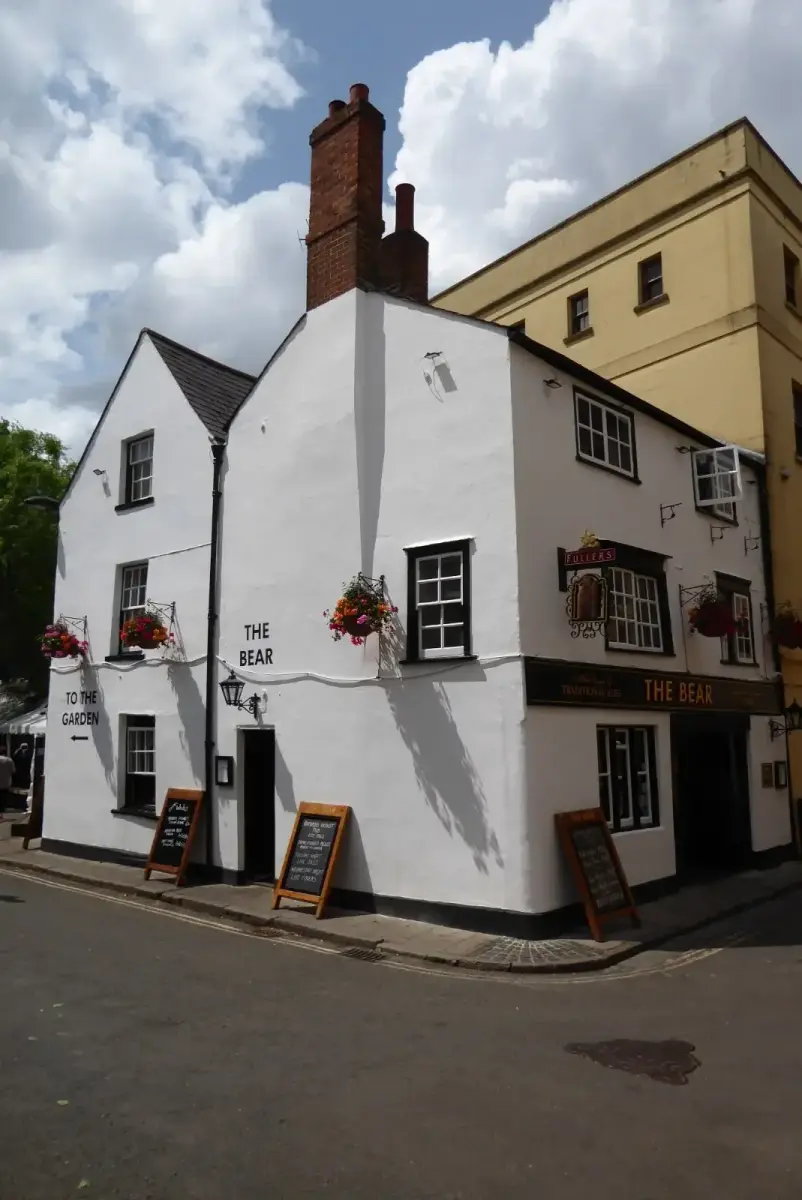
The Bear is a very small pub on the corner of Alfred Street and Blue Boar Street, a minute from Christ Church, with two low rooms, thousands of snipped-off tie ends in glass cases and a date on its signage: 1242. On that number it is commonly called the oldest pub in Oxford, and a good deal of the city’s tourist traffic arrives at the door because of it.
The unusual thing about this claim is that the date is not invented, not rounded and not borrowed from a battle. There is a document behind it, of roughly the right period, and an archaeological report published in 2018 cites it. The trouble is what the document is about.
What the records show
Oxford has better medieval property records than almost any English town, because the colleges and the priories kept their deeds and the historian H. E. Salter spent the 1920s working through them. The result is that the Bear’s history can be followed in unusual detail — and that it can be seen to belong somewhere else.
The earliest mention is in the cartularies of St Frideswide’s Priory, in the middle of the thirteenth century, when Christina Pady bequeathed property to the priory in frankalmoign, that is in free alms. Cotswold Archaeology, summarising the site’s history in its 2018 report, takes the view that the properties Christina Pady gave formed the yard of the inn — and locates that inn on the corner of the High Street, at numbers 123 and 124, where it had grown out of a medieval tenement called Parne Hall. The next document is a tenancy agreement of 1277, under which Thomas Pope, his wife and his son were assured the house for the rest of their lives at two marks a year on a deposit of thirty marks.
Then it burned. The original building was destroyed by fire in 1421. In 1432 the rebuilt inn was leased to John and Joan Berford, and at that date it was called Le Tabard; by 1457 the sign had become the Bear. A lease of 1523 fixes its boundaries and tells us the Bear was bounded on the south by the cemetery of St Edward’s church. On one detail the sources disagree: the Oxford History project has the inn called Le Tabard established in 1421 and soon renamed, where the archaeological report has the fire in 1421 and the Tabard name attached to the lease of 1432. Either way the sign moved twice in the fifteenth century, which is worth remembering the next time a pub name is treated as evidence of continuity.
The building, dated
The house a drinker now stands in is a different building on a different street, and its own date is seventeenth century.
Historic England lists the Bear Inn public house at Grade II, list entry 1047357, designated on 12 January 1954. Cotswold Archaeology’s report describes it as possibly built in the early seventeenth century and altered since — and then, six pages later in its own discussion, calls it late seventeenth century. The commonly published date is 1606. A hundred-year spread inside one report is a fair signal of how loosely the fabric has been dated, and nobody has tree-ring tested it.
What the building was is not in doubt. It was the residence of the coaching inn’s ostler — the man who looked after the horses — standing in the Bear’s yard and stable ground behind the High Street frontage. That is why it is tiny: it was never a public room. Alfred Street was Bear Lane before it was Alfred Street, and Vine Hall Street before that, and in 1220 it appears as Venella Sancti Edwardi, the lane of St Edward’s church.
How the name moved
The transfer can be dated to the year, which is what makes this case unusually clean.
The big inn on the High Street spent the eighteenth century as a coaching house. John Bew had it from about 1745 and ran Bew’s Oxford Machine to the Black Bull in London three times a week by 1760; Thomas Rackstrow took it in 1784, announced in 1789 that he had enlarged it and claimed in 1792 to have rebuilt it. In 1801, having failed to sell, it closed, and the premises were converted into two shops. They are still there, and still listed.
The ostler’s house had already gone its own way. It became a separate tavern, under the name the Jolly Trooper, in 1774. When the Bear on the High Street shut in 1801 the name was transferred to the Jolly Trooper, and the Jolly Trooper has been the Bear ever since. So the sequence is a house that was not a pub until 1774, trading under another name for twenty-seven years, inheriting in 1801 the sign — and eventually the date — of a bigger inn that had been demolished round the corner.
The tie collection, incidentally, is genuine and began in 1952: more than 4,500 snipped ends, catalogued in cases round the walls.
The bones under the cellar
In 2018 the pub dug a sump in its cellar and found a person.
Cotswold Archaeology were called in for a watching brief for Fuller, Smith & Turner — project 770796, report 18435, August 2018 — after human remains turned up unexpectedly. Thames Valley Police were informed first, as they must be. What the archaeologists recorded was graveyard soil at 100 to 150 mm below the cellar floor, disarticulated bone from feet, ribs, shoulder and one cheek, and then an articulated lower leg — tibia, calcaneus and metatarsals — running underneath the external wall of the cellar. A burial that continues under a wall was there before the wall was.
The burial ground is St Edward’s, whose church stood on the west side of the lane and which was given to St Frideswide’s in 1122; the parishes were united by 1298 and St Edward’s became the church of the united parish. Bone has been coming out of this corner for a century and a half: remains were found along Blue Boar Lane in 1874, medieval pottery during footings work in 1914, a number of medieval skulls in 1937, and burials next door at 5 Alfred Street in 1963.
This is the most satisfying part of the story, because it is the part where something under the Bear really is medieval. Not the pub. The churchyard it was built on.
So how old is the Bear?
The house is early seventeenth century, the licence is 1774, and the 1242 is a real document about somewhere else.
Nothing here is dishonest so much as inherited. A pub that is handed a name in 1801 is handed the name’s history with it, and by the time anybody wrote a guidebook the distinction had gone. The Bear is genuinely old, genuinely small, and standing on a medieval churchyard, which is more than most pubs can say. What it is not is a house that has been serving since the thirteenth century, and the city’s own records are the reason we can be sure.
Oxford has form for this. The Turf Tavern advertises 1381 and Salter found it first recorded as a public house, under the name the Spotted Cow, towards the end of the eighteenth century; the Chequers has the earliest date anybody here can verify, 1605. All three are on the walk through Oxford’s oldest taverns, and the city’s full list is at the oldest pubs in Oxford. How our grades work is set out in the methodology.
Sources
- reports.cotswoldarchaeology.co.uk/wp/content/uploads/2019/02/770796-WB-report-Bear-Inn-Oxford.pdf
- oxfordhistory.org.uk/high/tour/south/bear_inn.html
- historicengland.org.uk/listing/the-list/list-entry/1047357
- en.wikipedia.org/wiki/The_Bear,_Oxford
- bearoxford.co.uk/
- camra.org.uk/pubs/bear-inn-oxford-157007
Found something wrong?Suggest a correction