Blog
Why Do London Pubs Close at Eleven?
They do not have to, and no law says they must. Fixed national closing times ended with the Licensing Act 2003, which left each pub's hours to its own premises licence. Eleven o'clock is a habit with a paper trail, and it runs back to a 1921 statute that gave London an hour the rest of England and Wales did not get — and further back to a wartime board set up to keep munitions workers at their benches.
Published 28 September 2026

What this establishes
- Eleven o'clock closing is London's before it is anybody else's, and it is datable. Section 1(1) of the Licensing Act 1921 set weekday hours at "eight hours, beginning not earlier than eleven in the morning and ending not later than ten at night, with a break of at least two hours after twelve (noon)", and then provided that "in the application of this provision to the metropolis 'nine' shall be substituted for 'eight,' and 'eleven at night' shall be substituted for 'ten at night'". The metropolis got a ninth hour in 1921; the rest of England and Wales did not get eleven until the Licensing Act 1988.legislation.gov.uk
- The Act that abolished closing time names no closing time. We read the consolidated text of the Licensing Act 2003 through: "permitted hours" appears five times and every one of the five is in Schedule 8, the transitional provisions, describing the hours a justices' licence allowed under the 1964 Act while old licences were being converted. The clock time "11.00 p.m." appears twice, both in Schedule 2, in the definition of late night refreshment — the supply of hot food or hot drink between 11.00 p.m. and 5.00 a.m.legislation.gov.uk
- Parliament abolished the wartime liquor board and kept its timetable, in the same Act and two Parts apart. Part II of the Licensing Act 1921 is headed "Winding-up of Central Control Board (Liquor Traffic)" and section 15 repeals the Intoxicating Liquor (Temporary Restriction) Act 1914 and the Defence of the Realm (Amendment) (No. 3) Act 1915 and abolishes the Board; Part I keeps the afternoon break the Board had introduced. The break was still on the statute book in section 60(1)(a) of the Licensing Act 1964 — "a break of two and a half hours beginning at three in the afternoon" — and was struck out by section 1 of the Licensing Act 1988.legislation.gov.uk
- Drinking-up time was doubled by an Act of Parliament whose relevant section is one sentence long. Section 2 of the Licensing Act 1988, in full: "In section 63(1) of the principal Act, for the words 'ten minutes' there shall be substituted the words 'twenty minutes'." The call that goes with it is not statutory: we read the Licensing Act 1964 end to end and the words "time, gentlemen, please" appear nowhere in it.legislation.gov.uk
- The "24-hour drinking" the 2003 Act was said to have brought in is, on the Home Office's own count, about one premises licence in twenty-two. At 31 March 2024 there were 224,100 premises licences in force in England and Wales and 10,300 premises with a 24-hour alcohol licence, of which 38 per cent were supermarkets and stores and 31 per cent hotel bars. The department adds that such a licence "refers to premises that are licensed for the sale or supply of alcohol 24 hours per day (but may not operate 24 hours per day)".gov.uk
There is no law that closes a pub in England or Wales at eleven o’clock. Fixed national hours ended with the Licensing Act 2003, fully in force from 24 November 2005, which repealed the Licensing Act 1964 outright and put every pub’s hours into its own premises licence. Eleven survives as a habit, a lease clause, a planning condition and the verdict of a licensing sub-committee. It is not a statute and has not been one for twenty years.
That is the honest answer to the question, and it is better than the answer the question expects, because the eleven o’clock everybody remembers is entirely real, it is peculiarly London’s, and it began as a scheme for getting shells filled on time.
Nothing in the current Act says eleven
A pub’s hours now come from section 17 of the 2003 Act, which requires an applicant to file an operating schedule stating “the times during which it is proposed that the relevant licensable activities are to take place” and “any other times during which it is proposed that the premises are to be open to the public”. The pub proposes; the licensing authority, having heard the police and the neighbours, decides. There is no national timetable to consult, because Schedule 7 repeals the whole of the Licensing Act 1964 and the whole of the Licensing Act 1988 along with it.
We read the consolidated text to see what was left of the old regime, and the answer is: a memory in the small print. The phrase “permitted hours” appears five times in the Act, and every one of the five sits in Schedule 8, among the transitional provisions, meaning the hours an old justices’ licence allowed while it was being converted into a premises licence. The clock time “11.00 p.m.” appears twice, both of them in Schedule 2, in the definition of late night refreshment: the supply of hot food or hot drink between 11.00 p.m. and 5.00 a.m. The only eleven o’clock in the Act that replaced closing time is about a hot pie.
So when a London pub calls last orders at half past ten and puts the lights up at eleven, the reason is on the licence for that address, and the reasons behind the licence are prosaic. The hours somebody applied for in 2005 and nobody has varied since. A condition the committee attached after the flats next door wrote in. A brewery lease. A rota. The last train. None of it is uniform, which is why this site prints no opening hours: check the pub’s own website before you set out.
Eleven o’clock is London’s, and it dates from 1921
The first restriction arrived five weeks into the First World War. The Intoxicating Liquor (Temporary Restriction) Act 1914 of 31 August 1914 let licensing justices, on the chief constable’s recommendation and where it was desirable “for the maintenance of order or the suppression of drunkenness”, order that sale be suspended during such hours as they specified — with a proviso that any order biting earlier than nine at night had to be approved by the Secretary of State in person.
Then came the Defence of the Realm (Amendment) (No. 3) Act 1915 of 19 May 1915, which gave the Crown power to take the liquor trade of an area into state control on the ground “that war material is being made or loaded or unloaded or dealt with in transit in the area” or that naval or military forces were assembled there. The body it created, the Central Control Board (Liquor Traffic), is where the afternoon break comes from. Pubs shut in the middle of the day so that the people making munitions went back to work after lunch. The stated interest of the state was industrial output, which is worth holding on to: the afternoon closure was a production measure that happened to be about beer.
Then 1921, the year that actually answers the question. The Licensing Act 1921 of 17 August set weekday hours at “eight hours, beginning not earlier than eleven in the morning and ending not later than ten at night, with a break of at least two hours after twelve (noon)”. And then the proviso: “in the application of this provision to the metropolis ‘nine’ shall be substituted for ‘eight,’ and ‘eleven at night’ shall be substituted for ‘ten at night’”. London, alone, was given the ninth hour. Everywhere else in England and Wales shut at ten, or at half past where the local justices ordered it.
London pubs close at eleven because in 1921 Parliament handed the metropolis one hour more than the rest of the country, and the rest of the country took sixty-seven years to catch up.
The comedy of the 1921 Act is structural. Part II of it is headed “Winding-up of Central Control Board (Liquor Traffic)”, and section 15 repeals both wartime Acts and abolishes the Board in a single sentence. Parliament wound up the emergency in Part II and kept its timetable in Part I. Where the Board had gone furthest, in Carlisle, the state simply went on owning the pubs: state management was not abolished until the Licensing (Abolition of State Management) Act 1971.
The afternoon that lasted until 1988
Forty-three years after the war, the break was still there in black letter. Section 60(1)(a) of the Licensing Act 1964 gave, on weekdays, “the hours from eleven in the morning to half past ten in the evening, with a break of two and a half hours beginning at three in the afternoon”, and subsection (2) added that “in relation to the metropolis” those hours “shall have effect as if the hours specified therein ended at eleven in the evening”. London’s extra hour, still in place, forty-three years on.
Section 1 of the Licensing Act 1988 finished it: out went the words “with a break of two and a half hours beginning at three in the afternoon”, and in went “eleven” for “half past ten”, which is the moment England and Wales as a whole joined London. A rule written to keep munitions workers at their benches outlived the war that produced it by seventy years and the board that imposed it by sixty-seven.
The same Act contains section 2, which we quote in full because that is all of it: “In section 63(1) of the principal Act, for the words ‘ten minutes’ there shall be substituted the words ‘twenty minutes’.” Drinking-up time, doubled by Act of Parliament. The words that traditionally accompany it are not the law’s at all — we read the 1964 Act end to end, and “time, gentlemen, please” is nowhere in it. Parliament supplied the deadline and the trade supplied the line.
Scotland had gone first
Section 53(2) of the Licensing (Scotland) Act 1976 set public house hours at “the period between eleven in the morning and half-past two in the afternoon and the period between five and eleven in the evening”, with Sunday opening available on application to the licensing board. Scotland had eleven o’clock from end to end, and a much shorter afternoon gap, while most English pubs were still putting the towels over the pumps at half past ten. Scotland has since gone its own way again, under the Licensing (Scotland) Act 2005.
The 24-hour drinking that did not happen
The phrase attached to the 2003 Act in advance was “24-hour drinking”. We counted what arrived, in the Home Office’s licensing statistics for England and Wales: at 31 March 2024 there were 224,100 premises licences in force and 10,300 premises holding a 24-hour alcohol licence, which is about one in twenty-two. Of those 10,300, 38 per cent were supermarkets and stores and 31 per cent hotel bars. The department’s own note does the rest of the work: a 24-hour licence “refers to premises that are licensed for the sale or supply of alcohol 24 hours per day (but may not operate 24 hours per day)”. What most pubs asked for in 2005 was an hour, and what most of them use it for is a Friday.
What that looks like in the pubs
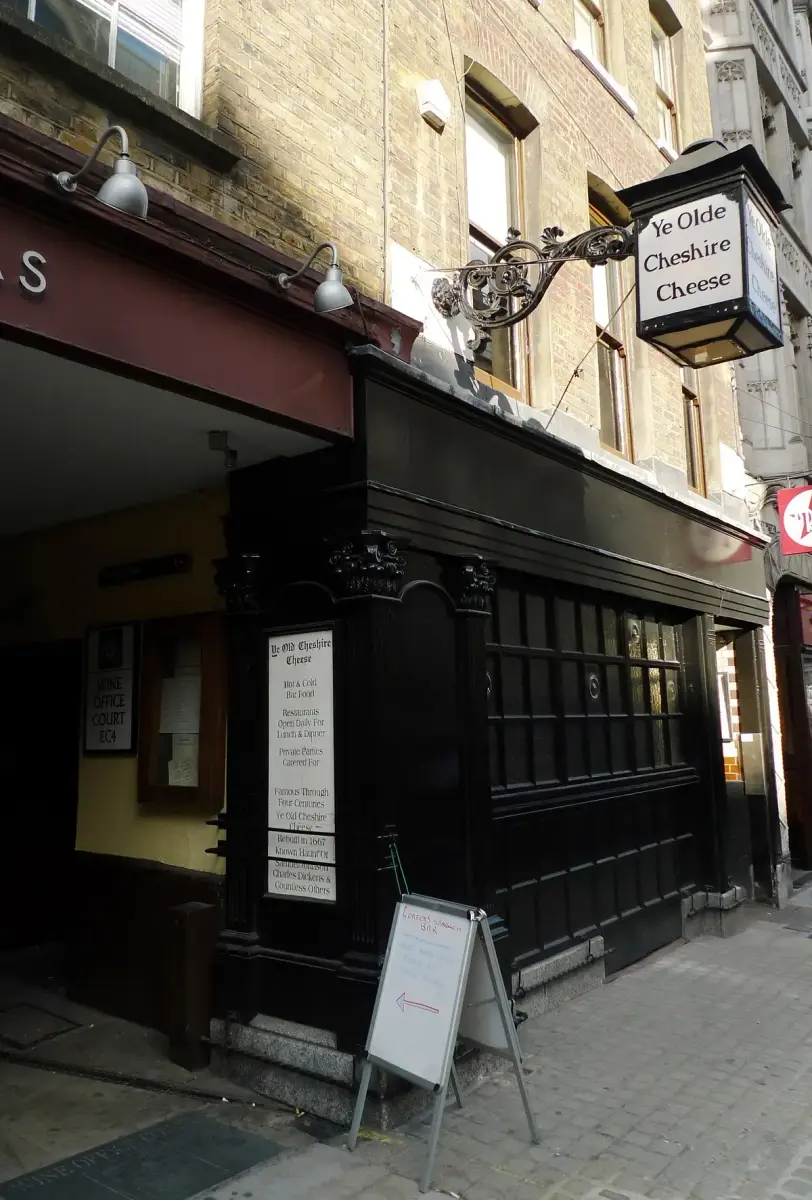
Ye Olde Cheshire Cheese in Wine Office Court, off Fleet Street, claims 1538 and the earliest record we hold for it is a broadside ballad of 1680; the house itself went up after the Great Fire of 1666. It was trading before the Board, through it, under the 1921 hours, through the 1964 consolidation and the 1988 afternoons, and it trades today on a premises licence like everybody else. The George Inn in Southwark, whose surviving south range was rebuilt in 1677 after the Southwark fire, is grade I listed and usually described as the last galleried coaching inn left in London; it kept coaching hours before anyone thought to legislate hours at all. And our row for Ye Olde Mitre in Ely Court, taken from the pub’s own site, records a house that does not open on Sundays — the modern position in miniature, where the week belongs to the pub and not to Parliament.
If you want the capital’s arguments about age rather than about hours, they are on the London list and in the oldest-pub-in-London claim, checked. For the longer arc from alehouse to premises licence, start with the history of the British pub.
Eleven o’clock, then, is not a closing time. It is a hundred-year-old administrative concession to one city, kept on out of habit by a country that has been free to do otherwise since 2005.
The pubs in this post
- Ye Olde Cheshire Cheese London
- The George Inn London
- Ye Olde Mitre London
More in the blog, and every change to the data at what changed.