Blog
The Mermaid Leaves the Top 100
The Mermaid at Rye is one of the best-known old inns in England and it has come off our own Top 100, because a topographer writing in 1847 says the house stopped being an inn about 1767 and names the private owner who had it instead. That is a break in the trade, not a gap in the paperwork, and the rule we published in September says a pub dates from when it resumed.
Published 26 September 2026
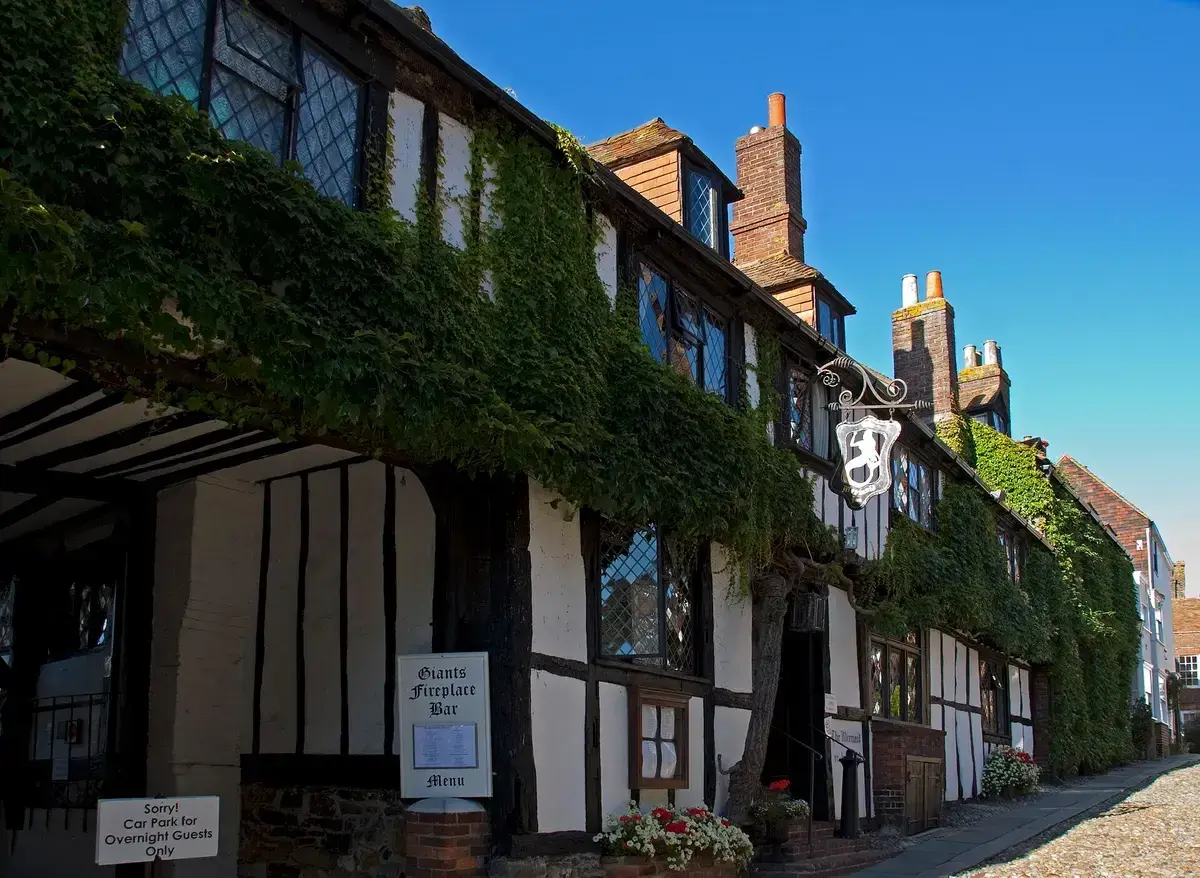 Photo: Tony Hisgett from Birmingham, UK · licence

What this establishes
- William Holloway's history of Rye, published in 1847, walks up Mermaid Street house by house and says of the Mermaid that "it only ceased to be an inn about eighty years ago" — about 1767 — and that its wainscoting "is carefully preserved by its present proprietor, Mr. Charles Poile". The passage names what the house was instead of an inn, which is what makes it a record of closure rather than a silence.archive.org
- Boyne and Williamson's catalogue of seventeenth-century trade tokens, in its 1889 edition, says under the Rye entry for Michael Cadman's farthing that "there is now no Mermaid Inn, but it formerly stood on the north side of the present Mermaid Street at Rye, and ceased to be an inn about 1770". It is an independent statement, by different authors for a different purpose, and it agrees with Holloway to within three years.archive.org
- Louis J. Jennings went to Rye to find the Mermaid in the 1870s and could not. The sexton told him "I never heerd of it"; an old man said the inn had "gone ever so long ago, sir" and pointed out the house, where "a labouring man lives in it now"; the woman at the door said "yes, but now we lives in it". Published testimony that the house was not trading, from somebody who looked.archive.org
- Wikipedia's article on the Mermaid cites Holloway at page 327 for the statement that the house became a private residence. We read both scans of the 1847 edition on the Internet Archive and the passage is at page 601, in the Antiquities chapter. Anybody checking our working against that footnote will not find the sentence where the footnote sends them.en.wikipedia.org
- The 1891 census for Mermaid Street does not list the house as an inn because it was let as lodgings, and it appears as an inn again by the 1901 census, according to Sheila Maddock's account for the Rye Castle Museum. Between those two returns is the point at which the house starts being a pub again.ryemuseum.co.uk
The Mermaid Inn on Mermaid Street at Rye is one of the most photographed old buildings in England. Its front is dated 1420, its cellars are older than that, and it tells visitors it was founded in 1156. It is also, from today, not in our Top 100. This post is about why, because a pub leaving our own list is the most useful thing we can show you about how the list is made.
What we were actually trying to settle
The Mermaid’s row had a two-century hole in it. The last paper we held that calls the house an inn was dated 1758; the next firm thing was 1955. A hole like that has two completely different explanations and they lead to opposite answers.
The first is that the records simply do not survive. Licensing series are patchy, quarter sessions records burn and flood, and a house can trade for two hundred years without leaving a document that reaches us. If that is what a gap is, then it is our ignorance and not the pub’s history, and the honest thing is to keep the pub ranked and print the gap on the page where a reader can see it.
The second is that the house stopped being a pub. If that is what happened, our rule is that the pub dates from when it started again, whatever the age of the walls. The building is not the business.
The difference between those two is not a matter of judgement. It is a question about whether a source exists, and we went looking for one.
The source that settled it
It is William Holloway’s History and Antiquities of the Ancient Town and Port of Rye, published in 1847, and you can read the page itself rather than take our word for it. In the Antiquities chapter Holloway walks up Mermaid Street describing each house in turn, and when he reaches the Mermaid he writes that it was “for many years the principal one of the town”, that “some old people still remember to have seen the sign-post”, and then this:
It only ceased to be an inn about eighty years ago.
Eighty years before 1847 is about 1767. And Holloway does not stop at the closure. He says the wainscoting inside “is carefully preserved by its present proprietor, Mr. Charles Poile” — a named private owner, of a house, not a landlord of an inn.
That last clause is what makes this decisive rather than suggestive. A source that says no licence survives tells you about the archive. A source that says the house stopped being an inn and then tells you who owned it as a private property instead is a positive record of what the building was for. Absence of evidence has become evidence.
We then looked for contradiction, which is the part that matters when a single sentence is about to move a pub off a list. We did not find any. Boyne and Williamson, cataloguing seventeenth-century trade tokens in 1889 for reasons that have nothing to do with Holloway, note under Michael Cadman’s Rye farthing that the Mermaid “ceased to be an inn about 1770”. Louis Jennings, walking the south coast in the 1870s, went looking for the inn and could not find anyone in Rye who knew it: the sexton said “I never heerd of it”, and an old man told him it had gone “ever so long ago, sir” and showed him the house, where a labouring man was living. Upstairs, in what had been the great chamber, Jennings found one widow with one room and her Dutch tiles. Sheila Maddock’s work for the Rye Castle Museum puts the 1891 census on the street and the house is in it as lodgings, not an inn; by 1901 it is an inn again. Three sources, three purposes, a century apart, all saying the same thing.
Two things we had wrong
Checking the claim properly also corrected our own file in two places, and both are worth printing.
The 1758 date was never a licensing record at all. We had it filed as the last year the house was licensed. It is actually the year a £4 annual charge on the property — settled on Rye’s free school by Thomas Peacock’s will of 1638 — was redeemed for £50 and the money lent on to another trust. It is a piece of school finance. All it proves is that in 1758 somebody writing about the charge still called the house an inn, which makes it the last dated paper to use the name and not a licence at all.
The second is smaller and more awkward. Wikipedia’s article on the Mermaid cites Holloway at page 327 for the private-residence statement. We read both Internet Archive scans of the 1847 edition and the passage is at page 601. Anybody who tries to check our working against that footnote will not find the sentence, so we are saying plainly where it is.
What changed on the site
The Mermaid keeps its page, its photographs, its map pin and every date we hold for it. What it loses is its place in the ranking, and the page now says why in a sentence rather than leaving a reader to wonder: the house stopped being an inn about 1770, spent the nineteenth century as a private house and then as lodgings, took guests again by the 1901 census, was a private club from 1913, and was not permitted a bar until 1955.
We have deliberately not written a year into the field that records when it became a pub again. We could have picked 1901, 1913 or 1955 and none of them is honestly the year that drink-led trade resumed — they are a census return, a club, and a counter. All three are after 1750, so which one we chose would make no difference to the ranking, and inventing precision we do not have to tidy a field is the exact habit this site exists to argue with.
The Mermaid was 22nd. Everything below it has moved up one place, and Ye Olde Bulls Head Inn at Beaumaris, which claims 1472, comes off the reserve bench into 100th. The hundred is still a hundred.
One thing did survive in the Mermaid’s favour, and we have added it. There is a seventeenth-century Rye trade token reading MICHELL CADMAN AT THE MEAREMADE IN RYE — a landlord’s token, struck for a man selling drink at the sign of the Mermaid. It is real evidence of the trade, from the same catalogue that records the closure. It carries no date, so the earliest year we can document for the house stays 1670 and the token does not move it. It is the kind of find that makes a row better without making it older, which happens more often than you would think.
If you want the rule this decision was made under, it is on how we date a pub. If you would rather see the claims that did not survive contact with a document, they are in myths, checked — including the Mermaid’s own 1156, published today.
The pubs in this post
- The Mermaid Inn Rye
- Ye Olde Bulls Head Inn Beaumaris
More in the blog, and every change to the data at what changed.