
The claim
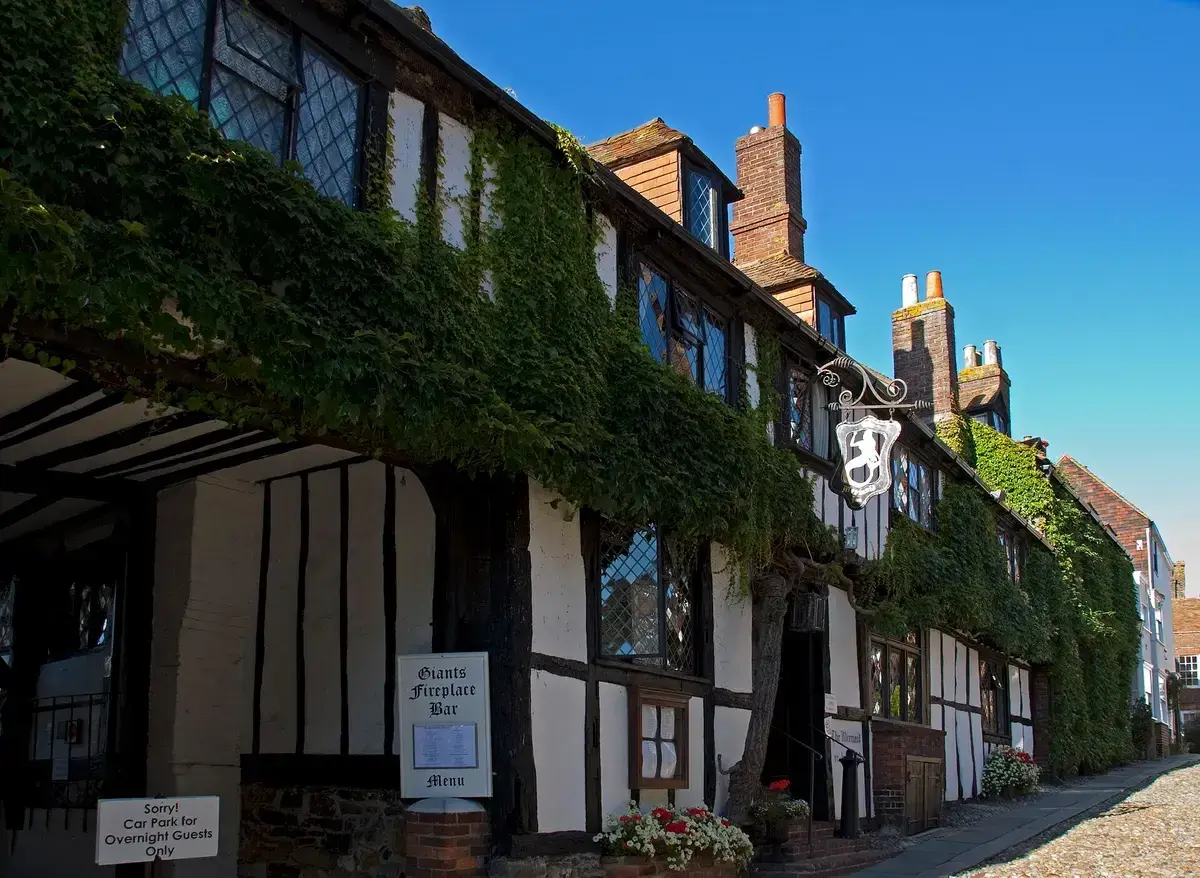
The Mermaid stands halfway up Mermaid Street in Rye, on cobbles that punish a suitcase, behind a jettied timber front that appears on more postcards than any other building in East Sussex. Its own history page is headed “1156 to the present day”, and 1156 is the year Rye was admitted to the Cinque Ports. The house attaches it to the cellar: barrel-vaulted, cut into the rock, the one part of the building that survived when the French burned the town.
Two things are usually said next, and both are worth separating. The first is that the cellar is that old. The second — the quieter claim, carried entirely by the words “to the present day” — is that there has been an inn here ever since. The second is the one that decides where a house sits in a ranking of the oldest pubs, and it is the one almost nobody checks.
What the records show
Rye kept good papers and a local historian went through them. William Holloway’s history and antiquities of the town, published in 1847, prints the schedule of the king’s bailiff’s rents of assize for 1670, and the heaviest charge in Middle Street ward — five shillings a year — falls on the tenements, stable, close and garden of the heirs of William Gostrey, “called the Mermaide”, late of Thomas Higgins, jurat, some time of William Didsbury, jurat, and before Pedell’s. That is a named property with a boundary description, and Holloway uses it to reconstruct the old wards of the town: Mermaid Street, he says, was the Middle Street of 1670.
Earlier again, Thomas Peacock’s will of 1638 endowed Rye’s free school with four pounds a year charged on “a tenement or messuage, situate in the Middle street of the town of Rye, called the Mermaid”. Neither document uses the word inn. The word is Holloway’s reading, and he is probably right — but it is worth saying which is which, because the site’s whole method is to separate the record from the historian’s gloss on it.
There is one more piece, and it is the best of them. Among the seventeenth-century trade tokens of Sussex, catalogued by William Boyne and revised by George Williamson in 1889, is a Rye farthing reading MICHELL CADMAN AT THE — with a mermaid — MEAREMADE IN RYE. Tradesmen struck those tokens because small change had run out, and a token at the sign of the Mermaid is a man selling drink there. It carries no year, so it fixes none; the series as a whole belongs to the middle decades of the century.
Then, in 1758, Peacock’s four pounds was redeemed for fifty and the money lent on to another Rye school trust. That is the last dated paper naming the Mermaid as an inn, and it is where this site’s own account used to stop.
The break
Holloway’s antiquities chapter, at page 601, walks up Mermaid Street naming houses. Of this one he writes that “higher up, on the north side, stood the Mermaid Inn, for many years the principal one of the town”, that the ground behind it is still called the Mermaid yard, that some old people still remembered seeing the sign-post there — and then, in nine words that settle the question: “It only ceased to be an inn about eighty years ago.” He goes on to praise the carved wainscot inside, “carefully preserved by its present proprietor, Mr. Charles Poile”. Eighty years before 1847 is about 1767. In 1847 the Mermaid is a private house with an owner who looks after the panelling.
Boyne and Williamson, annotating Cadman’s token in 1889, put it flatly: “There is now no Mermaid Inn, but it formerly stood on the north side of the present Mermaid Street at Rye, and ceased to be an inn about 1770.”
The best account of the gap is an accident. Louis Jennings came through Rye in the 1870s writing what became Field Paths and Green Lanes, and he had read about the Mermaid in a book. He asked the sexton of the parish church where it was. “I never heerd of it,” said the sexton. Jennings roamed up and down Mermaid Street over the cobbles, “loth to give up the search”, and eventually found an old man who sighed and said: “the inn has long been closed. How curious you should ask for it. Gone ever so long ago, sir.” The old man offered to show him the house that had been the inn — “a labouring man lives in it now” — and the woman who answered the door said yes, this was it, “but now we lives in it”. She took him down a dark passage to the carved oak fireplace. Upstairs, in a room he reckoned would hold a hundred people, there was one occupant: “I am a poor lone widow, sir, and have only one room,” she told him, and showed him her Dutch tiles.
Rye Castle Museum’s account of Mermaid Street, by Sheila Maddock, closes the sequence from the census: from the mid-1700s the house declined and became tenements, the 1891 census does not list it as an inn because it was let as lodgings, and by the 1901 census it was an inn again.
The building, dated
None of this touches the fabric, which is the genuinely old part of the story.
Historic England lists the house at Grade II* — the register entry, number 1251961, names it as Mermaid House and The Mermaid Hotel, two properties under one roof. Pevsner and the listing both date the standing frame to the mid-fifteenth century and put the vaulted cellars in the thirteenth, which is a long way from 1156 but still older than most buildings anyone drinks in. The Giant’s Fireplace, the Caen stone chimney pieces and the carved dates of 1643 and 1646 are all real. CAMRA gives the interior one star on its national inventory, and its note is where the last date in this article comes from: “As licensed premises, it has a complex recent history and was not allowed to install a bar until 1955.” The counter of rough-hewn overlapping planks probably dates from that reopening.
So the bar a visitor is served at is younger than the Festival of Britain, in a room that is Tudor.
| Pub | Claims | First record | Building | Grade |
|---|---|---|---|---|
| The Mermaid InnRye | 1156 | 1670 | Rebuilt 1420 with 16th-century additions; vaulted cellars assessed by Pevsner as 13th century | Grade C |
| The Old BellRye | 1400 | — | Timber-framed, sharing one roof span with the neighbouring house on The Mint and probably once a single building; front much altered, mock-Tudor extension added about 1930 and the interior refitted in 1934 | Grade C |
So how old is the Mermaid?
The cellar is thirteenth-century, the frame is fifteenth, drink was being sold at the sign by the middle of the seventeenth, and the house stopped being an inn about 1770 and did not have a bar again until 1955.
That is a grade C claim on our scale and a house that stands outside the hundred, because the ranking measures drinking that kept going, and this one did not. It is not a black mark. A harbour silted up, a town stopped being a port, and the principal inn of Rye became a house, then rooms, then lodgings for a labouring family and a widow with one room and a fireplace worth showing to strangers. It came back. Very few buildings get a second act at all, and the reason the Mermaid could have one is that somebody kept the wainscot.
The town’s other claimant, the Old Bell at the bottom of the hill, comes with a smugglers’ tunnel said to run up to the Mermaid and an interior mostly of 1934. Both are on the oldest pubs in East Sussex, along with the Lamb at Eastbourne and its 1180. How the grades are decided is set out in the methodology.
Sources
- archive.org/details/historyantiquiti00holliala/page/n616/mode/1up
- archive.org/details/tradetokensissu00boyngoog/page/n397/mode/1up
- archive.org/details/fieldpathsgreenl00jennrich/page/n31/mode/1up
- ryemuseum.co.uk/mermaid-street-1891/
- camra.org.uk/pubs/mermaid-inn-rye-182763
- historicengland.org.uk/listing/the-list/list-entry/1251961
- en.wikipedia.org/wiki/The_Mermaid_Inn,_Rye
Found something wrong?Suggest a correction