3 pubs checked · updated 18 September 2026

The oldest pub in East Sussex

The short answer

Oldest claim

The Mermaid Inn

Says 1156. The first record is 1670.

Grade C · Tradition

By claim, the oldest pub in East Sussex is the Mermaid Inn on Mermaid Street in Rye, whose 1156 belongs to the vaulted cellars rather than to the inn above them; Pevsner and English Heritage put those cellars in the thirteenth century, and the timber-framed building over them was rebuilt in 1420. No pub on this page has produced a record of drinking from anywhere near the date it claims, so East Sussex has no oldest-by-evidence answer yet.

What is unusual about the East Sussex claims is that two of the three are underground. The Mermaid's 1156 refers to its cellars. The Lamb at Eastbourne rests its 1180 on a crypt-like cellar and a passage said to run to the Norman church next door — a story the pub itself declines to press, settling for a fourteenth-century building. The Old Bell in Rye comes with a smugglers' tunnel to the Mermaid, a few hundred metres uphill. A cellar is the one part of an old building that nobody can easily date and that listing entries barely describe: Historic England's entry for the Old Bell runs to a timber frame shared with the house next door, a much altered front and a mock-Tudor extension of about 1930, and says nothing at all about what is below. Above ground the county's documented history is eighteenth-century and it is criminal rather than architectural. The Mermaid was a haunt of the Hawkhurst Gang in the 1730s and 1740s, and smuggling is the thread that ties Rye's pubs together far more securely than any founding date does.

Rye, and what is under it

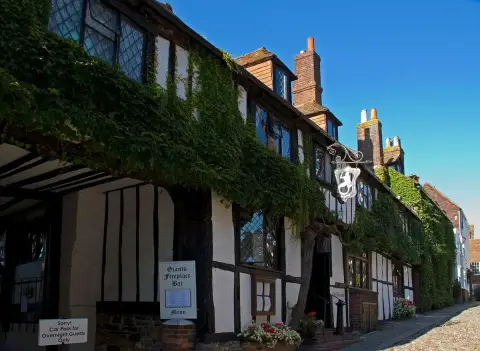
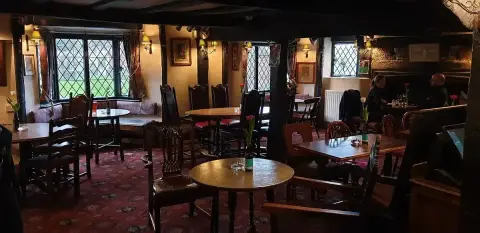
Two of the county’s three contenders stand a few minutes apart in the same small hilltop town, and both of them argue from the ground down. The Mermaid Inn is halfway up cobbled Mermaid Street, timber-framed, Grade II* and rebuilt in 1420 over the cellars its sign dates to 1156; the Giant’s Fireplace and the carved Tudor woodwork are entirely genuine, and CAMRA rates the interior one-star for historic importance. The Old Bell is at the foot of the hill on The Mint, dark and low, with doors still lettered Public Bar and Private Bar. Read the two listings side by side and the difference is instructive: one is a well-understood medieval building, the other is a frame nobody has dated behind a front that was substantially remade twice in the twentieth century.

Eastbourne, and the older number

The Lamb sits beside St Mary’s in Eastbourne’s Old Town and carries the earliest figure anyone has printed for an East Sussex pub, 1180, without the pub itself claiming it. That is a pattern worth noticing across this site: the boldest date usually comes from a round-up rather than from the licensee. The Lamb’s own history is medieval fabric, Harvey’s ales and a busy programme of music and comedy — a working local rather than a monument. For the wider comparison see the oldest pubs in England and neighbouring Kent, where the smuggling trade ran inland from the same coast; for how we weigh a cellar against a licence, the methodology.

East Sussex

OpenFreeMap · © OpenMapTiles · Data © OpenStreetMap contributors

Open the full map

The contenders, oldest claim first

Order the contenders
  1. Rye, East Sussex

    The 1156 date refers to the cellars, which Pevsner and English Heritage place in the 13th century. The timber-framed inn was rebuilt around 1420, and the house traded without a full licence for long periods and reopened with a bar in 1955. William Holloway's history of Rye, printed in 1847 from the town's records, carries it back further than this page could before. He prints the schedule of the king's bailiff's
    Claims 1156; first recorded 1670; building c.1420.
  2. The Lamb Inn

    Grade C

    Eastbourne, East Sussex

    Popular histories date it to 1180 and cite a crypt-like cellar and secret passage linked to the neighbouring Norman church; the pub itself more cautiously calls the building 14th century. No documentary licence date has been confirmed.

    Claims 1180; no early record found.
  3. The Old Bell

    Grade C

    Rye, East Sussex

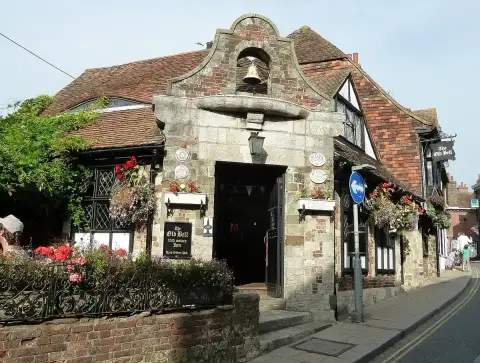
    CAMRA gives the Old Bell a 15th-century date and Rye tells of a smugglers' passage running from here to the Mermaid Inn. Historic England is unhelpfully brief: a timber-framed building sharing a roof span with number 32, probably one house originally, its front much altered, with a mock-Tudor extension added about 1930. CAMRA's own heritage note records that the pub was tiny until Star Brewery bought and demolished

    Dated 1400 by CAMRA; no early record found.

The photographs above are other people's work, used under open licences. Every photographer, licence and source page is named in the image credits.

Common questions

Which is the oldest pub in East Sussex?
The Mermaid Inn at Rye makes the earliest claim, 1156, and that date describes its cellars. Nothing here has a document from near the date it claims, so the honest answer is that the county's oldest pub is unsettled. The Mermaid at least has fabric of a known age above the cellars: a rebuilding of 1420.
Is the Mermaid Inn really from 1156?
Not as an inn. The 1156 refers to the vaulted cellars, which Pevsner and English Heritage assess as thirteenth-century. The Grade II* building above was rebuilt around 1420 with sixteenth-century additions. When drinking began here is not established; the Mermaid went for long periods without a full licence and reopened with a bar in 1955.
Is there a tunnel between the Old Bell and the Mermaid Inn?
It is a Rye tradition rather than a documented feature. CAMRA gives the Old Bell a fifteenth-century date and repeats the story of a smugglers' passage running up to the Mermaid. What can be checked is the interior, which mostly dates from a 1934 refit after Star Brewery demolished the warehouse next door.
How old is the Lamb in Eastbourne?
Popular histories date it to 1180, citing the cellar and a passage to St Mary's church. The pub is more cautious and calls the building fourteenth-century. No licence date has been confirmed either way, so the Lamb sits on tradition alongside its neighbours on this page.