By claim, the oldest cantina in Mexico City is La Peninsular in La Merced, which the Mexican press dates to 1872 and calls the oldest of the living ones — on the strength of a place in the city's register of cantina licences rather than of any licence anybody has produced. By evidence it is Bar La Ópera, whose move to Avenida 5 de Mayo in 1895 is the one pivot in the city's cantina story that three independent accounts agree on, and which began four years before that as a French pastry shop.
Mexico City dates its drinking houses by licences rather than by buildings, and that is the whole character of the evidence here. The cantina arrived as a licensed trade in the middle of the nineteenth century — the chronicler Salvador Novo counted eleven official cantinas in the city by then — and the age a house is known by is its number in that register: El Nivel was the first, La Peninsular the second, and when El Nivel closed in 2008 the title passed down a place. It is a measure nobody can check directly, because the register is quoted in every telling and reproduced in none — though it leaves one usable trace: El Nivel's licence number one was signed by Sebastián Lerdo de Tejada, who became president in July 1872, which puts the first two licences in the early 1870s whatever the signs say. The buildings cannot settle it either: these are ground floors in a centre that has been rebuilt after earthquakes, remodelled by owners and renumbered by the city. What the capital does have, more than almost anywhere on this site, is continuity of trade with the proof in the room — a walnut bar said to have come up from New Orleans, floor tiles kept through a heavy refit, a bullet hole in a ceiling that everyone attributes to Pancho Villa and nobody can date. Three houses are listed here, and the oldest claim among them is the one with the least paper behind it.
The register and the room
La Peninsular is the house the claim belongs to: a corner cantina on
Alhóndiga in La Merced, a few streets east of the Zócalo, where beers, cocktails, tequila and mezcal come over
the counter with peanuts, and an orchestra plays at weekends. Its 1872 is in every telling and in no document,
and the room itself was remodelled in 2013 — beams, floor tiles and doors kept, furniture and fittings lost. Its
ground floor is better recorded than its founding: it was the main location for Jorge Fons’s El Callejón de los
Milagros in 1995, the one film Salma Hayek made in Mexico.
The pastry shop that became a cantina
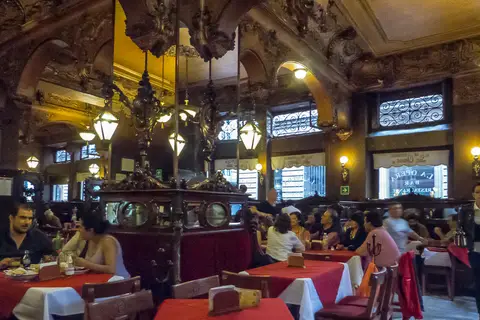
Bar La Ópera on Avenida 5 de Mayo is the best-documented of the three and the
one whose date moves when you read it properly. The house says 1876, and 1876 is a French pastry shop at another
address, run by the Boulangeot sisters; what happened on 5 de Mayo in 1895 was a cantina, and the city’s own
visitor service and Excélsior tell the same sequence. So the year over the door dates confectionery and the year
that matters is the move. The gilded ceiling, the carved booths and the walnut bar are worth the journey on their
own, and the hole in the plaster overhead is attributed to Pancho Villa, in 1914, by everybody and by no record.
Garibaldi, and the youngest of the three
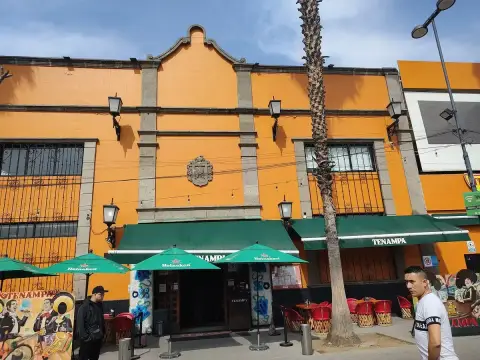
Salón Tenampa on Plaza Garibaldi is the youngest house here and the loudest:
founded in the mid-1920s by Juan Indalecio Hernández, who came from Cocula in Jalisco and brought Jaliscan
musicians with him, it is the reason mariachi belongs to that square. The salon and Spanish Wikipedia say 1925
and the English article on the plaza says 1923, which is the sort of gap a century-old claim usually has. For how
we weigh a claim against a record, see our methodology; for the country beyond the capital,
including Ensenada’s Hussong’s, see the oldest cantinas in Mexico.
The year is the press's, not the house's. El Financiero, visiting on 15 November 2025, says the cantina opened in 1872 and is four years older than Bar La Ópera; México Desconocido, Uno TV and the trade press say 1872 too, and all of them rest the claim on the same thing — not a founding document but a place in a register. The story they tell is that El Nivel held the city's first cantina licence and La Peninsular
Three accounts agree on the sequence and not one of them points at a document. The house says it opened in 1876 as a French pastry shop at another address and moved to 5 de Mayo in 1895 as a cantina. Mexico City's own visitor service says the same: an exclusive pastry shop run by the French Boulangeot sisters, which gave up desserts on moving in 1895 to become the most sumptuous bar in the capital. Excélsior adds
The salon and Spanish Wikipedia give 1925, founded by Juan Indalecio Hernández of Cocula, Jalisco; English Wikipedia's Plaza Garibaldi article gives 1923. Hiring of mariachi Cirilo Marmolejo by 1927 is widely recorded. Mexico City's own visitor service, read on 17 September 2026, is the first publisher here that is neither the house nor an encyclopaedia, and it settles less than it confirms: it credits the cantina
The press and the travel guides give it to La Peninsular, on a claimed licence of 1872, second in the city's register after El Nivel, which closed in 2008. One guide dates the same licence to 1871 and credits the city government with that year. Neither licence has been published, so what the record supports is weaker than what the guides assert.
Why does the licence matter more than the building here?
Because a cantina was a licensed trade from the start, and because the centre's buildings have been rebuilt, remodelled and renumbered too often to date the drinking inside them. All three pubs on this page carry a founding year that comes from an account of a licence rather than from fabric, which is why none of them is graded higher than tradition.
Is it true that women could not drink in cantinas?
A Mexico City cantina guide reports that women were admitted only after the Federal District government ordered mixed access in 1982, and the rule is part of how these houses are remembered. We have not traced the order itself, so it sits on this site as something widely reported rather than as a date we can stand behind.
What happened to El Nivel?
It held licence number one, closed in 2008 after the national university won possession of the building, and the corner is now the Museo UNAM Hoy — a ticket rather than a drink. Its story, and the problem with its own 1857, is in our archive entry for [El Nivel](/lost-old-pubs/el-nivel-mexico-city/): the first licence was signed by Sebastián Lerdo de Tejada, who did not become president until July 1872.