3 pubs checked · updated 18 September 2026

The oldest pub in Somerset

The short answer

Oldest claim

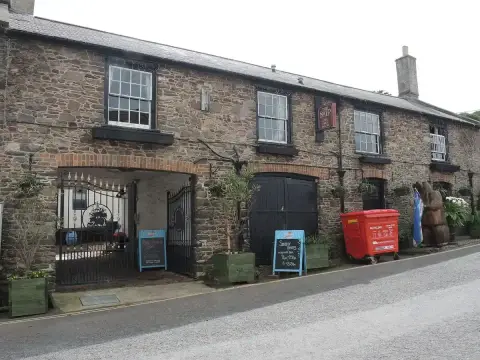
The Ship Inn

Says 1200. No document from that date has been found.

Grade C · Tradition

Oldest proof

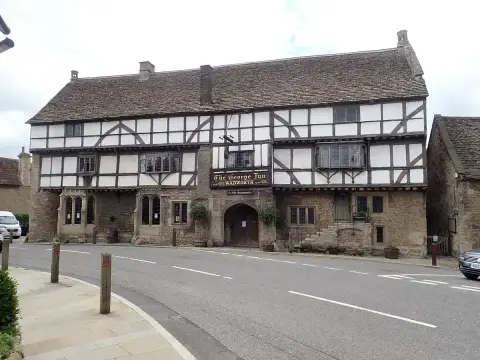
The George Inn

On record from 1432; the building is dated to about 1430.

Grade A · Documented

By claim, the oldest pub in Somerset is the Ship Inn at Porlock, which advertises itself as a thirteenth-century coaching inn; Historic England lists a building of the sixteenth to seventeenth centuries, enlarged in the early to mid nineteenth. By evidence it is the George at Norton St Philip, whose timber upper floors have been tree-ring dated to 1430–32 and which Historic England regards as probably the earliest surviving purpose-built inn in England.

Somerset's answer rests on physical science, which is rare — tree-ring dating has been decisive in only a handful of cases on this site — and the reason here is monastic. Two of the three pubs here were built by religious houses to accommodate people: the George at Norton St Philip was raised by the Carthusians of Hinton Priory to serve the wool fairs it ran, and the Luttrell Arms at Dunster is traditionally the guest house of the abbots of Cleeve, standing on property conveyed to the Luttrell family in 1443. That matters more than it sounds. A monastery that built an inn built it as an inn, so the fabric and the function share a date, and dendrochronology can then fix it: the George's jettied upper floors gave 1430–32, over a stone ground floor of the late fourteenth or early fifteenth century. Very few pubs anywhere can say as much, and it is why a house claiming 1397 outranks houses on this page claiming the thirteenth century. The county's earliest claim is also its softest — the Ship at Porlock, where the listing reads as three hundred years of Exmoor building history rather than one medieval moment.

Inns built as inns

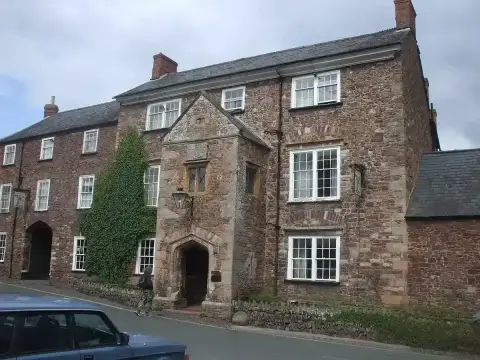
The George Inn is the reason this county page reads differently from its neighbours. Everything about it can be checked: the stone ground floor, the jettied timber above dated to the early 1430s, the galleried courtyard, the wool fairs it was built for, and the fact that Historic England lists it Grade I and treats it as probably the earliest purpose-built inn still standing in England. The Luttrell Arms is the same idea one generation on and less firmly attested: a late fifteenth-century stone house facing Dunster’s yarn market below the castle, on ground the Luttrells acquired in 1443, said to have lodged the abbots of Cleeve. It works as a hotel now, and its beamed bar and courtyard garden still do the job of a village pub. Our guide to what a coaching inn was explains what these buildings were designed to do.

Exmoor, and the softer claim

The Ship Inn — the Top Ship, to the village — stands where Porlock’s street begins to climb the hill, part-thatched, with flagged floors, log burners and a yard behind. Its thirteenth century is not supported, and the building it actually is happens to be more interesting than the one the sign describes: a cross-passage house of the sixteenth or seventeenth century, extended twice in the nineteenth as Exmoor filled with visitors. If you want to know how those judgements are reached, see how to tell how old a pub is. For the county over the border, where the buildings are old and the documents absent, see Devon; the national picture is at the oldest pubs in England.

Somerset

OpenFreeMap · © OpenMapTiles · Data © OpenStreetMap contributors

Open the full map

The contenders, oldest claim first

Order the contenders
  1. The Ship Inn

    Grade C

    Porlock, Somerset

    The Ship advertises itself as a 13th-century coaching inn at the foot of Porlock Hill. Historic England lists it as an inn of C16 to C17 date, probably a three-room and cross-passage house, enlarged by a bay to the left and four bays to the right in the early to mid C19, its thatch half-hipped at one end. The Exmoor National Park Historic Environment Record, which keeps the record for this parish, reads it
    Claims 1200; no early record found.
  2. Norton St Philip, Somerset

    Historic England regards it as probably the earliest surviving purpose-built inn, erected by Hinton Priory. The claimed 1397 licence is not itself verified, but tree-ring dates of 1430-32 and its medieval function as an inn for the priory's wool fairs are well documented, and the earliest documented use recorded here is that tree-ring date. The Grade I list entry, written in 1968, disagrees with the tree-ring

    Claims 1397; first recorded 1432; building c.1430.
  3. Dunster, Somerset

    The 1443 is the hotel's own: its history page, archived in 2016, says the Luttrell Arms occupies the site of three ancient houses recorded from 1443, when two were conveyed to Richard Luttrell by William Dodesham, and adds that nothing shows how old those houses were or what part they play in the building standing today. The Grade II* building is late 15th century. The tradition that it was a guest house of the

    Claims 1443; no early record found; building c.1443.

The photographs above are other people's work, used under an open licence. Every photographer, licence and source page is named in the image credits.

Common questions

Which is the oldest pub in Somerset?
The George at Norton St Philip, on the evidence: built by the Carthusians of Hinton Priory as an inn, with timbers tree-ring dated to 1430–32 and a Grade I listing. The Ship at Porlock claims the thirteenth century but is listed as a sixteenth to seventeenth-century building.
Is the George at Norton St Philip England's oldest inn?
Historic England regards it as probably the earliest surviving purpose-built inn, which is a different and more careful statement. Its own claim of a licence in 1397 has not been verified; the tree-ring dates of 1430–32 and its documented function as the priory's inn for wool fairs are what earn it an A grade.
Is the Ship Inn at Porlock thirteenth-century?
Not on the listing. Historic England describes an inn of the sixteenth to seventeenth centuries, probably a three-room and cross-passage house, with a bay added to the left and four to the right in the early to mid nineteenth century and thatch half-hipped at one end. CAMRA notes its sixteenth-century core.
Was the Luttrell Arms really the abbots' guest house?
Unproven, though the building supports the idea of high-status medieval accommodation: it is Grade II*, late fifteenth-century, built on property conveyed to the Luttrells in 1443, with a four-centred stone doorway to look for. When the house first became an inn has not been established, and the Cleeve tradition rests on local repetition.
Which Somerset pub has the most to see?
The George, which keeps a galleried courtyard, a stone base and jettied timber floors above. Monmouth used it as his headquarters in 1685 and Pepys dined there in 1668, and film crews return for the unaltered medieval rooms — The Remains of the Day and Moll Flanders were both shot there.