3 pubs checked · updated 18 September 2026

The oldest pub in Gloucestershire

The short answer

Oldest claim

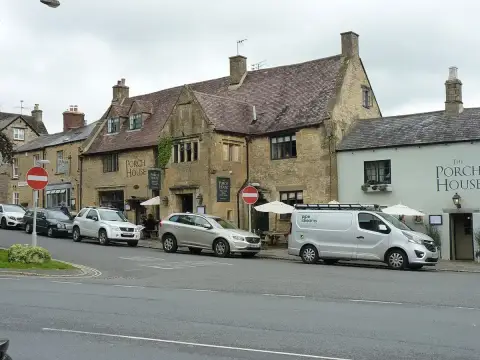
The Porch House

Says AD 947. No document from that date has been found.

Grade C · Tradition

Oldest proof

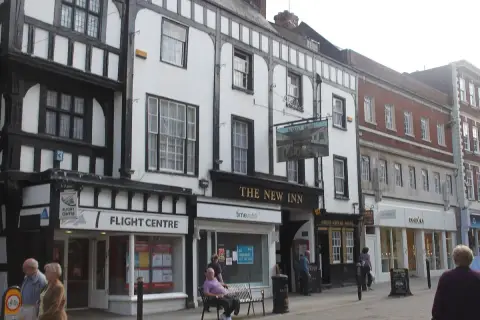
New Inn

On record from 1450; the building is dated to about 1450.

Grade A · Documented

By claim, the oldest pub in Gloucestershire is the Porch House in Stow-on-the-Wold, which dates itself to AD 947. By evidence it is the New Inn in Gloucester, built about 1450 by the monk John Twyning for St Peter's Abbey to lodge its visitors and listed Grade I as a mid-fifteenth-century galleried inn — a house that was an inn from the day it opened rather than a building that later took a licence.

Gloucestershire holds both ends of the oldest-pub argument. In Stow-on-the-Wold is one of the most repeated claims in England and one of the least supported: the Porch House's AD 947 rests on tradition, and the radiocarbon date of about AD 1000 usually cited in its defence cannot be traced at all. The buildings archaeologist James Wright asked the county archaeologist, who holds no record of any samples ever being taken from the building, and no report has been published. English Heritage attributes the standing house to the fifteenth century, and no record of an inn here — it was the Eagle and Child, later the Royalist Hotel — appears before the eighteenth century. In Gloucester, meanwhile, is a building whose date nobody argues about, because the abbey that commissioned it wrote the purpose into the plan. The lesson of the county is blunt: where a medieval institution built an inn as an inn, the evidence survives; where a house drifted into selling drink, the date is whatever the sign says. Chipping Campden's Eight Bells shows the ordinary version of the second case, claiming the fourteenth century against a listing that describes seventeenth-century Cotswold ashlar.

The claim that cannot be checked

The Porch House is a genuinely old honey-stone building on Digbeth Street, with low beams, inglenooks and witch marks scratched into the timber, and it is worth visiting on those terms. Its date is a different matter, and the interesting thing is not that AD 947 is unproven but that the scientific evidence everyone cites for it has no paper trail. We take the argument apart in is the Porch House England’s oldest inn. At the Eight Bells the gap is smaller and easier to see: three centuries between the claimed fourteenth century and the listed fabric, with the passage through to the courtyard and the great hearth genuine enough on their own.

An inn from the day it opened

A carriage arch off Northgate Street in Gloucester opens into the courtyard of the New Inn, ringed by three storeys of jettied timber galleries. Lady Jane Grey was proclaimed queen from those galleries in 1553; fire took part of the roof and several bedrooms in May 2018 and the medieval frame came through it. The story that the inn housed pilgrims visiting Edward II’s tomb was first written down in the eighteenth century and may be later colour, which matters less here than it would elsewhere, because the building’s own date does the work. If you want to know how a surveyor reaches a date like that, see how to tell how old a pub is, and for what the word inn meant when the abbey used it, inn, tavern or alehouse. The county comparison is at the oldest pubs in England.

Gloucestershire

OpenFreeMap · © OpenMapTiles · Data © OpenStreetMap contributors

Open the full map

The contenders, oldest claim first

Order the contenders
  1. Stow-on-the-Wold, Gloucestershire

    The 947 is the house's own claim, though it has faded from its website: the current site says only 'England's oldest inn' and eleven centuries, while the history page archived in September 2020 gave the tradition that part of the building was a hospice built for Aethelmar, Duke of Cornwall in 947AD, quoting a local history published in 2000. The date rests on that tradition. The radiocarbon test usually cited in
    Claims AD 947; no early record found.
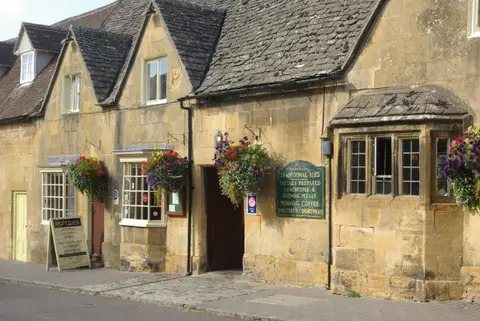
  2. Eight Bells

    Grade C

    Chipping Campden, Gloucestershire

    The Eight Bells is described as 14th century by CAMRA and by the inn, with a story that it housed the masons who built St James's church and stored the bells that gave it its name. Historic England lists a C17 Cotswold ashlar building with mullioned and bay windows, a stone slate roof and an inglenook by the stone bay. That is three hundred years short of the claim, and no record of drinking here in the 1300s has

    Claims 1300; no early record found.
  3. New Inn

    Grade A

    Gloucester, Gloucestershire

    The New Inn gives 1450, when the monk John Twyning built it for St Peter's Abbey to lodge visitors — an inn from the start rather than a house that later took a licence. No document states that year: Historic England lists it Grade I as a mid-C15 inn of four ranges around a galleried courtyard, the most complete survival of its kind in Britain, and the Victoria County History of Gloucestershire says the same without

    1450 with no published claimant; first recorded 1450; building c.1450.

The photographs above are other people's work, used under open licences. Every photographer, licence and source page is named in the image credits.

Common questions

Which is the oldest pub in Gloucestershire?
The Porch House at Stow-on-the-Wold claims AD 947 and cannot support it. On the evidence the answer is the New Inn in Gloucester, dated to about 1450 and listed Grade I as a purpose-built galleried inn, which Historic England calls the most complete medieval example of its kind in Britain.
Is the Porch House really England's oldest inn?
No published record supports AD 947. The radiocarbon test quoted in support has never been produced and the county archaeologist holds no record of samples being taken. English Heritage dates the standing building to the fifteenth century, and Guinness World Records no longer maintains an oldest-pub category at all.
Why does the New Inn grade higher than a pub with an earlier date?
Because its date is documented and its purpose is not in doubt. It was built for St Peter's Abbey around 1450 to lodge visitors, so the building and the trade begin together, and Historic England's Grade I listing describes the four galleried ranges of massive oak framing that still stand round the courtyard.
How old is the Eight Bells at Chipping Campden?
CAMRA and the inn describe it as fourteenth-century, with a tradition that it lodged the masons who built St James's church and stored the bells it is named for. Historic England lists a seventeenth-century Cotswold ashlar building with mullioned windows, an inglenook and a courtyard passage.