
The claim
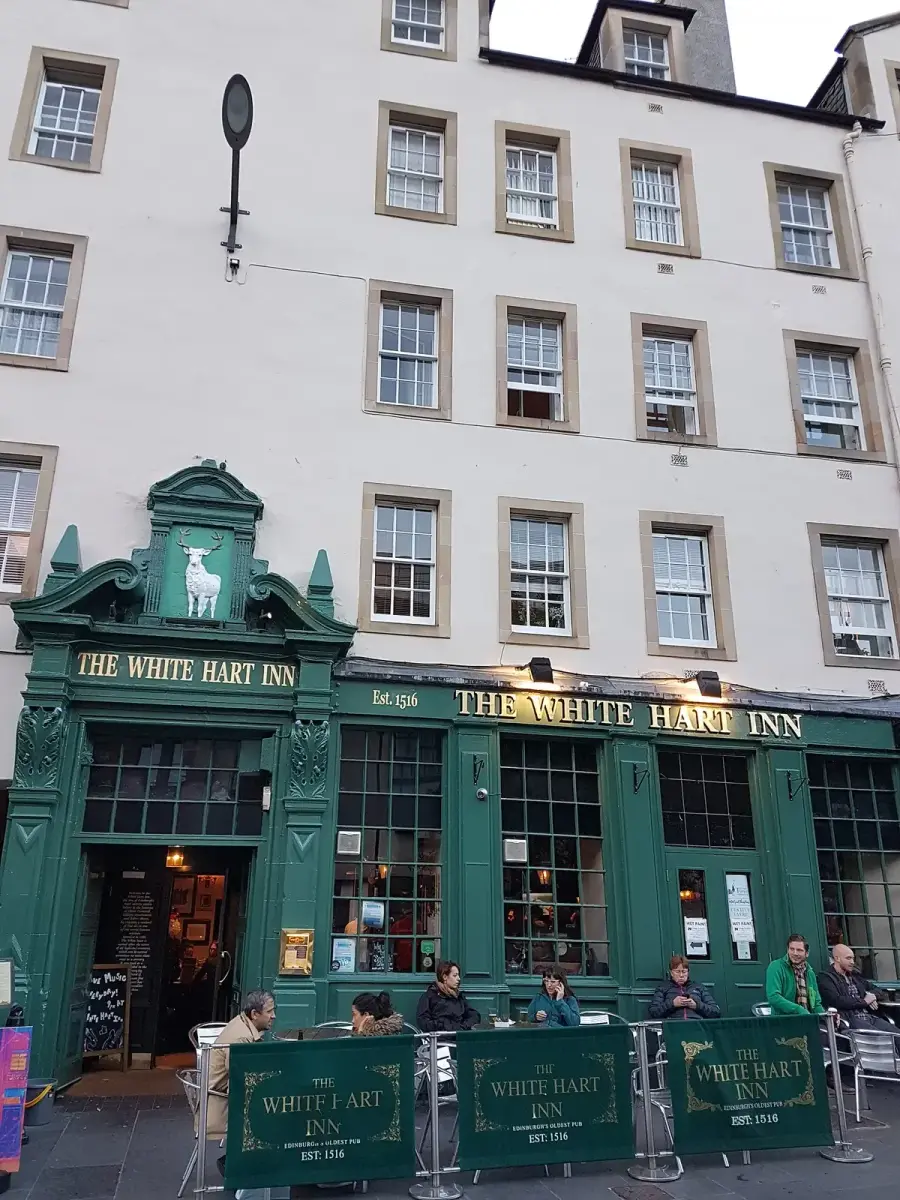
The Grassmarket was where Edinburgh arrived and departed. Coaches and waggons drew up under the castle rock, and the north side of the square filled with inns to meet them. One of them is still there. The White Hart Inn occupies the ground floor at the west end of a long tenement, behind a doorpiece with thistle-carved consoles and a swan-necked pediment holding a carved stag, and it is routinely described in Edinburgh guides as the city’s oldest pub. The date attached to it is 1516, usually with the qualification that the cellars are what survive from then.
Most pub claims on this site come from the pub and are contradicted by the register. This one is interesting because the register says it too.
What the records show
Historic Environment Scotland lists the range as 30–40 (even numbers) Grassmarket, including White Hart Inn, at category B, designated on 14 December 1970. In the supplementary description the entry sets the scene — the Grassmarket as the principal arrival and departure point for coaches, several busy coaching inns visible in old photographs — and then states that records of the White Hart Inn go back to 1516, that its well-known guests included Cromwell, Robert Burns in 1791 and Dorothy and Mary Wordsworth in 1803, and that the White Hart is presumably the one associated with David I and the foundation of Holyrood Abbey.
Read that paragraph slowly and it says less than it appears to. No record of 1516 is named, quoted or referenced. The authorities the entry does cite are Gifford, McWilliam and Walker’s Edinburgh volume of 1984 and information supplied in 2000 by the architect who carried out the building’s restoration. And the Holyrood sentence hangs on the word presumably.
Historic Environment Scotland is also explicit about what its own entries are for. The only part of a listing with legal force is the address or name of the site; the description and the further details are supplementary and carry no legal weight. A listing is a protection order with a note attached, not an adjudication of a founding date, and this is a good illustration of why that distinction matters. A date without a source does not acquire one by being typed onto an official page.
The same body’s other record makes the position stranger rather than clearer. Canmore, the national record of the historic environment, holds 32–34 Grassmarket — Dunlop’s Court — as site NT27SE 5401.00, and classes it as an inn of the fifteenth century and a public house of the eighteenth, while classing the other halves of the same listed range as tenements, shops and a restaurant of the eighteenth century. A period in a classification field is not a record of anybody drinking anywhere. And because Canmore and the statutory list are one organisation on two websites, this is not two publishers agreeing; it is one publisher giving two answers, a fifteenth-century inn on one page and a tenement of about 1740 on the other.
The building, dated
On the fabric there is no disagreement at all. The listing names the builder: James Lithgow, around 1740. It is a four-storey, thirteen-bay double tenement, lime rendered with indented sandstone margins, with nepus gables and apex stacks, three piend-roofed dormers in the attic, a stone-vaulted pend leading through to Dunlop’s Court, and two semi-octagonal stair towers at the back. It lost its harling in a Zeppelin raid in 1916 and was restored for the Old Town Housing Association in 1994–5, when it was re-roofed, a wallhead gable rebuilt and the chimneys rebuilt.
CAMRA’s Edinburgh branch tells the same story in fewer words: the cellars from 1516, the rest from 1740. Which leaves the cellars carrying the entire claim, and cellars are the hardest part of any building to date. Vaults were reused for centuries under Edinburgh’s tenements; a new house built on an old plot commonly kept the cellarage beneath it. A sixteenth-century vault under an eighteenth-century tenement would be entirely plausible here, and no survey has been published that shows one.
Scotland’s wider problem
The Edinburgh argument is a local version of a national one, and it has a published answer. In Appendix 2 of his history of Scottish drinking, A History of Drinking: The Scottish Pub since 1700 (2015), Anthony Cooke put the question directly and reached a negative conclusion, quoting David Walker, formerly chief inspector for Historic Scotland: no surviving building in Scotland proven to have been built as an inn is older than the seventeenth century. Cooke goes through the contenders — the White Hart among them, with the Bluebell at Haddington, the Stag and the Falkland Arms at Falkland with its inscription of 1607, the Four Marys at Linlithgow, the Boar’s Head at Laurencekirk with its datestone of 1638 and the Black Bull at Moffat — and finds the same thing each time. Either the house was rebuilt on an older site, or the building is genuinely old and was not built to be an inn.
That pattern holds across our own Scottish entries. The Sheep Heid at Duddingston claims about 1360 against an essentially eighteenth-century listed building. The Golf Tavern claims 1456, a date that seems to belong to golf on Bruntsfield Links rather than to a tavern, and carries no listing at all. The King’s Wark at Leith takes its 1434 from a royal arsenal whose taverns are documented in 1613, nearly two centuries later.
So how old is the White Hart?
Honestly: nobody knows, and the register has not helped as much as its readers assume. What can be said is that the tenement is of about 1740, that the inn was well enough known in the 1790s for Burns to lodge in it, that Dorothy Wordsworth stayed in 1803, and that a documented licensed house has stood on this ground since at least the eighteenth century in a square that was full of them.
The name may be the oldest thing about it. The white hart belongs to the story of David I, thrown from his horse while hunting on the feast of the Holy Rood in 1128 and saved, in the telling, by a stag bearing a cross between its antlers, in thanks for which he founded Holyrood Abbey. That is a fine legend, the carved stag over the door is a fine piece of work, and neither is a record of anyone selling ale in 1516.
Our methodology explains why we grade this C and why a date in a listing entry without a document behind it is treated as tradition rather than as proof, and the rest of the field is on our pages for Edinburgh and Scotland. If the 1516 record exists in a burgh register somewhere, we would like to read it, and we will publish what it says.
Sources
- portal.historicenvironment.scot/designation/LB28938
- camra.org.uk/pubs/white-hart-inn-edinburgh-151644
- belhaven.co.uk/pubs/edinburgh/white-hart
- scotlandspubsandbars.co.uk/location/the-white-hart-inn/
- cambridge.org/core/books/history-of-drinking/which-is-the-oldest-pub-in-scotland/00FC5807A162E376F38A30E271E8FB12
Found something wrong?Suggest a correction