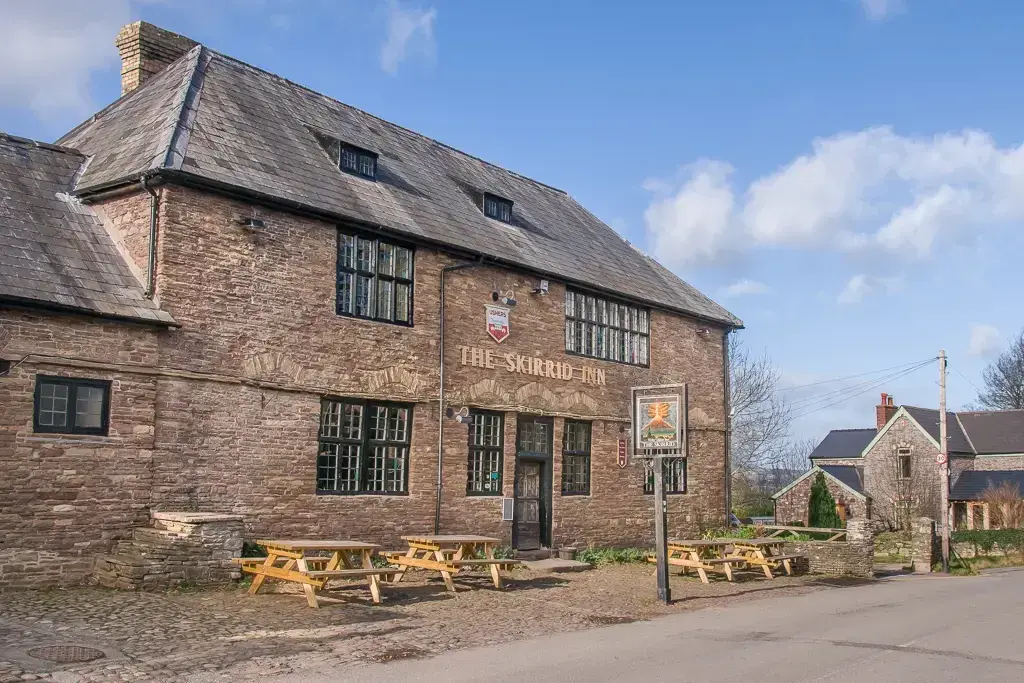

The claim
Four miles north of Abergavenny, in a village whose name most visitors do not attempt twice, a red sandstone house stands with its back to the Skirrid mountain and a hanging sign over the cobbles. The Skirrid Inn — the Skirrid Mountain Inn on older signs — says on its own front page that it is over 900 years old and that it is the oldest pub in Wales. In most retellings the year attached to that is about 1110.
Around the date has grown one of the densest thickets of legend attached to any British pub. Owain Glyndŵr is said to have mustered men in the cobbled yard. The first floor is said to have been a courtroom in medieval and Tudor times, where sheep stealers and worse were sentenced, and as many as 180 of them are said to have been hanged from the oak beam over the stairwell, where marks in the wood are shown to visitors as rope burns. The inn has been filmed by more than one television programme about ghosts, and it sells ghost hunts of its own.
None of that is told here to be laughed at. Llanvihangel Crucorney sits on a route that pilgrims really did walk towards Llanthony Priory, and the suggestion credited to the writer Forde in the Wikipedia account — that an inn stood here to serve them — is a sensible guess about a sensible place for one. A guess is what it remains, as that account says itself. What follows is what happens when you ask the registers instead.
What the records show
No document naming a drinking house here in the twelfth century has been traced, by us or by anybody who publishes the 1110. The earliest year we have seen offered in print is 1859, in a Welsh beer writer’s survey of old Welsh pubs, which gives it as the first mention of the Skirrid as a beerhouse and cites no record for it. We have left that out of the pub’s data for the same reason we mention it here: it is somebody’s note rather than a source you could go and read.
Documented life at the inn begins, as it so often does, in the newspapers. In August 1914, days after the war began, a labourer named Thomas Irons followed a cyclist along the road from Pontrilas shouting that he was a German, and had him stopped outside the inn by a man who was helping there and assumed the pursuer was a policeman; the victim turned out to be the son of a Macclesfield police sergeant, and Irons was fined ten shillings. Two months later Charles Powell of the Skirrid Mountain Inn was one of three landlords fined £5 each for stealing a black spaniel from a house nearby. A Victorian landlady, Fanny Price, died at thirty-five and is buried a few steps away. That is the texture of a real pub’s past, and none of it needs a gallows.
The building, dated
Cadw listed the inn on 6 May 1952, and the entry is among the franker pieces of writing in the Welsh register. It records that the house was listed as a medieval stone house, well restored, and is advertised as the oldest inn in Wales, and then states that close inspection makes both of those unlikely. Its own dating is mid to late seventeenth century, with major alterations late in the nineteenth and minor ones late in the twentieth.
The detail is where the interest lies. The mullion-and-transom windows across the front are reproduction. The relieving arches in the sandstone show that the ground floor originally had three windows on each side of the door, which would have made a symmetrical front quite unlike the one there now. Cadw notes that Sir Joseph Bradney’s History of Monmouthshire carries a photograph of 1906 showing the inn already looking as it does today, so the remodelling must have happened shortly before that; the yellow brick in the chimneys may be of the 1880s. In other words, the seventeenth-century appearance the building wears is substantially a Victorian recreation of the seventeenth century, made during the Old English revival, over a house that really was built in the seventeenth century.
Two other bodies have looked and said the same. The Glamorgan-Gwent Historic Environment Record, now kept by the Heneb HER Charitable Trust, holds the house as record 01623g: a mid to late seventeenth-century building that appears to have been purpose-built as an inn, with its seventeenth-century work surviving in the main roof timbers, the ceilings of the principal downstairs rooms, the oak stair climbing to the attics in its own tower, and the main door and its frame. It states in terms that the house is popularly supposed to be medieval and that there is no evidence for anything earlier than the seventeenth century, and it cites Peter Smith’s Houses of the Welsh Countryside, which classes the building as a stone house of a regional type with a lateral chimney and an internal cross-passage. The Royal Commission on the Ancient and Historical Monuments of Wales enters the same house in the national record as NPRN 20846, a public house of the post-medieval period.
What the fabric is worth
A purpose-built seventeenth-century inn is not a consolation prize. England and Wales have very few buildings that were put up to be inns and are still selling drink, and a stair tower built to carry guests to the attics is a rarer survival than most of what the claim asks you to believe instead. The mounting stone outside, set there so that a rider could get back on his horse, is the sort of detail that tells you what the house was for more reliably than any sign.
The hangings are the one part of the story worth setting down plainly, because it is the part that fills the car park. No court record, no assize return and no register of executions has ever been produced for a courtroom on the first floor of this building, and the number 180 appears attached to no source at all. Judicial hangings in Monmouthshire were carried out by the county, at the county gaol, and they generated paperwork. A house that cannot be shown to have existed before the 1650s cannot have hanged anyone under Henry IV.
So how old is the Skirrid Inn?
By the registers, it is a mid to late seventeenth-century purpose-built inn wearing an 1880s version of its own face, and no record of drink sold here has been traced before the nineteenth century. That grades C on our methodology — tradition — and it puts the house in the same position as most famous four-figure claims rather than above them.
Wales does have houses that can show more. The Groes Inn above the Conwy valley is named as a tavern in a court order of 1578. The George & Dragon at Beaumaris has had its beams tree-ring dated, which settles its age to within a few years. The Old Swan at Llantwit Major is listed at the high grade of II* precisely because so much of a sixteenth-century Welsh townhouse survives in it. The full field is on our page for the oldest pubs in Wales.
The inn closed for four years and reopened in 2023, and CAMRA’s surveyors were last through the door in March 2025. It is open, it is worth the drive, and the ghosts are free. The 1110 is not a record; it is a habit.
Sources
- cadwpublic-api.azurewebsites.net/reports/listedbuilding/FullReport?lang=en&id=1918
- archwilio.org.uk/arch/query/page.php?watprn=GGAT01623g&dbname=ggat&tbname=core
- coflein.gov.uk/en/sites/20846
- historypoints.org/index.php?page=the-skirrid-mountain-inn-llanfihangel-crucorney
- en.wikipedia.org/wiki/The_Skirrid_Inn
- skirridinn.com/
- camra.org.uk/pubs/skirrid-mountain-inn-llanfihangel-crucorney-161746
Found something wrong?Suggest a correction