
The claim
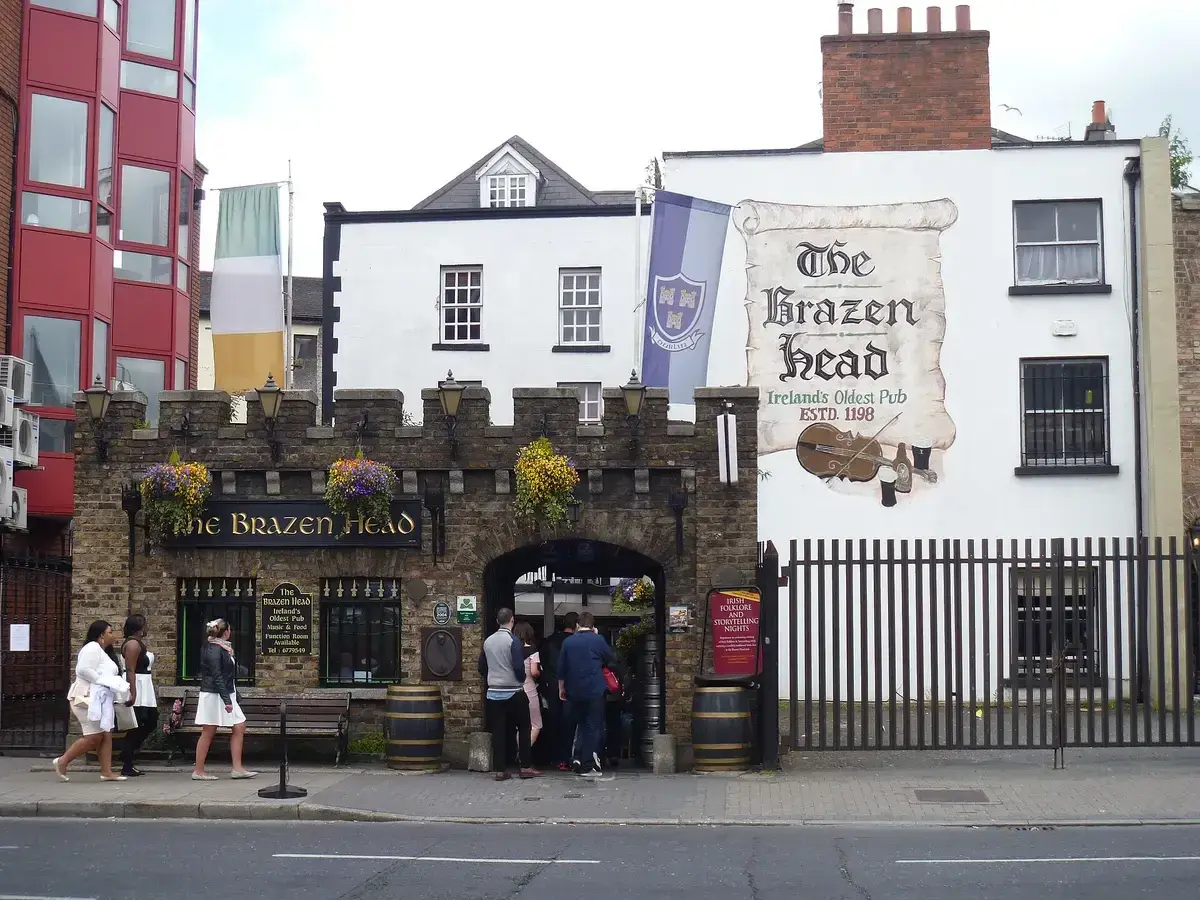
Lower Bridge Street drops from the ridge of the old walled city towards the Liffey, and at the bottom of it an arch leads through a stone front into a courtyard that is full from four in the afternoon. The Brazen Head tells its own story on its website in three sentences that have been copied ten thousand times: there has been a hostelry on this site since 1198, the present building was put up in 1754 as a coaching inn, and the house appears in documents as far back as 1653. It describes itself as Ireland’s oldest pub, and mentions a recent survey that ranked it fifth-oldest in the world.
The first of those three sentences is the one on the T-shirts. It is also the only one with nothing behind it — and, oddly, the pub’s own account understates its paper trail in the third sentence while overstating it in the first.
The claim is not absurd on its face, which is part of why it has lasted. Bridge Street is named for the bridge, and a crossing of the Liffey here goes back to the twelfth century or earlier. The city wall ran along the back of these plots. An inn at the landward end of the only bridge into a walled port is precisely what one would expect to find, and nobody would be surprised if one had stood here in 1198. Expecting a thing and documenting it are different activities.
What the records show
The earliest document connected with the name is from 1613, when a property called the Brazen Head is recorded in Dublin in connection with Richard Fagan of Feltrim. That is 415 years after the year on the sign, and 40 years before the 1653 the pub itself gives as its earliest record.
The next fixed point is a court matter with a very precise date. In 1703, following a claim against Fagan’s forfeited estates, James King was granted what the papers describe as the large timber house called the Brazen Head, and they give its dimensions: about 35 feet 6 inches along the street, 49 feet at the rear and 168 feet deep, with outhouses, stables and yards. The following year the City Assembly, over the objections of neighbouring traders, leased King a tower and part of the city wall behind the premises so that he could extend. Two things follow from this. The house on this plot in 1703 was timber, not the stone front standing now; and it was substantial enough to be worth a fight at the Assembly.
Drink itself enters the record between those two dates. An ale licence is recorded in 1661 and the premises are in use as an inn by 1668 — and that 1668 has an independent reading behind it. John Thomas Gilbert, whose History of the City of Dublin was written from the corporation’s own papers and published from 1854, describes the Brazen Head as an inn located from the year 1668 in a recess at the rear of the western side of Bridge Street, where, he adds, it still exists. He reaches it while writing about the United Irishmen, who met in the house: in February 1797 Oliver Bond laid before the society there his plan for seizing the capital. A Dublin historian working from the city’s records a century and a half ago gives the same date the registers give, and nothing earlier.
The building, dated
The National Inventory of Architectural Heritage records the house at 19–20 Bridge Street Lower under reference 50080525. Its appraisal repeats the tradition of a public house on the site since 1198 — registers do report local tradition, and this one labels it as such — and then sets beside it the one document it can cite, which is King’s grant of 1703. The present building, it says, was rebuilt in the middle of the eighteenth century.
That agrees with the pub’s own 1754 and with the earliest advertisement anybody quotes, which the house displays: Christopher Quinn of the Brazen Head in Bridge Street announcing that he had fitted the place with neat accommodations and commodious cellars. Another reading, on the Irish History site, calls the fabric early eighteenth century and is candid that whether an older tavern stood on the same ground is a matter of argument rather than of evidence.
So the building is Georgian, set back behind an arch off the street, which is exactly what Gilbert’s “recess” describes. The courtyard everyone drinks in is the yard of a coaching inn.
Where 1198 came from
We cannot tell you, and neither can anyone else who prints it. No writer we have found traces the figure to a deed, a grant, a chronicle or a charter. The nearest thing to an explanation is the year itself: 1198 sits at the end of the reign of Richard I and at the beginning of the Anglo-Norman city, a period when Dublin was being rebuilt in stone and given the wall these plots back onto. It is a date that sounds like the foundation of something.
There is also a structural reason the number has been hard to dislodge. A pub with a grant of 1703 and an inn recorded in 1668 is already, by any ordinary measure, a very old house. But Dublin has several of those, and 1198 is the only claim that puts one of them ahead of every other pub in Ireland. Sean’s Bar in Athlone makes the same move with AD 900, and Kyteler’s Inn in Kilkenny with the fourteenth century; we have looked at how those two hold up in our piece on the oldest pub in the world.
So how old is the Brazen Head?
By the documents, this is a house whose name is on record from 1613, which was licensed to sell ale by 1661, was functioning as an inn by 1668, was granted as a timber house in 1703, and was rebuilt in stone in the 1750s. That is four hundred years of traceable history in one recess of one street, and it grades C only because the claim on the sign is so much older than the paper.
It is also unambiguously open. Revenue’s register of liquor licences, current to 2 September 2026, carries a seven-day ordinary publican’s licence at 19/20 Lower Bridge Street under the reference S1475, held by Bridge Street Taverns Limited and trading as the Brazen Head — the full public-house class, so drink is served without a meal.
Our methodology sets out why an inn recorded in 1668 outranks a tradition of 1198 in our grading, how historians date an old pub explains what a grant or a licence can and cannot settle, and the rest of the city is on our page for the oldest pubs in Dublin. The Liffey has been crossed here for eight hundred years. The inn has been here for three and a half centuries, which is long enough for anyone.
Sources
- brazenhead.com/story/
- buildingsofireland.ie/buildings-search/building/50080525/the-brazen-head-19-20-bridge-street-lower-dublin-8-co-dublin
- archive.org/details/ahistorycitydub02gilbgoog
- irishhistory.com/places/the-brazen-head-inn-dublin-south-city-co-dublin/
- en.wikipedia.org/wiki/The_Brazen_Head
- revenue.ie/en/corporate/information-about-revenue/statistics/excise/licences/liquor-licences.aspx
Found something wrong?Suggest a correction