Blog
Why the Pub Matters to the British
Britain protects its pubs in two separate ways and the two protect different things. Listing protects the fabric — section 7 of the 1990 Act is about the character of a building and says nothing about what it sells. Community-value law protects the use, for five years at a time, as a right to try rather than a right to keep. Our archive is where the two come apart: 42 closed pubs with pages of their own, several of them protected buildings with nobody behind the bar.
Published 28 September 2026
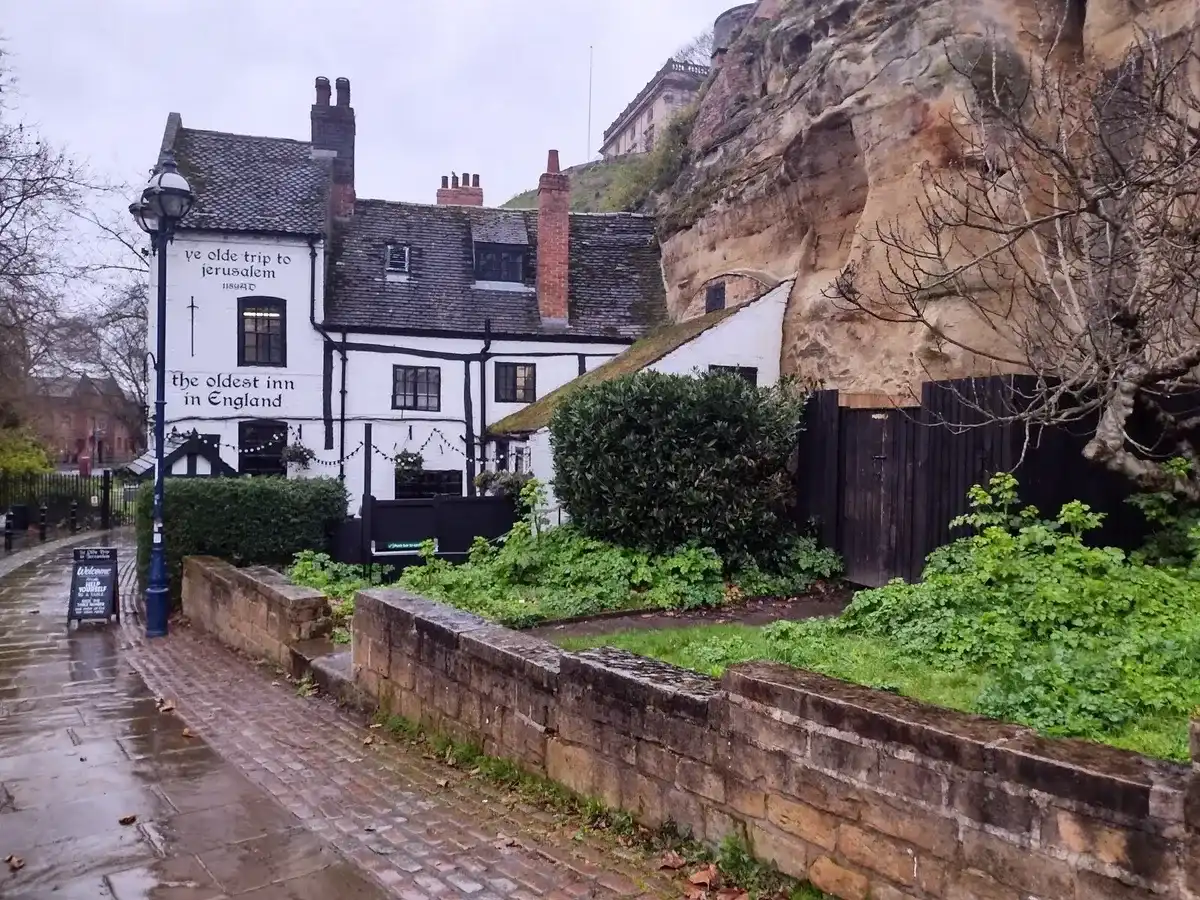 Photo: Chris Andrews · licence

What this establishes
- Of the 89 publishable pubs where our file holds both a dated building year and a first documented year of drinking, 19 show a gap of a century or more between the fabric and the trade, and nine a gap of two hundred years or more. The widest is the Tobie Norris at Stamford, where the Royal Commission reads the house as a hall and cross wing of about 1500 refronted from 1663, and the drinking begins about 2005.oldpubs.com
- We counted 42 closed pubs that have earned a page of their own in our archive, and in most of them the building has outlived the business. The Crispin and Crispianus at Strood is the plainest case: a Grade II listed shell, boarded up since a fire in March 2011 that KentOnline reported as arson, still recognisable as a pub from the street and still fully protected as a building.oldpubs.com
- The Red Lion at Wingham was registered as an asset of community value in May 2015, after a developer who had bought it from Punch applied to convert it into six flats. The application was withdrawn and the pub has not poured since. An entry on a community-value list is a right to bid when the owner sells, not an instrument that reopens a bar.oldpubs.com
- The Plough Inn at Stalisfield Green is a fifteenth-century Wealden hall house whose earliest traced record of drinking is 1841, and the Kentish Gazette of 23 October 1860 reports a coroner's inquest held on the premises. Four centuries of building stand between the frame and the first named licensee, which is why we grade the pub B and not A.oldpubs.com
The pub matters to the British in a way that can be checked rather than felt: it is one of the very few kinds of business Parliament has written specific protection for, and that protection comes in two pieces that guard two different things. Listing guards the fabric. Community-value law and a planning order of 2017 guard the use. The interesting part is what happens when the two come apart, and that is the one part of this subject our own file can settle rather than assert, because we hold 42 closed pubs with pages of their own and a good many of them are protected buildings with nobody behind the bar.
What the law actually protects
Section 7 of the Planning (Listed Buildings and Conservation Areas) Act 1990 is the sentence that does the work, and it is worth reading closely: no person shall execute or cause to be executed any works for the demolition of a listed building, or for its alteration or extension in any manner which would affect its character as a building of special architectural or historic interest, unless the works are authorised. Read it twice and notice what is absent. There is nothing in it about what the building is for. Listing is a statement about character, and a listed pub that stops selling beer on Tuesday is on Wednesday a listed building with exactly the same protection it had before.
The use waited longer and got a thinner instrument. Until 2017 a pub in England could be turned into a shop, or pulled down, under permitted development rights — that is, without anybody applying for planning permission at all. The Town and Country Planning (General Permitted Development) (England) (Amendment) (No. 2) Order 2017 was made on 28 April 2017 and came into force on 23 May. It removed those rights, so that changing the use of a drinking establishment or demolishing one now needs permission, while allowing a pub to serve more food without losing its category. It is a short order, and it says something long: that the country decided a pub should not be allowed to disappear over a weekend without anyone being asked.
The older instrument is the Localism Act 2011, which is where assets of community value come from. Section 87 requires that a local authority must maintain a list of land in its area that is land of community value; section 88 sets the test, which is whether a current or recent use furthers “the social wellbeing or social interests of the local community”; an entry lasts five years; and when a listed asset is put up for sale the moratorium in section 95 buys a community group time to assemble a bid. That is the whole of it. It is a right to try. We went looking for a published national count of pubs on those lists and could not find one — the lists are kept council by council — and the nearest thing on offer is CAMRA branches saying community groups have registered thousands of pubs this way since 2012.
What happens when the two protections part company
This is where a site full of dated rows earns its keep. The Seven Stars at Robertsbridge is a Wealden hall house of about 1400, Grade II* since 1961, claimed as 1177 on the strength of the abbey up the road. It stopped trading on 30 June 2015 and CAMRA has carried it as closed long term ever since. The listing protects the hall house and its crown-post roof whatever happens to the licence, which is exactly the right outcome for the timber and no use at all to anybody who wants a drink in Robertsbridge.
Up in the Forest of Bowland, the Hark to Bounty at Slaidburn has an external stair up its front wall to a first-floor door, and behind that door a courtroom used by the manorial and forest courts. Historic England lists the building and, by extension, the courtroom. CAMRA recorded the pub closed long term on 30 November 2024 and the property is on the market. The room where the forest’s business was done is safe; the business of the pub is not.
The Crispin and Crispianus at Strood makes the point less gently. Dickens walked to it from Higham and put it in The Uncommercial Traveller. It closed for renovation in 2010, a fire in March 2011 that KentOnline reported as arson took the roof and most of the timber-framed interior, and what stands at 8 London Road is a boarded listed building that still reads as a pub from the pavement. And at Wingham the village did everything the Localism Act invites: a developer bought the Red Lion from Punch in October 2014 and applied to make six flats of it, the application was withdrawn, and in May 2015 the Red Lion went on the list of assets of community value. Eleven years later it has still not poured. Nobody did anything wrong. The instrument simply does what it says on the tin, which is to give a community first refusal, and first refusal is not a landlord.
The route that does protect a use is the expensive one: buy the thing. Plunkett UK, which supports community-owned businesses, puts community-owned pubs trading across the UK at 147, of which it counts only 22 in towns and cities — research it published in 2022, and the most recent national figure we could open. It is a small number set against the closures. It is also the only instrument on this page that has actually put anybody back behind a bar.
The inn was the room the parish did not have
The sentimental answer to why the pub matters is company. The duller and better answer is administration. The business of an English parish had to be transacted somewhere, and for several centuries the inn was frequently the room available: warm, licensed, and large enough to sit a jury in. Our own rows are full of it.
The Plough Inn at Stalisfield Green is a fifteenth-century hall house on Historic England’s list. The earliest drinking we can trace there is 1841, when the census gives Thomas Brenchley at 65 as its licensee, and the Kentish Gazette of 23 October 1860 reports a coroner’s inquest held at the Plough — a record we value precisely because an inquest notice is a third party confirming the house was trading under that name. The Hand & Shears at Smithfield has a pie powder court traced through the Illustrated London News of 5 September 1846 and an inquest through the London City Press of 18 February 1860, which is a fuller paper trail than exists for the 1532 lettered across its own website.
Licensing, coaching, inquests, manorial courts, land auctions in the parlour: the pub mattered because the state used it. That is a sturdier reason to protect one than affection, and it is the reason the buildings are so often listed while the trade is not.
A pub is a use, not a structure
Which brings the argument to the thing our data is unusually placed to show. We counted the pubs where we hold both a building year and a first documented year of drinking — 89 of them — and in 19 the gap between the two is a century or more, in nine of them two hundred years or more. The record holder is the Tobie Norris at Stamford: a stone house the Royal Commission reads as about 1500, refronted from 1663 by Toby Norris the younger, bellfounder, then an RAF Association club through the 1950s, and a pub only from about 2005. Grade II* listed as a house, and about twenty years old as a pub.
The Fleece at Bretforton was an early fifteenth-century longhouse that was a farmhouse until it was first licensed in 1848. Ye Olde Fighting Cocks at St Albans, which claims 793 on its own website, stands on a rebuilt pigeon house — the Round House, up by 1622 — and its first firm record as an alehouse is 1756, under the name the Three Pigeons. Historic England traces the 793 itself to an early twentieth-century postcard.
And then there is the Mermaid at Rye, which went the other way and came back. William Holloway’s history of the town, published in 1847, says the house ceased to be an inn about eighty years earlier and names the private owner who had it instead. It appears as lodgings in the 1891 census, as an inn again by 1901, as a private club from 1913, and it was not permitted a bar until 1955. We took it off our own Top 100 for that reason and published the working. Same walls throughout. Four different things to do with them.
So why does it matter
Put all of that together and the answer is not affection, though there is plenty of that about. A pub is heritage that has to be re-earned every week. A cathedral is safe if nobody comes; an empty pub is a building. Statute can hold the timber still and can slow the paperwork down, and neither can make a house sell beer, which is why the protections we have are shaped the way they are and why 147 community-owned pubs are worth more than they look.
You can see the same anxiety painted on the gable of Ye Olde Trip to Jerusalem in Nottingham, which carries 1189 in black letters across its whitewash. Historic England notes the first reference to a pub on that site — as the Pilgrim — in 1751, and traces the “oldest inn in England” line on the frontage to about 1910, when a landlord put up new signage. That is not a scandal and we have never written it up as one. It is a house insisting, in paint, that it is worth keeping. The record says 1751, the caves are older than the building, and the only part of the claim that is genuinely fragile is the part nobody thought to legislate for: that somebody is behind the bar next year.
If you want the rule behind the grades, it is on how we date a pub. If you would rather read the buildings that lost their trade, they are in the archive of lost old pubs.
The pubs in this post
- Ye Olde Trip to Jerusalem Nottingham
- The Plough Inn Stalisfield Green
- Hand & Shears London
- The Tobie Norris Stamford
- The Fleece Inn Bretforton
- Ye Olde Fighting Cocks St Albans
- The Mermaid Inn Rye
More in the blog, and every change to the data at what changed.