Blog
The Six Claims With a Record, Read One by One
Of the hundred oldest pub claims this site holds, 33 have a dated document of any kind behind them and six have one that reaches the year on the sign. In September this post said seven. One house has left the list because the record we held for it was its own claimed year entered twice, and that correction is the most useful thing on this page.
Published 25 September 2026 · updated 9 October 2026
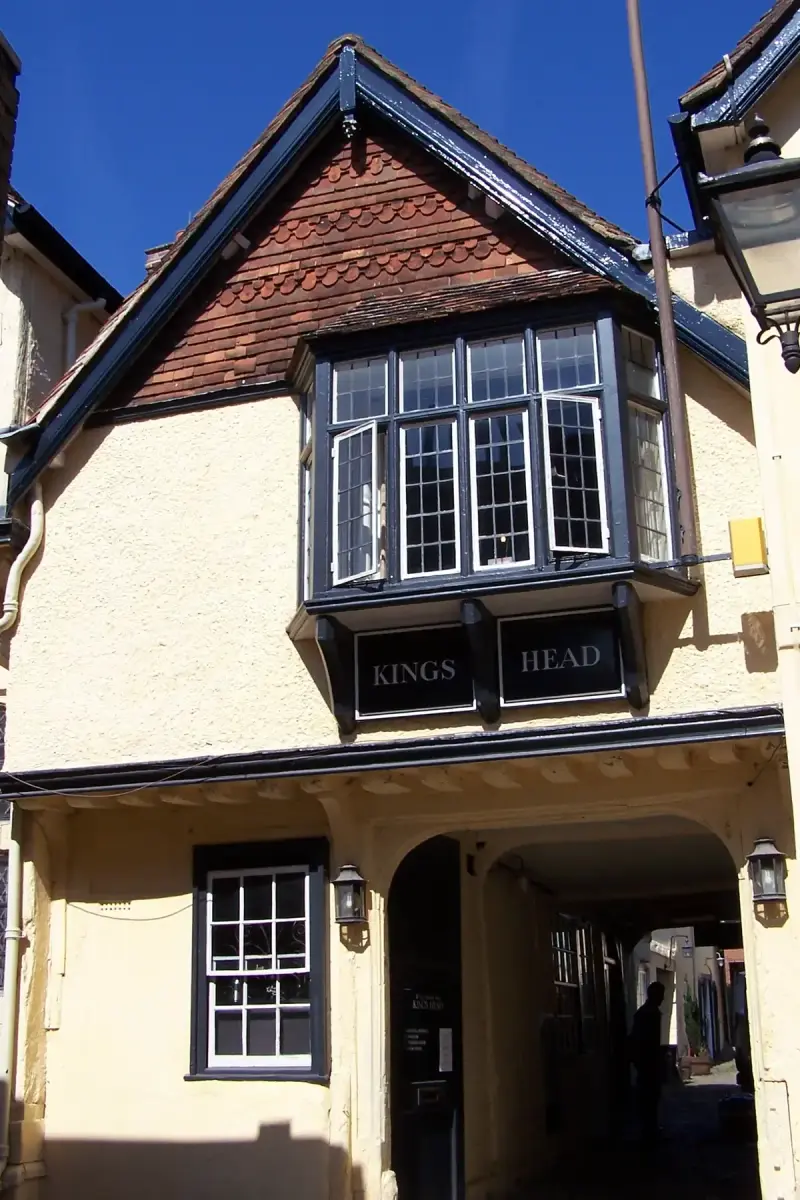 Photo: Chris Nyborg · licence

What this establishes
- Of the hundred oldest claims on this site, 33 have a dated document of any kind behind them, six have a record reaching the year claimed, and 67 have nothing traced. The middle gap between claim and record is 376 years across the 33, and 409 across the 27 whose record is later than the claim.oldpubs.com
- One of the seven this post counted in September was counted in error. The New Inn at Gloucester held a first-record year of 1450, which was its own claimed year of 1450 entered a second time in the field meant for independent evidence. No document gives that year: Historic England and the Victoria County History of Gloucestershire both say mid-fifteenth-century and name none. The row is grade B and its record field is empty.oldpubs.com
- The deed behind the King's Head at Aylesbury has been traced to The National Archives' catalogue, reference 705:349/12946/494987, among the Hampton (Pakington) of Westwood Park papers at the Worcestershire Archive and Archaeology Service, which files it under King's Head Inn. Dated 18 December 1455, it is a grant from William Wandesford, esquire — not a wool merchant — to Ralph Verney, citizen and mercer of London, and five others, of three messuages called the Kyngeshede, a shop, a cellar beneath that shop and a cottage in Aylesbury.discovery.nationalarchives.gov.uk
- The 1455 deeds name that house by its sign and never use the word inn. Nor does a lease of 6 November 1539, which still calls it a messuage called the Kyngs Hed. The earliest paper in the series to call it the Kinges Head Inne is a counterpart lease of 30 May 1650 to William Dawney of Aylesbury, innkeeper.discovery.nationalarchives.gov.uk
- Two details this post published about Aylesbury in September are in no record we can read. That the Kyngeshede was newly built in 1455 is a National Trust guidebook's gloss repeated by Wikipedia, and the dating of the great hall to the 1470s is an English Wikipedia sentence carrying its own editors' citation-needed tag. Historic England's Grade II* list entry 1160205, which this post cited for the 1470s, mentions neither a hall nor that decade: it gives "C15-16 and 17 and later… Left hand gable C15".historicengland.org.uk
- Two of the six rest on charters that name an estate's tavern rather than a building — the deed of 17 October 1259 by which the Habsburgs sold Dietikon to Wettingen Abbey, which names the taverns of Dietikon and Schlieren without describing either, and the charter of 12 May 1268 in which Duke Vladislav of Opole renewed the Orlová Benedictines' rights over a taberna at Těrlicko.e-periodica.ch
- One row on the hundred has a record older than its own claim: U Medvídků in Prague dates itself to 1466, and the house is recorded with a maltster from 1433 and a brewer, Jakub Starostka, from 1438.oldpubs.com
Correction, 9 October 2026. This post was published on 25 September under the title “The Seven Claims With a Record” and it counted seven. The number is six. The New Inn at Gloucester was on the list because its first-record year was 1450 — which is its own claimed year, 1450, written a second time into the field meant for independent evidence. No document gives that year, this post said so in the paragraph about the house, and the count underneath it said otherwise anyway. The row was regraded B and its record cleared on 9 October, and three figures moved with it: 33 of the hundred have a dated document of any kind rather than 35, six reach the year claimed rather than seven, and 67 have nothing traced rather than 65. The Aylesbury section has been rewritten as well, for reasons given there. Both changes are on what changed. The address of this page still says seven, because changing a published URL is a decision of its own.
Of the hundred oldest pub claims this site holds, 33 have a dated document of any kind behind them, six have a record that reaches the year claimed or precedes it, and 67 have nothing that anybody has yet produced. Those figures are counted at build time from the same rows the ranking is built from, and we counted them again before rewriting a word of this: 33, six, 67, with a middle gap of 376 years across the rows that have a record at all and 409 across the 27 whose record is later than the year on the sign.
The counting is on the claims report and it is not the interesting part. The interesting part is what happens when you take the strongest rows on the list — the ones where the record actually arrives at the claimed year — and read each of them again, to the end of its sources, asking one question: what is the document, and what does it name?
The shape the numbers make
Before the six, one thing about the other 27. The gaps do not tail off. The nearest of them is 35 years: the George at Norton St Philip advertises a licence of 1397, and what is dated is its timber — the jettied upper floors were tree-ring dated to 1430–32. The next nearest is 179 years, and nothing at all falls in between. No record on this list is between 35 and 179 years later than the year its house claims. After the George the list jumps to the King’s Wark in Edinburgh, which takes 1434 from the royal arsenal James I began building on the Shore, and whose drink enters the record in 1613, in James VI’s grant of the Wark to Bernard Lindsay.
That void is why the six are worth reading closely. They are not the near misses of a gentle distribution. They are a small, separate group, and every one of the seven rows this site grades A is either one of them or the George.
The six, one at a time
Taverne zur Krone, Dietikon, claims 1259. Karl Grunder, writing on the house in the Mitteilungen der Antiquarischen Gesellschaft in Zürich for 2007, dates the document to 17 October 1259 and says what it is: the deed by which the Habsburgs sold Dietikon to the abbey of Wettingen. It names the taverns of Dietikon and Schlieren beside the mills and describes neither. So a tavern existed at Dietikon in 1259, named in passing in a property transaction, and the year is the year the abbey bought the village rather than a year in which the house was doing anything in particular. We have not read the charter itself; we have read a scholar who has, in the journal’s own digitised run.
Jaškovská krčma, Těrlicko, claims 1268. A charter of 12 May 1268 in which Duke Vladislav of Opole renewed the rights of the Benedictines of Orlová, among them a taberna at Těrlicko alongside those at Žukov and Ostrava. The citation runs through Prasek’s Dějiny knížectví Těšínského of 1894, and the district archive at Karviná publishes its own account of the house. Again it is an estate’s tavern rather than a building: the standing house burned in 1682 and was rebuilt in 1691.
Bremer Ratskeller, Bremen, claims 1405. The council of Bremen held the privilege of selling wine from 1330, and an ordinance of 1342 confined the trade to wine lords it appointed. In 1405 the city’s wine cellar moved into the vaults of the town hall then being built, and two grades of Rhine wine were poured at two prices. That is wine sold to the public on these premises in the year claimed. It is also the year the town hall was begun, and no charter naming 1405 has been read here.
Cantina Do Spade, Venice, claims 1448. The year comes from Giuseppe Tassini’s Curiosità veneziane of 1872, which cites Carle de Zuane, hosto all’insegna delle Spade. We could not fetch the scan of Tassini — it is a PDF larger than anything we can pull down — so the citation is known here at second hand, from Italian writers who report it. What it dates is a sign rather than a street number, and the reason for reading it as this house is topographical: the calle, the sottoportego and the bridge outside all still carry the name, and the Venetian cadastre of 1566 lists an osteria delle do spade at San Matteo, a hundred metres away.
King’s Head, Aylesbury, claims 1455. With Gloucester off the list, this is the only claim in the hundred standing in Britain whose record reaches the year on its sign, which is reason enough to be exact about what the record is. Three deeds dated 18 December 1455 — the thirty-fourth year of Henry VI — survive among the Hampton (Pakington) of Westwood Park papers at the Worcestershire Archive and Archaeology Service, which files them under King’s Head Inn, and The National Archives’ catalogue describes all three. The first, 705:349/12946/494987, is a grant from William Wandesford, esquire, to Ralph Verney, citizen and mercer of London, and to five others, of “three messuages called the Kyngeshede, a shop, a cellar beneath the said shop and a cottage in Aylesbury, co. Buckingham”. The other two appoint attorneys to give and to take possession of the same property. What those deeds name is the house by its sign, and they never use the word inn; neither does a lease of 6 November 1539, which still calls it a messuage called the Kyngs Hed. The earliest paper in the series to call it the Kinges Head Inne is a lease of 30 May 1650 to William Dawney of Aylesbury, innkeeper. So 1455 dates a property called the King’s Head, with a shop and a cellar under it, passing to a London mercer — not a house described as selling drink to travellers. On the fabric, Historic England’s Grade II* entry gives fifteenth- to seventeenth-century work with a fifteenth-century left-hand gable, and the Victoria County History of Buckingham calls the house a good specimen of a mediaeval timber house of about 1450, four ranges round a courtyard with a hall of five bays. The deed and the building agree within five years.
Three details in that paragraph were wrong in September and have gone. We called William Wandesford a London wool merchant: the catalogue calls him an esquire, and it is Verney who is the London mercer. We said the Kyngeshede was newly built in 1455, which is a National Trust guidebook’s phrase repeated by Wikipedia and is in none of the deeds. And we dated the great hall to the 1470s on the authority of Historic England’s list entry, which says nothing about a hall and nothing about that decade — its wording is “C15-16 and 17 and later… Left hand gable C15”. The 1470s comes from an English Wikipedia sentence that carries its own editors’ citation-needed tag. We had cited a list entry for material the entry does not contain, which is the thing this site exists to catch other people doing, and we were describing deeds we had not looked for. We have now looked: everything above is the catalogue’s, and the pub’s own page says the same.
U Medvídků, Prague, claims 1466. The only row on the hundred whose record is older than its own claim. The house appears in writing from 1404, in an entry about the property of the late Pavel Hubený that has nothing to do with drink; malt arrives in 1433, when Mikuláš the maltster bought the house and probably the right to brew with it; and from 1438 Jakub Starostka brewed here. The 1466 on the sign is the year Jan Nedvídek, who gave the house its name, founded the brewery.
The house that was counted and should not have been
New Inn, Gloucester, claims 1450. It is still ninety-second in the hundred, because the ranking goes by the year a pub claims and nothing traced suggests the New Inn is younger than it says. What it does not have is a record reaching 1450. Historic England lists the house Grade I as a mid-fifteenth-century inn of four ranges round a galleried courtyard, the most complete survival of its kind in Britain, and the Victoria County History of Gloucestershire says the same without a year: the New Inn, built in the mid 15th century, has a galleried courtyard. That is a good record of a building, and the building was put up as an inn rather than becoming one — by the monk John Twyning, for St Peter’s Abbey, to lodge visitors. The century belongs to scholarship and the year belongs to the inn.
September’s version of this post wrote that last sentence and then counted the row anyway, because the data under it held 1450 twice: once as the claim, once as the earliest record. Arithmetic cannot tell a year read off a deed from a year copied out of a pub’s own history, which is why those two fields have to be filled from different documents — and why this row is now grade B with its record field empty, rather than grade A. The claim is untouched and the house is where it was. What has gone is this site presenting the New Inn’s date back to it as corroboration.
What “a record from the year claimed” turns out to mean
Five kinds of evidence, then, under one column heading, across six houses. One dated deed naming the house. Two charters naming a landlord’s tavern in a village. A city council moving its own wine business into a new building. A nineteenth-century antiquarian citing an archive entry we have not been able to open. And a town’s property records naming first a maltster and then a brewer in one house.
A sixth kind has just left, and its leaving is the lesson: an inn dated by its century rather than by its year. That is real evidence about a building, it is the kind of evidence most of these houses would be glad to have, and it is not a record from the year claimed. For a fortnight this site counted it as one.
None of that makes the six wrong. They are still, by a distance, the best-documented claims on the list, and each of the five kinds is a real form of evidence that historians use. What it does mean is that the strongest end of the record is thinner than a single number suggests, and that a reader who wants to know how solid a date is has to be told what kind of date it is. That is what the methodology tries to do and what the evidence notes on each page say in full.
Not one of the six is held here from the original document. The Dietikon and Těrlicko charters are known through scholars who read them, Tassini’s entry through Italian writers who report it, the Bremen date through the cellar’s own history, the Prague entries through Czech accounts of the house, and the Aylesbury deeds through an archivist’s description of parchment we have not seen. A catalogue entry written by somebody with the deed in front of them is a far better source than a guidebook’s gloss, and it is still not the deed. If you can send a photograph, a transcript or a reference for any of the six, it goes on the page with your name on it, and it is the fastest way anyone can improve this site.
The pubs in this post
- King's Head Aylesbury
- Taverne zur Krone Dietikon
- Jaškovská krčma Těrlicko
- Bremer Ratskeller Bremen
- Cantina Do Spade Venice
- New Inn Gloucester
- U Medvídků Prague
- The George Inn Norton St Philip
More in the blog, and every change to the data at what changed.