On record from 1668; the building is dated to about 1840.
Grade B · Building dated
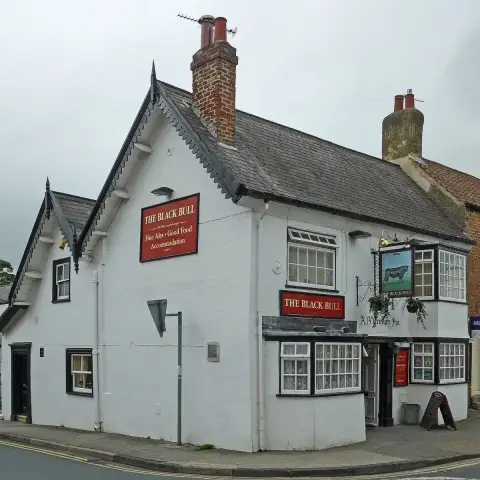
By claim, the oldest pub in North Yorkshire is the Black Bull Inn at Boroughbridge, described in regional round-ups as thirteenth-century and reported as the last survivor of the twenty-two inns that once served the Great North Road there. By evidence it is the Golden Fleece on Pavement in York, licensed in 1668 — the first firm record of drinking on a site whose sign advertises 1503.
North Yorkshire is a good county in which to learn the difference between an entry in an archive and a licence to sell drink. York's city archives really do record the Golden Fleece's property in 1503, when it belonged to the Merchant Adventurers' Company, and that record is genuine, dated and checkable. Nothing in it makes the house an inn. Following Young's 2015 study, York Archaeological Trust's Jorvik pages have the property known as an inn from 1656 and licensed only in 1668, and Historic England lists the standing building as a rebuilding of about 1840, refurbished in 1926. So the 1503 is real and simply does not mean what the sign implies. The Black Swan on Peasholme Green is the same lesson again with a different document: its 1417 is the year William Bowes, a wool merchant, was mayor, and York Civic Trust records that the house has been a public house only since the late eighteenth century. The other two claims work the other way round. Neither has any paperwork, and in both cases the trade is the convincing part: the Black Bull stood on the coaching road through Boroughbridge, and the Lion at Blakey Ridge stands alone on a moor at about 1,325 ft, where drovers, corn dealers and ironstone miners had no alternative. The Lion's own history page is unusually straight about it, offering 1553 or 1558 as tradition and calling its evidence circumstantial.
An entry in the archives is not a licence
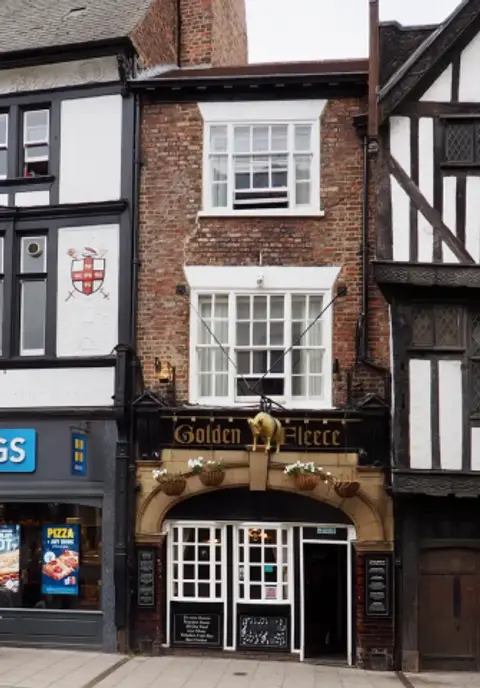
The Golden Fleece faces the Shambles across Pavement and takes its name from
the wool merchants whose guild held the property in 1503. That single line in the city archives has become the
pub’s founding date, which is how most of these claims begin — not with an invention but with a real document
saying something adjacent to what is wanted from it. The pub’s own reputation rests on other ground entirely:
it styles itself York’s most haunted inn, keeps a gothic-tinged interior of the sort a 1926 refit produced, and
lets four rooms upstairs.
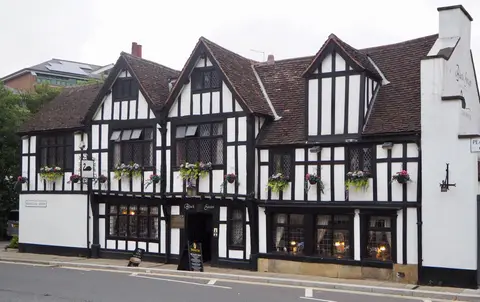
The Black Swan on Peasholme Green makes the same move with a person instead of a
property. Its 1417 is the year William Bowes was mayor of York; Historic England dates the timber-framed house
to the late sixteenth century with seventeenth-century brick wings, and York Civic Trust attributes the
rebuilding to Sir Martin Bowes in 1560 and says plainly that the house has been a pub since the late eighteenth
century. That last fact keeps it out of the Top 100 and takes nothing from the building, whose interior CAMRA
rates of outstanding national importance. The wider practice of dating a building rather than trusting a sign
is set out in how to tell how old a pub is.
The road and the ridge
The Black Bull is what is left of an inn town. Boroughbridge sat on
the Great North Road and supported more than twenty houses catering to travellers, and the reported survival of
exactly one of them is a fair summary of what happened to English coaching trade after the railways; our guide
to what a coaching inn was explains the type.
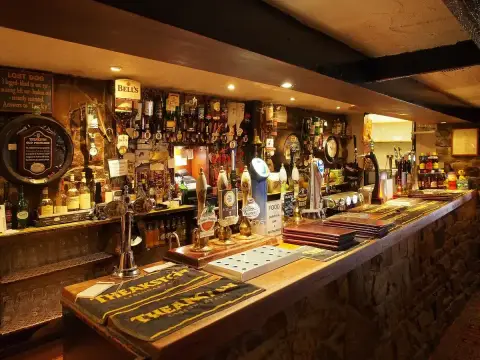
The Lion Inn is the opposite kind of survival — a stone building alone on
Blakey Ridge in the North York Moors, with low beams, open fires, food from noon and thirteen bedrooms for
walkers who have misjudged the distance. Neither can prove its age; both are standing where the trade
obviously was. For the neighbouring county see
the oldest pubs in West Yorkshire, and for the ghost stories both of
these trade on, haunted pubs.
The 13th century is CAMRA's: its Harrogate and Ripon branch entry calls the Black Bull a 13th-century inn and a Grade II listed building. Regional round-ups (On: Yorkshire 2021, The Yorkshireman October 2025) repeat the same origin and note it is the last of the town's 22 former inns. The pub's own domain no longer resolves to a site. The listing CAMRA points at has now been read: Historic England designated the
The pub's history page says the house was built for William Bowes, a merchant and Sheriff of York, in 1417, and that he became Lord Mayor in 1428. The same page says the building dates to the fifteenth century "when it was a private house", and that a medieval inn is only supposed to have stood on the site before the present one. Historic England lists the building Grade II* (list entry 1256886, first listed in
Claims 1417; no early record found; building c.1560.
York's city archives record the property in 1503, when it belonged to the Merchant Adventurers, but nothing in that entry makes it an inn. York Archaeological Trust's Jorvik pages and the Wikipedia article, following Young (2015), have it known as an inn from 1656 and licensed only in 1668, and that licence is the first firm record of drinking use. Historic England lists the standing building as a rebuilding of
Claims 1503; first recorded 1668; building c.1840.
The inn's own history places its origin in 1553 or 1558, when a bush was hung out after brewing, and admits the evidence is circumstantial: medieval pottery found nearby and possible links to a friary. A search of the national heritage list around Blakey Ridge returns boundary stones and guide stones but no entry for the inn, so there is no listing description to date the walls. Newspaper writing about the pub
Claims 1553; no early record found.
The photographs above are other people's work, used under open licences. Every photographer, licence and source page is named in the image credits.
Common questions
Which is the oldest pub in North Yorkshire?
The Black Bull at Boroughbridge makes the earliest claim, the thirteenth century, on the strength of regional round-ups rather than records. The best-evidenced house is the Golden Fleece in York, whose 1668 licence is the earliest firm record of drinking among the pubs checked here.
Is the Golden Fleece in York really from 1503?
The 1503 is a genuine archive entry recording the property, then owned by the Merchant Adventurers. It does not describe an inn. The house is known as an inn from 1656 and licensed in 1668, and the building standing on Pavement today is a rebuilding of about 1840.
Is the Lion Inn at Blakey Ridge from 1553?
The inn says tradition places its origins in 1553 or 1558, when a bush was hung out after brewing, and acknowledges the evidence is circumstantial — medieval pottery found nearby and possible links to a friary. Its eighteenth-century corn market and its trade with Rosedale ironstone miners are better attested.
Which old pubs in North Yorkshire have you checked?
The Black Bull at Boroughbridge, the Golden Fleece and the Black Swan in York, and the Lion at Blakey Ridge. We list a pub only when its date, its trading status and a source can each be checked, and others will be added here as evidence for them turns up.
Can you visit the Black Bull at Boroughbridge?
It was trading when we last checked in September 2026, but we could not reach a working website for it, so confirm before making a journey. It is a town-centre inn with a reputation for ghostly goings-on in the kitchen and neither a listing entry nor a documentary date we have been able to trace.