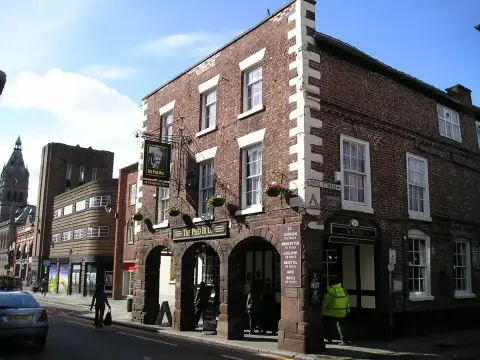
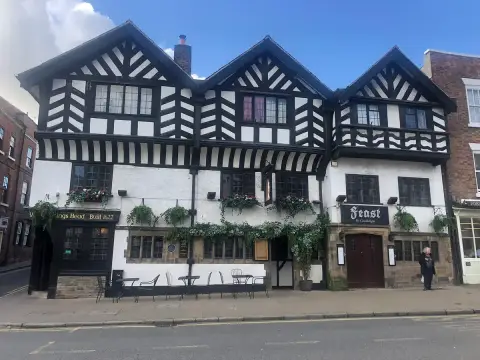
By claim, the oldest pub in Chester is the Pied Bull on Northgate Street, which dates itself to 1155 and calls itself the city's oldest licensed house. By evidence it is the Boot on Eastgate Row, where Historic England dates the fabric to the early or middle seventeenth century and CAMRA records the house under that name from 1750. Ye Olde King's Head has the firmest early date of the three — Historic England puts the building up about 1208 for Peter the Clerk, who administered Chester Castle — and by the pub's own account it became an inn in 1717.
Chester's old pubs are documented early and licensed late, and the Rows are part of the reason. Two of the three stand on or over them — the raised walkways that run at first-floor level above the shops — and the houses they occupy have been described in detail twice over, by Historic England and by the Victoria County History of Chester, which treats the Rows as a group and names which buildings kept theirs through a rebuilding. A pub here therefore gets written about as a building. Historic England can say that Ye Olde King's Head went up about 1208 as the town house of Peter the Clerk, who administered Chester Castle, and was rebuilt from the old Row level upward for Randle Holme I, first of four generations of herald painters; the Victoria County History of Chester narrows that rebuilding to the middle of the sixteenth century. That is an unusually firm medieval date, and it dates a house rather than a house of drink — the pub's own history gives 1717 for the year it became the King's Head. The same gap runs through all three. The Pied Bull's listing describes a seventeenth-century inn probably standing on the site of two medieval tenements, the oldest thing in it a stretch of oak framing between the two that the entry puts at perhaps the sixteenth century; the pub prints 1155 and a staircase of 1535, and the listing reads that stair as seventeenth-century oak. Only the Boot carries a date its own fabric can meet, and it is the latest of the three by four hundred and eighty-eight years.
Three houses, three kinds of paper
The Pied Bull stands inside the walls on Northgate Street with thirty-one bedrooms
above and the only microbrewery within those walls behind, and an open-well oak staircase climbs from its hall;
George Borrow drank here and wrote about the ale in Wild Wales. Ye Olde King’s Head
is black-and-white framing on the corner of Lower Bridge Street and Castle Street, set over a sandstone undercroft
at pavement level, with the pillars of the enclosed Rows still standing on the middle floor and a reputation for
ghosts that the house trades on. The Boot is the plainest-looking and the
best-documented of the three: sandstone at the base, timber-framed storeys above with plaster panels, herringbone
studding and that canted oriel over Eastgate.
Why a medieval date turns up on a pub here
Chester’s early record is a record of buildings, and the buildings here are described far better than the
drinking in them. Historic England gives the King’s Head a named builder and a date. The Victoria County History
narrows its rebuilding to the mid sixteenth century and names the neighbours that kept their Row through one. The
Pied Bull’s entry reaches down to a single stretch of oak framing between two former tenements. Not one of those
readings mentions a drink, which is how a pub here can carry a date four centuries earlier than anything written
about trade in it, and why two of these three sit at grade C with first-rate listings behind them. Keeping the two apart is the whole of this site’s method,
set out in how to tell how old a pub is; what the words inn, tavern and
alehouse meant to the people drawing up those deeds is in
inn, tavern or alehouse; and for the national comparison, including the
houses whose claims the records do reach, see the oldest pubs in England.
The pub says it dates to 1155, is reputedly Chester's oldest licensed house and has a staircase of 1535. Historic England's entry for 57 Northgate Street, read on 17 September 2026, calls the house an inn, probably on the site of two medieval tenements, and dates the fabric to the 17th century, partly refronted later that century and extended to the rear in the 19th. The oldest thing it names is oak framing on the
Historic England is unusually specific: this Grade II* building was put up about 1208 as the town house of Peter the Clerk, who administered Chester Castle, and rebuilt from the old Row level upward in the C15, C16 and early C17 for Randle Holme I, first of four generations of heralds. So the 1208 is real, but it dates a house, not a house of drink. The pub's own history says it became an inn called the King's Head
The building is the documented part. Historic England lists 17 Eastgate Street and 9 Eastgate Row at Grade II*, dating the fabric to the early or middle seventeenth century and describing a sandstone base, timber-framed upper storeys with plaster panels, a jettied top storey on carved brackets and a canted five-light mullioned and transomed oriel window; the front was rebuilt and restored late in the nineteenth
It depends which question you ask. The Pied Bull carries the earliest claim, 1155, which nothing traced supports. The Boot has the earliest dated fabric and the earliest step towards drinking: CAMRA's note that the house has borne the name since 1750. Ye Olde King's Head has a building of about 1208 and the latest start as an inn.
Is the Pied Bull really from 1155?
No record traced reaches that far. Historic England's entry for 57 Northgate Street describes an inn of the seventeenth century, partly refronted later that century and extended to the rear in the nineteenth, probably on the site of two medieval tenements. The 1155 stays tradition, and the house is graded C for it.
Which of the three has the oldest building?
Ye Olde King's Head, on Historic England's reading: a town house of about 1208, rebuilt from the Row level upward across the fifteenth, sixteenth and early seventeenth centuries and heavily renovated in 1935. The Victoria County History puts the reconstruction in the mid sixteenth century. Neither record describes drinking there.
Why does the Boot have the best evidence and the latest date?
Because both its fabric and its name can be dated. Historic England lists 17 Eastgate Street and 9 Eastgate Row at Grade II*, early to middle seventeenth century, with a jettied top storey on carved brackets and a canted five-light oriel window. The 1643 opening is reported by CAMRA and Chester Civic Trust, not recorded.
Can you drink up on the Rows?
At the Boot you are on them: the bar occupies the Row level above the street, reached from the walkway. The whole of that floor became the pub only after alterations in 1988, before which the front was a barber's shop with a corridor leading back. Samuel Smith's runs it and does not welcome mobile phones.